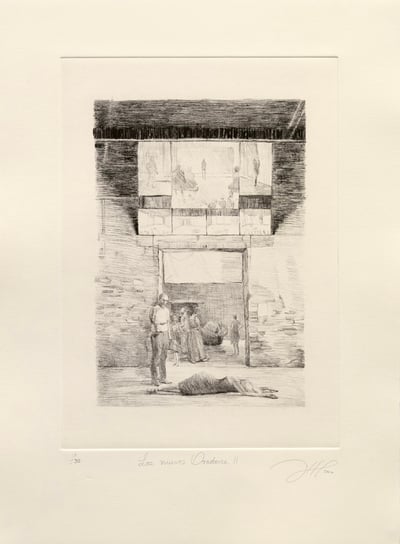
// Los nuevos Oradores II by Sandra Gamarra, a 2010 drypoint etching, portrays a contemplative and complex scene within a seemingly rustic interior space. In this composition, figures are scattered across different planes: a person lies face down in the foreground, while others stand or move in the background, framed by an open doorway and illuminated by soft, natural light. The setting appears to be an industrial or warehouse-like space, with textured brick walls and a high, open ceiling that adds depth to the scene. The careful linework and monochromatic tones convey a quiet tension, as if capturing a moment of unspoken narratives and subtle human interaction. Gamarra’s work often delves into themes of presence and absence, and this piece evokes a sense of mystery, prompting viewers to ponder the connections and stories between the figures in this isolated environment.
Sandra Gamarra (Peru, 1972) is a Peruvian artist who examines cultural narratives and the dynamics of art institutions. Working with painting, sculpture, and installation, she explores themes like colonialism, identity, and cultural appropriation. Her work often challenges traditional exhibition formats, encouraging viewers to question ownership and interpretation of art and artifacts.
DrypointDrypoint is an intaglio printmaking technique where an image is incised onto a plate using a sharp, pointed tool, typically a needle made of metal or diamond. Traditionally, copper plates were used, but today zinc, plexiglass, or acetate are also common. Drypoint is easier for drawing artists to master compared to engraving, as the needle technique resembles drawing with a pencil rather than the more complex burin used in engraving.
// Los nuevos Oradores II by Sandra Gamarra, a 2010 drypoint etching, portrays a contemplative and complex scene within a seemingly rustic interior space. In this composition, figures are scattered across different planes: a person lies face down in the foreground, while others stand or move in the background, framed by an open doorway and illuminated by soft, natural light. The setting appears to be an industrial or warehouse-like space, with textured brick walls and a high, open ceiling that adds depth to the scene. The careful linework and monochromatic tones convey a quiet tension, as if capturing a moment of unspoken narratives and subtle human interaction. Gamarra’s work often delves into themes of presence and absence, and this piece evokes a sense of mystery, prompting viewers to ponder the connections and stories between the figures in this isolated environment.
Sandra Gamarra (Peru, 1972) is a Peruvian artist who examines cultural narratives and the dynamics of art institutions. Working with painting, sculpture, and installation, she explores themes like colonialism, identity, and cultural appropriation. Her work often challenges traditional exhibition formats, encouraging viewers to question ownership and interpretation of art and artifacts.
Sandra Gamarra is a Spain-based Peruvian conceptual artist who works with oil on canvas and mixed media. She explores the mystical experience of art through her in works through the themes of perception; veneration; and cultural appropriation in her native South America. In Sandra Gamarra's series The New Worshipers and The New Pilgrims feature depictions of worship in public galleries investigating the notion of art as an act of faith. The series explores the metaphors of the art gallery as a place of devotion, depicting subjects lying in exultation in front of works of art. Infused into these works are parallels with the Christianization of South America and raises the question of whether natives attended church out of true devotion or out of obligation to the religion imposed on them through colonization. In her 2011 exhibition At The Same Time for the Bass Museum in Miami Sandra Gamarra presented canvases that were based on photographs she had taken of people contemplating art in galleries. These works deal with the concept of the observer being observed, highlighting the relationship between artist and audience in the location of the gallery where they come together. These works reflect on notions of authenticity, replication, and the activity of interacting with a work of art.
Appropriation in art involves using pre-existing images or objects with little or no modification. This technique has played a significant role across various art forms, including visual arts, music, performance, and literature. In visual arts, appropriation refers to the practice of adopting, sampling, recycling, or borrowing elements—or even entire forms—of existing visual culture, integrating them into new works to create meaning or critique.