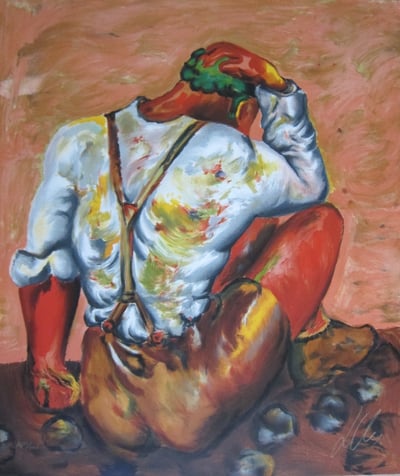
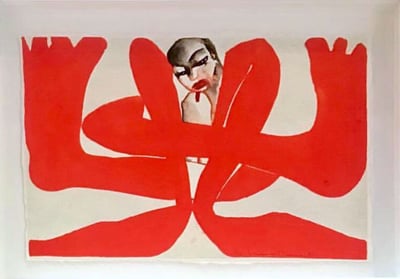
Sandro Chia's Disegno di Donna (1974) presents a hauntingly minimalist composition that captures a delicate and ethereal figure enveloped in a soft green aura. Rendered in oil on canvas, this painting centers on a faint, almost ghostly outline of a reclining female form. The figure’s pale contours are gently suspended within a diffused green cloud, creating a sense of introspection and otherworldliness. This 100 cm square artwork invites contemplation on themes of presence and absence, as Chia blurs the line between form and void, hinting at an emotional depth within the simplicity of his palette and brushwork. The painting, part of the Già Collezione Livio Collina in Bologna, exemplifies Chia’s ability to evoke complex emotions through minimalist techniques.
Sandro Chia (Italy, 1946) is a prominent painter and sculptor, associated with the Transavanguardia movement. Known for his expressive, figurative style, his works blend mythology, history, and personal symbolism, often rendered in vibrant colors and dynamic compositions. Chia’s art has been exhibited globally, cementing his role in revitalizing Italian contemporary art.
Oil on canvasOil paint is a slow-drying type of paint made from pigment particles suspended in a drying oil, typically linseed oil. The viscosity of the paint can be adjusted by adding a solvent like turpentine, and varnish can be added to increase the glossiness of the dried paint film. Oil painting has been used since the 12th century in Europe, initially for decoration, but it was not widely adopted as a primary painting medium until the 15th century.
Sandro Chia's Disegno di Donna (1974) presents a hauntingly minimalist composition that captures a delicate and ethereal figure enveloped in a soft green aura. Rendered in oil on canvas, this painting centers on a faint, almost ghostly outline of a reclining female form. The figure’s pale contours are gently suspended within a diffused green cloud, creating a sense of introspection and otherworldliness. This 100 cm square artwork invites contemplation on themes of presence and absence, as Chia blurs the line between form and void, hinting at an emotional depth within the simplicity of his palette and brushwork. The painting, part of the Già Collezione Livio Collina in Bologna, exemplifies Chia’s ability to evoke complex emotions through minimalist techniques.
Sandro Chia (Italy, 1946) is a prominent painter and sculptor, associated with the Transavanguardia movement. Known for his expressive, figurative style, his works blend mythology, history, and personal symbolism, often rendered in vibrant colors and dynamic compositions. Chia’s art has been exhibited globally, cementing his role in revitalizing Italian contemporary art.
Painting is a bit like finding one's roots again.
- Sandro Chia
Sandro Chia (b. 1946 Italy) is an Italian painter and sculptor, renowned for his vibrant and expressive works that played a significant role in the Transavanguardia movement, Italy's version of Neo-Expressionism. Emerging in the late 1970s, Chia's work is characterized by bold colors, dynamic brushstrokes, and a revival of figurative painting, often featuring mythological, historical, and personal themes. His style is both sensual and monumental, combining elements of classical art with a contemporary twist. Chia’s paintings and sculptures often exude a sense of energy and vitality, reflecting his interest in the human figure and its emotional depth. As a leading figure in the resurgence of figurative art in the late 20th century, Chia has left a lasting impact on contemporary art.
Sometimes known as Figurativism, figurative art refers to sculptures and paintings that are clearly or specifically derived from real objects, making them representational. The term figurative art is often used in contrast to abstract art. However, since the emergence of abstract art, figurative art has come to describe any form of modern art that has strong references to the real world or actual situations.