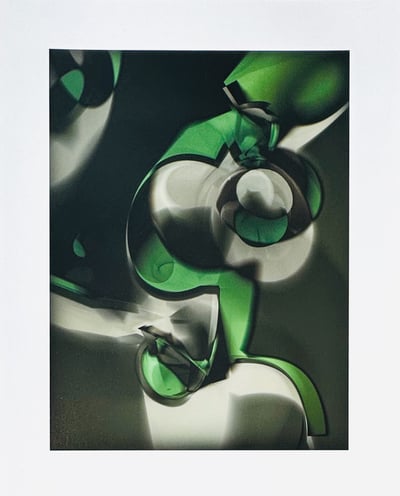
phg.s.01 by Thomas Ruff is a C-print based on a digital image from the artist’s phg series, conceived in 2012 and printed in 2020. Rather than using a traditional photograph, Ruff creates abstract compositions by manipulating computer-generated imagery, resulting in luminous forms that appear to float between photography, painting, and digital rendering. In this work, translucent green, black, and silver shapes overlap and refract light, producing a dynamic illusion of depth and movement. The composition reflects Ruff’s longstanding investigation into the nature of photographic representation and the impact of digital technologies on visual perception. Printed as a C-print in an edition of 100, phg.s.01 exemplifies the artist’s innovative approach to expanding the boundaries of contemporary photography.
Thomas Ruff (Germany, 1958) is a contemporary photographer known for his conceptual approach and exploration of the photographic medium. A member of the Düsseldorf School, he has produced diverse series, including large-scale portraits, architectural studies, and digitally manipulated images. Ruff's work challenges perceptions of reality and representation in photography.
C-PrintA C-type print, also known as a chromogenic print, is a photographic print made from a color negative or slide. The print is created on chromogenic paper, which contains three emulsion layers, each sensitized to a different primary color. After exposure, the paper is processed in a series of chemical baths, where each layer reacts to the chemicals to produce the final image. C-type prints are known for their rich color depth and are widely used in fine art and commercial photography.
phg.s.01 by Thomas Ruff is a C-print based on a digital image from the artist’s phg series, conceived in 2012 and printed in 2020. Rather than using a traditional photograph, Ruff creates abstract compositions by manipulating computer-generated imagery, resulting in luminous forms that appear to float between photography, painting, and digital rendering. In this work, translucent green, black, and silver shapes overlap and refract light, producing a dynamic illusion of depth and movement. The composition reflects Ruff’s longstanding investigation into the nature of photographic representation and the impact of digital technologies on visual perception. Printed as a C-print in an edition of 100, phg.s.01 exemplifies the artist’s innovative approach to expanding the boundaries of contemporary photography.
Thomas Ruff (Germany, 1958) is a contemporary photographer known for his conceptual approach and exploration of the photographic medium. A member of the Düsseldorf School, he has produced diverse series, including large-scale portraits, architectural studies, and digitally manipulated images. Ruff's work challenges perceptions of reality and representation in photography.
My images are not images of reality, but show a kind of second reality, the image of the image.
- Thomas Ruff
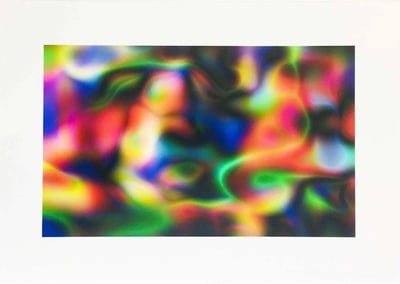
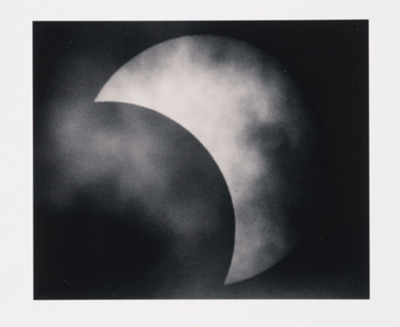
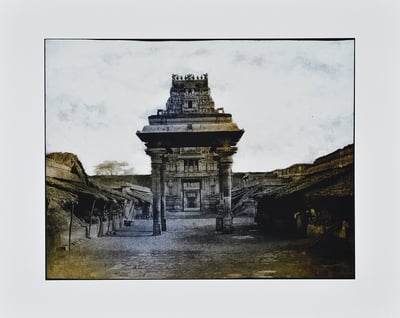
Deemed the ‘master of edited and reimagined images’, Thomas Ruff is a photographer renowned for his use of technological advancements as a means of bringing new meaning and visual possibilities to his field. Press++ is among the photographer’s most notable works and is comprised of numerous images that had been published in American newspapers and magazines between the 1920’s and 1970’s, later sourced by Ruff on eBay - in producing the works, he scanned the front and back of the images and digitally combined them, with consideration taken of touch-ups, scribbles and date stamps. Among Ruff’s wider oeuvre are expressionless portraits, blurred pornography, domestic interiors and internet-sourced JPEGs. Heavily inspired by his teachers Bernd and Hilla Becher, Ruff learned from their expertise in straight photography; Joel Meyerowitz and Stephen Shore are among his other early influences.
The Düsseldorf School of Photography refers to a group of photographers who studied under Bernd and Hilla Becher at the Kunstakademie Düsseldorf during the 1970s. This group was known for its devotion to the black-and-white industrial images characteristic of the German tradition known as New Objectivity. The photographers focused on precise, methodical documentation of industrial structures, often using a detached and objective approach.