
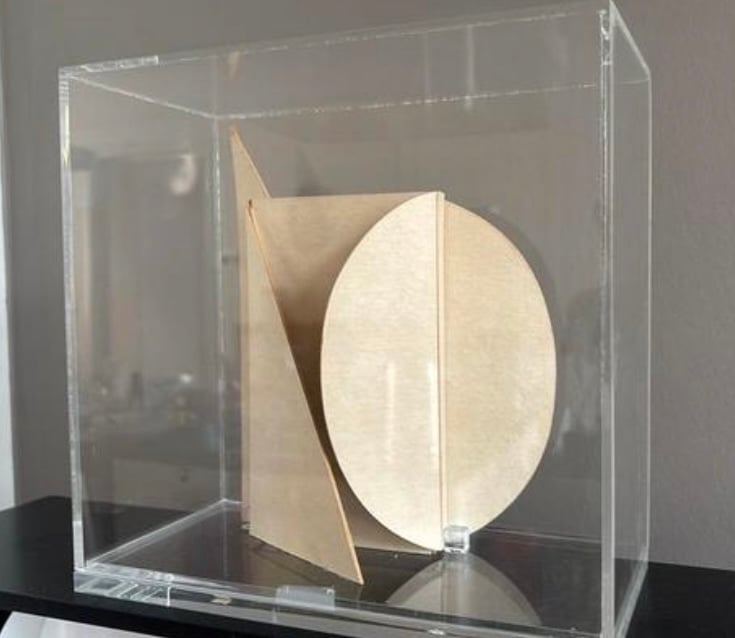
Cardboard project for sculpture number 1450 (The work is in the collection of the Museum of Fine Arts, Brussels).
Catalogue raisonné nr 1450 bis.
Archetypes by Walter Leblanc, created in 1985, is a cardboard maquette for sculpture number 1450, measuring 22 x 17.5 x 7 cm. Enclosed in a transparent display case, the composition explores geometric purity and spatial tension through the interplay of triangular, circular, and rectangular forms. This small-scale study reflects Leblanc’s transition from his earlier kinetic and textile works to a more structural, minimalist vocabulary in his later career. The title Archetypes suggests a focus on essential forms and universal shapes, aligning with the artist's philosophical interest in form, balance, and perception. Listed in the catalogue raisonné as 1450 bis.
Artwork Copyright © Walter LeblancWalter Leblanc (Belgium, 1932–1986) was a pivotal figure in European post-war art, renowned for his contributions to kinetic and optical art. A founding member of the Antwerp avant-garde group G58, he introduced the 'torsion' technique, twisting materials like cotton threads and metal to create dynamic works that engage light and movement. Leblanc's innovative approach earned him international recognition, with his works featured in major exhibitions and collections worldwide.
Artwork Copyright © Walter LeblancArchetypes, 1985
Form
Medium
Size
- Inches
- Centimeters
Edition
Price
- USD
- EUR
- GBP
- CHF
- Authenticity Guaranteed
- Insured Shipping
- Online Since 2005
●Inventory 16372
●Not signed
●Comes with gallery invoice and certificate
●Sell Us a Similar Artwork. Learn more.
Cardboard project for sculpture number 1450 (The work is in the collection of the Museum of Fine Arts, Brussels).
Catalogue raisonné nr 1450 bis.
Archetypes by Walter Leblanc, created in 1985, is a cardboard maquette for sculpture number 1450, measuring 22 x 17.5 x 7 cm. Enclosed in a transparent display case, the composition explores geometric purity and spatial tension through the interplay of triangular, circular, and rectangular forms. This small-scale study reflects Leblanc’s transition from his earlier kinetic and textile works to a more structural, minimalist vocabulary in his later career. The title Archetypes suggests a focus on essential forms and universal shapes, aligning with the artist's philosophical interest in form, balance, and perception. Listed in the catalogue raisonné as 1450 bis.
Artwork Copyright © Walter LeblancWalter Leblanc (Belgium, 1932–1986) was a pivotal figure in European post-war art, renowned for his contributions to kinetic and optical art. A founding member of the Antwerp avant-garde group G58, he introduced the 'torsion' technique, twisting materials like cotton threads and metal to create dynamic works that engage light and movement. Leblanc's innovative approach earned him international recognition, with his works featured in major exhibitions and collections worldwide.
Artwork Copyright © Walter Leblanc- Recently Added
- Price (Low-High)
- Price (High-Low)
- Year (Low-High)
- Year (High-Low)
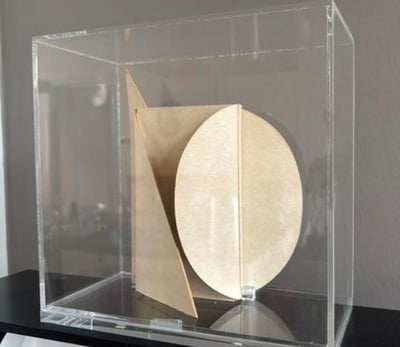
Walter Leblanc
Archetypes, 1985
Sculpture / Object
Mixed Media
EUR 15,000
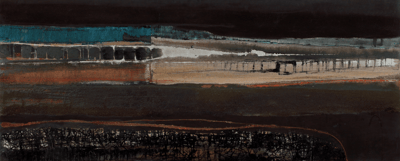
Walter Leblanc
Antwerp, 1958
Painting
Mixed Media
Inquire For Price
Related Artists

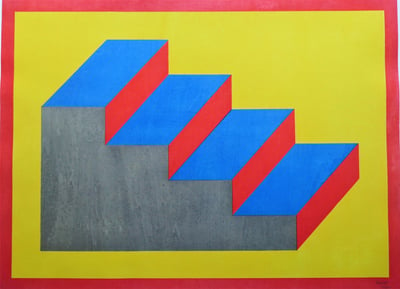

Artwork by Gunther Uecker
What is the Zero Movement?
ZERO was an art movement founded by Otto Piene and Heinz Mack, aiming to develop into a large international and cross-border movement. The name ZERO originated from a magazine founded by Heinz Mack in 1957, which became a platform for the group's ideas. The magazine was published for several years before ceasing in 1967. The ZERO movement sought to create a new beginning in art, emphasizing light, space, and movement, and became influential in post-war European art.

Walter Leblanc
Archetypes, 1985
22 x 17.5 x 7 cm


