Signed and dated -Wang Guangyi 2004- lower left - Provenance: Shanghart Gallery, Shanghai - Dominique & Sylvain L?vy collection, Paris
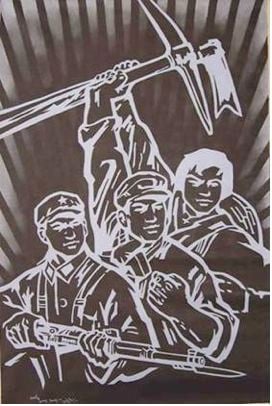
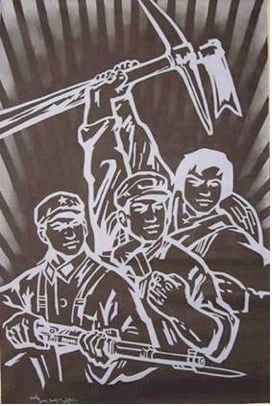
Eternal Halo by Wang Guangyi, painted in 2004, is an oil on canvas that encapsulates the aesthetics and themes of Chinese socialist realism while infusing a contemporary perspective. The artwork features three figures—two men and a woman—portrayed in stylized, heroic poses, each holding symbolic tools: a rifle, a sledgehammer, and a fist clenched in solidarity. The monochromatic palette with stark white outlines against a dark background emphasizes their forms, lending them an almost iconic quality. Radiating lines in the background create a halo effect, elevating the figures to near-mythical status. Known for critiquing propaganda and the commercialization of revolutionary imagery, Guangyi’s work often explores the intersections between ideology, nationalism, and consumerism. This unique piece, signed and dated by the artist, reflects Guangyi’s distinctive commentary on power and ideology through a mix of reverence and irony.
Artwork Copyright © Wang GuangyiWang Guangyi (China, 1957) is a Chinese artist renowned for his 'Great Criticism' series, which juxtaposes Cultural Revolution propaganda with Western brand logos, critiquing consumerism and political ideology. A leading figure in China's Political Pop movement, his work has been exhibited globally, including at the Venice Biennale.
Artwork Copyright © Wang GuangyiEternal Halo, 2004
Form
Medium
Size
- Inches
- Centimeters
Edition
Price
- Authenticity Guaranteed
- Insured Shipping
- Online Since 2005
●Inventory 1385
●Signed
●Comes with gallery invoice and certificate
●Sell Us a Similar Artwork. Learn more.
Signed and dated -Wang Guangyi 2004- lower left - Provenance: Shanghart Gallery, Shanghai - Dominique & Sylvain L?vy collection, Paris
Eternal Halo by Wang Guangyi, painted in 2004, is an oil on canvas that encapsulates the aesthetics and themes of Chinese socialist realism while infusing a contemporary perspective. The artwork features three figures—two men and a woman—portrayed in stylized, heroic poses, each holding symbolic tools: a rifle, a sledgehammer, and a fist clenched in solidarity. The monochromatic palette with stark white outlines against a dark background emphasizes their forms, lending them an almost iconic quality. Radiating lines in the background create a halo effect, elevating the figures to near-mythical status. Known for critiquing propaganda and the commercialization of revolutionary imagery, Guangyi’s work often explores the intersections between ideology, nationalism, and consumerism. This unique piece, signed and dated by the artist, reflects Guangyi’s distinctive commentary on power and ideology through a mix of reverence and irony.
Artwork Copyright © Wang GuangyiWang Guangyi (China, 1957) is a Chinese artist renowned for his 'Great Criticism' series, which juxtaposes Cultural Revolution propaganda with Western brand logos, critiquing consumerism and political ideology. A leading figure in China's Political Pop movement, his work has been exhibited globally, including at the Venice Biennale.
Artwork Copyright © Wang Guangyi- Recently Added
- Price (Low-High)
- Price (High-Low)
- Year (Low-High)
- Year (High-Low)
Wang Guangyi
Eternal Halo, 2004
Painting
Oil on canvas
Inquire For Price

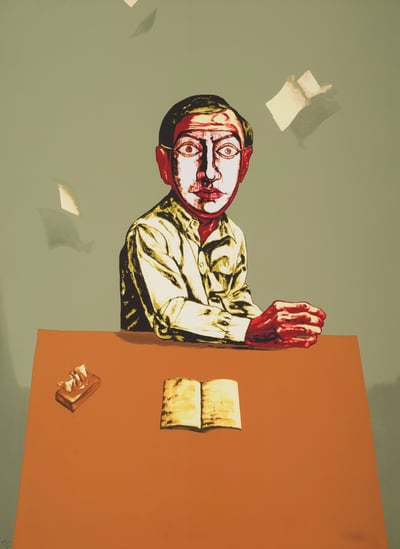
Wang Guangyi
Face of the believer, 2003
Limited Edition Print
Lithograph
Currently Not Available
Related Artists


Artwork by Miles Aldridge
What is contemporary art?
Contemporary art refers to avant-garde or innovative art created in the recent past or present day. The exact starting point of contemporary art varies depending on the institution, often tied to the founding year of museums or galleries that showcase the style. Contemporary art is characterized by its focus on current ideas, diverse media, and the exploration of new concepts and techniques.