
What is concrete art?
- Show All
- Established
- Discoveries
- Show All
Artworks Related to Concrete art

Francois Morellet
Chartres - vert orange, 1973
Limited Edition Print
Silkscreen
EUR 1,700

Francois Morellet
Chartres bleu rouge, 1973
Limited Edition Print
Silkscreen
EUR 1,700

Francois Morellet
Chartres - bleu violet, 1973
Limited Edition Print
Silkscreen
EUR 1,700

Julio Le Parc
Primeras modulaciones 8, 2018
Limited Edition Print
Lithograph
EUR 4,000

Julio Le Parc
Primeras modulaciones 10, 2018
Limited Edition Print
Lithograph
EUR 4,000

Julio Le Parc
Primeras modulaciones 9, 2018
Limited Edition Print
Lithograph
EUR 4,000

Julio Le Parc
Primeras modulaciones 6, 2018
Limited Edition Print
Lithograph
EUR 4,000

Julio Le Parc
Primeras modulaciones 7, 2018
Limited Edition Print
Lithograph
EUR 4,000

Julio Le Parc
Primeras modulaciones 5, 2018
Limited Edition Print
Lithograph
EUR 4,000

Julio Le Parc
Primeras modulaciones 4, 2018
Limited Edition Print
Lithograph
EUR 4,000

Julio Le Parc
Primeras modulaciones 2, 2018
Limited Edition Print
Lithograph
EUR 4,000

Julio Le Parc
Primeras modulaciones 3, 2018
Limited Edition Print
Lithograph
EUR 4,000

Julio Le Parc
Primeras modulaciones 1, 2018
Limited Edition Print
Lithograph
EUR 4,000

Julio Le Parc
Mobile Losange Rouge, 2018
Sculpture / Object
Mixed Media
Inquire For Price

Alberto Biasi
Torsioni Sovrapposte Noir, 2017
Sculpture / Object
Mixed Media
EUR 3,000

Yaacov Agam
Geometric 3 Agam, c. 1975-1980
Limited Edition Print
Screen-print
EUR 2,900
Related Articles

Pop Art is an art movement that began in Britain in 1955 and in the late 1950s in the U.S. It challenged traditional fine arts by incorporating imagery from popular culture, such as news, advertising, and comic books. Pop Art often isolates and recontextualizes materials, combining them with unrelated elements. The movement is more about the attitudes and ideas that inspired it than the specific art itself. Pop Art is seen as a reaction against the dominant ideas of Abstract Expressionism, bringing everyday consumer culture into the realm of fine art.

Tempera is a paint traditionally made by mixing colored pigments with egg yolk. It dries quickly and is highly durable, with some examples dating back to 100 AD still in existence. Modern tempera paint often uses glue size as a binder instead of egg yolk. Tempera is known for its bright colors and fine, detailed application, making it popular for panel paintings and icons.
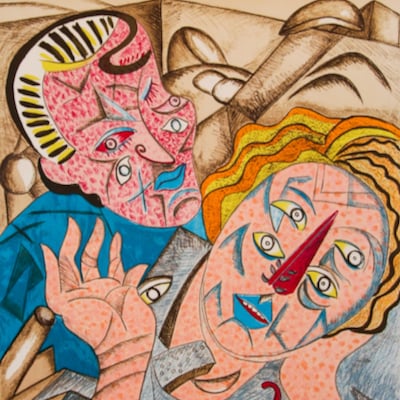
Arte Nucleare was the name of an artist group founded in Milan in 1951. The group aimed to create art that responded to the dangers and technologies of the nuclear age. Their works often utilized automatic techniques and depicted devastated landscapes and mushroom clouds, reflecting the anxieties of a world on the brink of nuclear catastrophe.
Can't find your Answer?
Thank you! Your question has been sent — we'll get back to you shortly.
