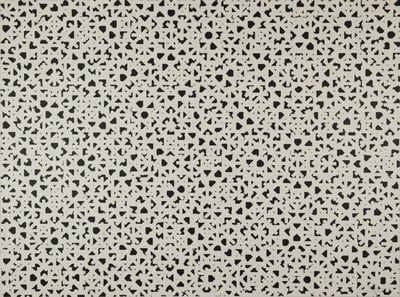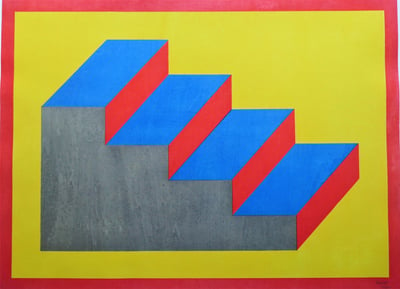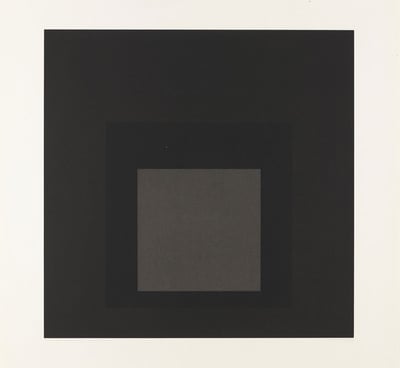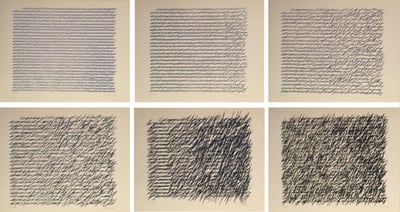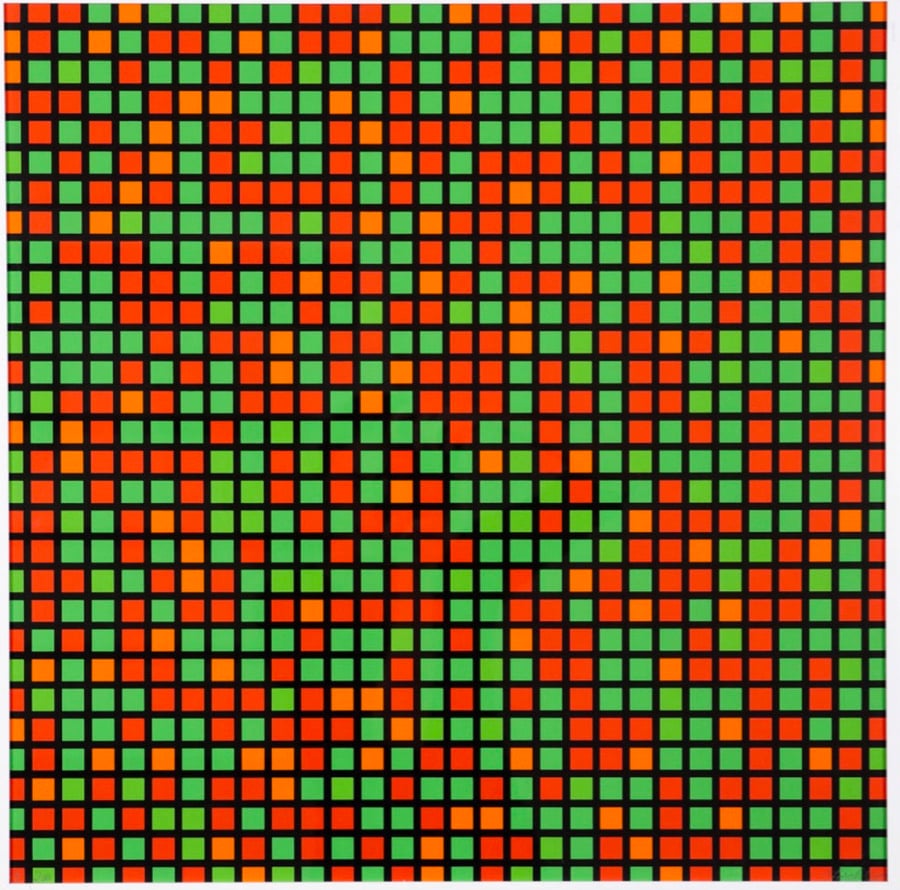
Screen print on PVC paper - These three screen prints are from the collective portfolio « 9 x 5 konkret. 9 Künstler. 5 Farben » (Adrian, Alviani, Bill, Calderara, Loewensberg, Mavignier, Novosad, Wilding, Morellet). Chartres is in reference to the stained glass windows of the Chartres Cathedral in France, that Morellet was very fond of.
Chartres - vert orange by François Morellet, created in 1973, is a silkscreen print that utilizes a vibrant grid of alternating green and orange squares on a black background. This structured, geometric pattern, composed of meticulously arranged squares, creates a visually pulsating effect as the contrasting colors interact with each other. Inspired by the stained glass windows of the Chartres Cathedral, which Morellet greatly admired, the work abstracts the idea of light and color seen through glass, evoking a sense of rhythm and harmony. The piece reflects Morellet’s dedication to systematic, mathematically driven art, as well as his fascination with the interplay between order and optical illusion.
François Morellet (France, 1926–2016) was a pivotal figure in geometric abstraction and conceptual art. Known for his precise, minimalist works, he often used systems, chance, and light to create dynamic visual effects. Morellet’s innovative use of neon and mathematically inspired compositions cemented his influence on contemporary art and kinetic aesthetics.
Silkscreen Silkscreen is a printmaking method that uses a screen made of silk or other mesh fabric. The screen is treated with a substance that blocks ink in certain areas, allowing ink to pass through only in the desired sections. Each color in the print requires a separate screen.
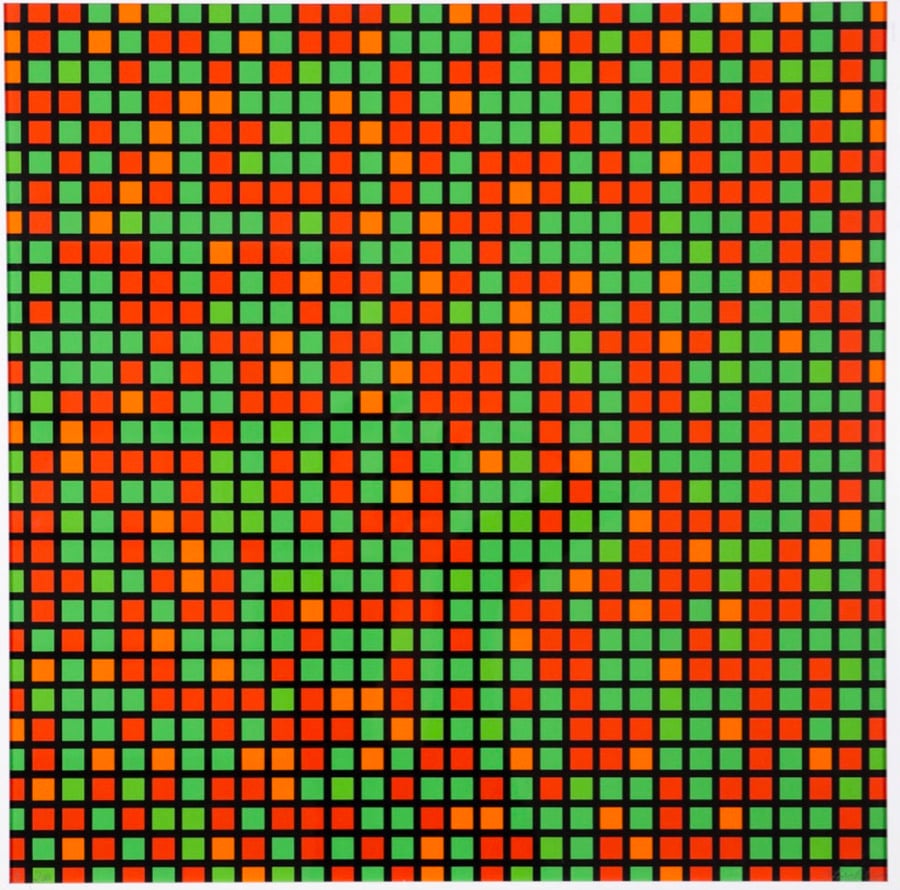
Screen print on PVC paper - These three screen prints are from the collective portfolio « 9 x 5 konkret. 9 Künstler. 5 Farben » (Adrian, Alviani, Bill, Calderara, Loewensberg, Mavignier, Novosad, Wilding, Morellet). Chartres is in reference to the stained glass windows of the Chartres Cathedral in France, that Morellet was very fond of.
Chartres - vert orange by François Morellet, created in 1973, is a silkscreen print that utilizes a vibrant grid of alternating green and orange squares on a black background. This structured, geometric pattern, composed of meticulously arranged squares, creates a visually pulsating effect as the contrasting colors interact with each other. Inspired by the stained glass windows of the Chartres Cathedral, which Morellet greatly admired, the work abstracts the idea of light and color seen through glass, evoking a sense of rhythm and harmony. The piece reflects Morellet’s dedication to systematic, mathematically driven art, as well as his fascination with the interplay between order and optical illusion.
François Morellet (France, 1926–2016) was a pivotal figure in geometric abstraction and conceptual art. Known for his precise, minimalist works, he often used systems, chance, and light to create dynamic visual effects. Morellet’s innovative use of neon and mathematically inspired compositions cemented his influence on contemporary art and kinetic aesthetics.
Anyway, I don't care about the future of my works.
- Francois Morellet
François Morellet was a prolific French Conceptual light artist of the late 20th century. He began experimenting with his preferred medium, neon, in the early 1960s, when he and some friends formed the Groupe de Recherche d’Art Visuel (Visual Arts Research Group). As a founding member of the group, he favored a non-traditional, experimental approach to art creation. Using light to translate geometry into art was his passion, particularly emphasizing circles and lines. His philosophy of art was akin to minimalism, and he believed that an artist should be a facilitator rather than cultivate the identity of an isolated genius. In his own compositions he liked to incorporate elements of the random, as he focused more on the process of creation rather than solely on the product. Besides an obsession with light and shape, he had a whimsical sense of humor, shown in his penchant for titling his pieces with forms of wordplay such as palindromes and puns. François Morellet’s works have been shown for decades in many exhibitions all over the world, and he also had his work commissioned for public locations in France and the Netherlands. (Artist website)
Op Art is a visual art style that uses optical illusions to create the impression of movement, vibrating patterns, flashing, or hidden images. The works are typically abstract, with many well-known pieces in black and white. The roots of Op Art can be traced back to earlier movements like Futurism, Constructivism, Dada, and Neo-Impressionism, particularly in their use of color effects and graphic design.