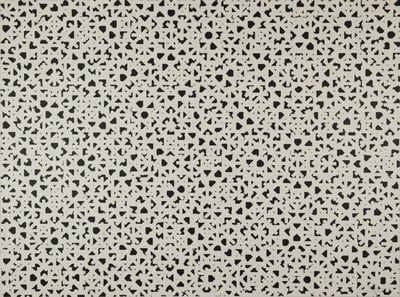
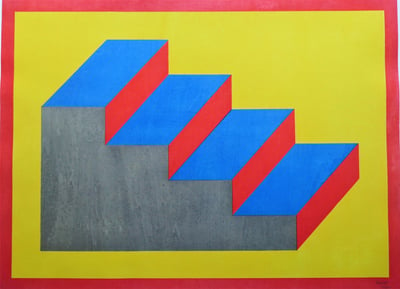
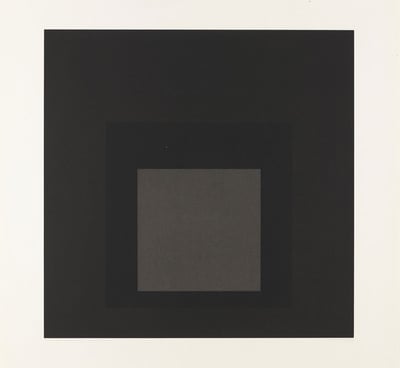
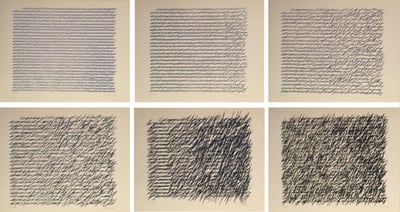
Untitled (Intersecting Lines) by François Morellet, created in 1975, is a minimalist lithograph that exemplifies the artist’s exploration of geometry, order, and randomness. The composition features an intricate network of intersecting black lines forming a grid of triangular and polygonal shapes against a white background. The systematic arrangement creates a sense of balance, while the density of the overlapping lines evokes complexity and visual rhythm. Measuring 70 x 70 cm, this work highlights Morellet’s innovative approach to abstraction, emphasizing the interplay between structure and chance.
François Morellet (France, 1926–2016) was a pivotal figure in geometric abstraction and conceptual art. Known for his precise, minimalist works, he often used systems, chance, and light to create dynamic visual effects. Morellet’s innovative use of neon and mathematically inspired compositions cemented his influence on contemporary art and kinetic aesthetics.
Lithograph Lithography is a printing method based on the principle that water and oil do not mix. It can be used to print artwork or text onto paper or other suitable materials. Traditionally, an image was drawn with wax, fat, or oil onto a lithographic limestone surface or plate. Today, metal plates and other surfaces are also used in lithographic printing.
Untitled (Intersecting Lines) by François Morellet, created in 1975, is a minimalist lithograph that exemplifies the artist’s exploration of geometry, order, and randomness. The composition features an intricate network of intersecting black lines forming a grid of triangular and polygonal shapes against a white background. The systematic arrangement creates a sense of balance, while the density of the overlapping lines evokes complexity and visual rhythm. Measuring 70 x 70 cm, this work highlights Morellet’s innovative approach to abstraction, emphasizing the interplay between structure and chance.
François Morellet (France, 1926–2016) was a pivotal figure in geometric abstraction and conceptual art. Known for his precise, minimalist works, he often used systems, chance, and light to create dynamic visual effects. Morellet’s innovative use of neon and mathematically inspired compositions cemented his influence on contemporary art and kinetic aesthetics.
Anyway, I don't care about the future of my works.
- Francois Morellet
François Morellet was a prolific French Conceptual light artist of the late 20th century. He began experimenting with his preferred medium, neon, in the early 1960s, when he and some friends formed the Groupe de Recherche d’Art Visuel (Visual Arts Research Group). As a founding member of the group, he favored a non-traditional, experimental approach to art creation. Using light to translate geometry into art was his passion, particularly emphasizing circles and lines. His philosophy of art was akin to minimalism, and he believed that an artist should be a facilitator rather than cultivate the identity of an isolated genius. In his own compositions he liked to incorporate elements of the random, as he focused more on the process of creation rather than solely on the product. Besides an obsession with light and shape, he had a whimsical sense of humor, shown in his penchant for titling his pieces with forms of wordplay such as palindromes and puns. François Morellet’s works have been shown for decades in many exhibitions all over the world, and he also had his work commissioned for public locations in France and the Netherlands. (Artist website)
Generative art refers to art that is wholly or partly created through an autonomous system. This system can be independent or non-human, capable of determining features that would otherwise be decided by the artist. The generative system can act as the creator or as a collaborator with the artist. Generative art often refers to works generated algorithmically by computers, where the system plays a significant role in the creation process.