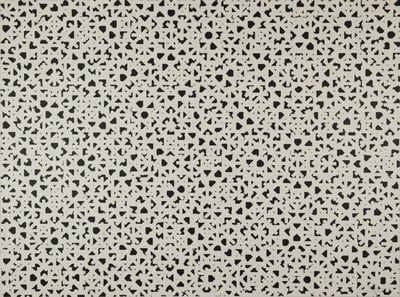
// Trames by François Morellet is a limited edition screen print that showcases the artist's exploration of geometric abstraction and systematic patterns. Measuring 62 x 83 cm, the composition is filled with a grid of black and white shapes, including circles, triangles, and various abstract forms, arranged in a seemingly random yet calculated manner. The repetitive, yet slightly irregular patterning creates a visual rhythm that plays with perception, as the eye navigates through the dense, interconnected shapes. Morellet’s work often challenges the viewer’s sense of order and chaos, demonstrating his mastery in balancing structure and spontaneity within a minimalist framework.
François Morellet (France, 1926–2016) was a pivotal figure in geometric abstraction and conceptual art. Known for his precise, minimalist works, he often used systems, chance, and light to create dynamic visual effects. Morellet’s innovative use of neon and mathematically inspired compositions cemented his influence on contemporary art and kinetic aesthetics.
Screen-print Screen printing is a technique where ink is transferred through a mesh onto a substrate, with areas blocked by a stencil to prevent ink from passing through. This method, also known as serigraphy or silkscreen printing, is commonly used to produce prints on posters, T-shirts, vinyl, stickers, wood, and other materials. The process is a type of stencil printing, allowing for vibrant, detailed designs on various surfaces.
// Trames by François Morellet is a limited edition screen print that showcases the artist's exploration of geometric abstraction and systematic patterns. Measuring 62 x 83 cm, the composition is filled with a grid of black and white shapes, including circles, triangles, and various abstract forms, arranged in a seemingly random yet calculated manner. The repetitive, yet slightly irregular patterning creates a visual rhythm that plays with perception, as the eye navigates through the dense, interconnected shapes. Morellet’s work often challenges the viewer’s sense of order and chaos, demonstrating his mastery in balancing structure and spontaneity within a minimalist framework.
François Morellet (France, 1926–2016) was a pivotal figure in geometric abstraction and conceptual art. Known for his precise, minimalist works, he often used systems, chance, and light to create dynamic visual effects. Morellet’s innovative use of neon and mathematically inspired compositions cemented his influence on contemporary art and kinetic aesthetics.
Anyway, I don't care about the future of my works.
- Francois Morellet
François Morellet was a prolific French Conceptual light artist of the late 20th century. He began experimenting with his preferred medium, neon, in the early 1960s, when he and some friends formed the Groupe de Recherche d’Art Visuel (Visual Arts Research Group). As a founding member of the group, he favored a non-traditional, experimental approach to art creation. Using light to translate geometry into art was his passion, particularly emphasizing circles and lines. His philosophy of art was akin to minimalism, and he believed that an artist should be a facilitator rather than cultivate the identity of an isolated genius. In his own compositions he liked to incorporate elements of the random, as he focused more on the process of creation rather than solely on the product. Besides an obsession with light and shape, he had a whimsical sense of humor, shown in his penchant for titling his pieces with forms of wordplay such as palindromes and puns. François Morellet’s works have been shown for decades in many exhibitions all over the world, and he also had his work commissioned for public locations in France and the Netherlands. (Artist website)
Hard Edge art is a style of abstract painting that became popular in the 1960s. It features areas of color separated by crisp, sharp edges that are painted with geometric precision. The term hard-edge painting was coined by art critic Jules Langsner to describe this approach, which contrasts with the softer, more fluid forms of other abstract styles.