Torsioni Sovrapposte Noir
Biasi, Alberto | Torsioni Sovrapposte Noir, 2017 — available on Composition Gallery
Wood and PVC. Hand signed by the artist.
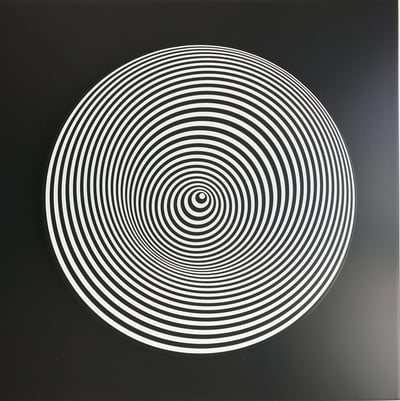
Torsioni Sovrapposte Noir by Alberto Biasi is a captivating mixed-media sculpture that explores optical effects through geometric patterns and layered materials. Created in 2017 and part of a limited edition of 15, this work uses wood and PVC to construct a striking interplay of light and shadow. The black and white grid pattern produces a dynamic, twisting illusion as the viewer’s perspective shifts, embodying Biasi’s mastery in the field of optical and kinetic art. Known for his ability to engage the viewer’s senses and alter visual perception, Biasi crafts a meditative experience that seems to pulse with energy despite its static form. Measuring 52 cm in both height and width, with a depth of 10 cm, this piece challenges the boundaries of two-dimensionality in sculpture, emphasizing the artist's exploration of movement through form and contrast.
Artwork Copyright © Alberto Biasi
Alberto Biasi (Italy, 1937) is an Italian artist and a leading figure in the Kinetic and Optical Art movements. As a co-founder of Gruppo N in 1960, he explored visual perception through dynamic works that engage viewers in interactive experiences. Biasi's art is featured in major institutions, including the Museum of Modern Art in New York and the Centre Pompidou in Paris.
Artwork Copyright © Alberto Biasi

Torsioni Sovrapposte Noir, 2017

Form

Medium

Edition

  • Authenticity Guaranteed
  • Insured Shipping
  • Online Since 2005
Inventory 5318
Signed
Comes with gallery invoice and certificate
Any questions?
Wood and PVC. Hand signed by the artist.
Torsioni Sovrapposte Noir by Alberto Biasi is a captivating mixed-media sculpture that explores optical effects through geometric patterns and layered materials. Created in 2017 and part of a limited edition of 15, this work uses wood and PVC to construct a striking interplay of light and shadow. The black and white grid pattern produces a dynamic, twisting illusion as the viewer’s perspective shifts, embodying Biasi’s mastery in the field of optical and kinetic art. Known for his ability to engage the viewer’s senses and alter visual perception, Biasi crafts a meditative experience that seems to pulse with energy despite its static form. Measuring 52 cm in both height and width, with a depth of 10 cm, this piece challenges the boundaries of two-dimensionality in sculpture, emphasizing the artist's exploration of movement through form and contrast.
Artwork Copyright © Alberto Biasi
Alberto Biasi (Italy, 1937) is an Italian artist and a leading figure in the Kinetic and Optical Art movements. As a co-founder of Gruppo N in 1960, he explored visual perception through dynamic works that engage viewers in interactive experiences. Biasi's art is featured in major institutions, including the Museum of Modern Art in New York and the Centre Pompidou in Paris.
Artwork Copyright © Alberto Biasi
SORT BY
  • Recently Added
  • Price (Low-High)
  • Price (High-Low)
  • Year (Low-High)
  • Year (High-Low)
Red Rain

Alberto Biasi

Red Rain, 2022

Sculpture / Object

Mixed Media

EUR 3,000

Rilievo ottico cinetico

Alberto Biasi

Rilievo ottico cinetico, 1972

Limited Edition Print

Screen-print

EUR 1,900

Torsioni Sovrapposte Noir

Alberto Biasi

Torsioni Sovrapposte Noir, 2017

Sculpture / Object

Mixed Media

EUR 3,000

Stay Updated on Alberto Biasi

Subscribe to receive updates on new artworks, exhibitions and news about Alberto Biasi.

We respect your privacy and protect your information.
What is kinetic art?

What is kinetic art?

Kinetic art is an international movement that emerged in the 1920s and gained prominence in the 1960s, referring to art that involves both apparent and real motion. It encompasses any medium that includes movement, either relying on actual motion for its effect or being perceived as moving by the viewer. Early examples include canvas paintings designed to create optical illusions of movement. Today, kinetic art often refers to three-dimensional figures and sculptures, such as those operated by machines or those that move naturally. The movement covers a variety of styles and techniques that frequently overlap.


Est. 2005 — twenty years of collecting, online.