

Artwork Copyright © Alberto Biasi
Alberto Biasi (Italy, 1937) is an Italian artist and a leading figure in the Kinetic and Optical Art movements. As a co-founder of Gruppo N in 1960, he explored visual perception through dynamic works that engage viewers in interactive experiences. Biasi's art is featured in major institutions, including the Museum of Modern Art in New York and the Centre Pompidou in Paris.
Artwork Copyright © Alberto BiasiGocce in Blue, 2013
Form
Medium
Size
- Inches
- Centimeters
Edition
Price
Available works →
- Authenticity Guaranteed
- Insured Shipping
- Online Since 2005
●
●Inventory 4292
●Signed
●Comes with gallery invoice and certificate
●Sell Us a Similar Artwork. Learn more.
Artwork Copyright © Alberto Biasi
Alberto Biasi (Italy, 1937) is an Italian artist and a leading figure in the Kinetic and Optical Art movements. As a co-founder of Gruppo N in 1960, he explored visual perception through dynamic works that engage viewers in interactive experiences. Biasi's art is featured in major institutions, including the Museum of Modern Art in New York and the Centre Pompidou in Paris.
Artwork Copyright © Alberto Biasi- Recently Added
- Price (Low-High)
- Price (High-Low)
- Year (Low-High)
- Year (High-Low)

Alberto Biasi
Red Rain, 2022
Sculpture / Object
Mixed Media
EUR 3,000

Alberto Biasi
Rilievo ottico cinetico, 1972
Limited Edition Print
Screen-print
EUR 1,900

Alberto Biasi
Torsioni Sovrapposte Noir, 2017
Sculpture / Object
Mixed Media
EUR 3,000
Available works by Alberto Biasi
See all →Alberto Biasi
Red Rain, 2022
Sculpture / Object
Mixed Media
EUR 3,000
Alberto Biasi
Rilievo ottico cinetico, 1972
Limited Edition Print
Screen-print
EUR 1,900
Alberto Biasi
Torsioni Sovrapposte Noir, 2017
Sculpture / Object
Mixed Media
EUR 3,000
Related Artists
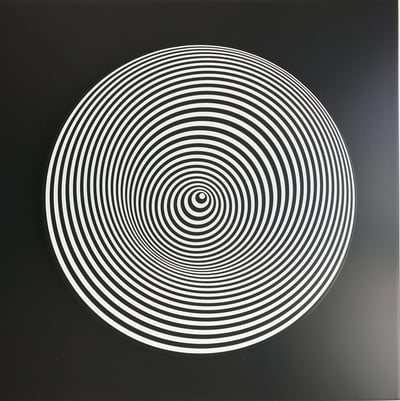
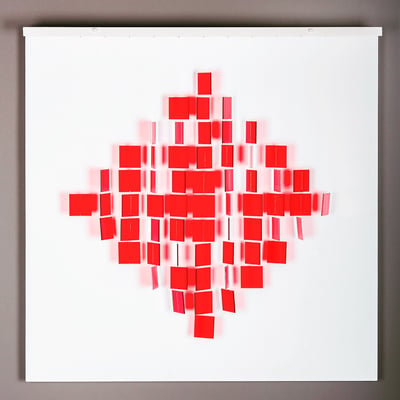


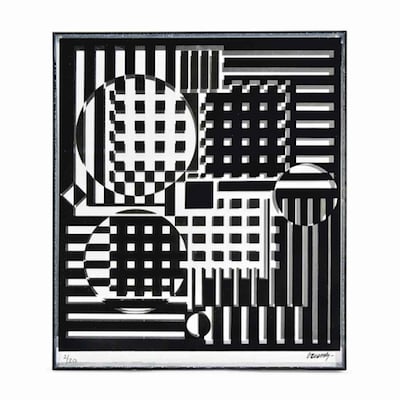
Artwork by Victor Vasarely
What is Op Art?
Op Art is a visual art style that uses optical illusions to create the impression of movement, vibrating patterns, flashing, or hidden images. The works are typically abstract, with many well-known pieces in black and white. The roots of Op Art can be traced back to earlier movements like Futurism, Constructivism, Dada, and Neo-Impressionism, particularly in their use of color effects and graphic design.


