

Signed and dated - Watercolour on paper
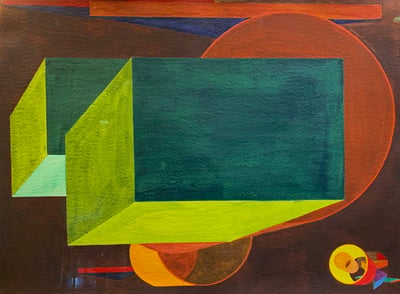
Al Held's Camerata XII (1989) is a watercolor on paper that exemplifies his exploration of geometric abstraction. The composition features a prominent green three-dimensional shape, reminiscent of a rectangular prism, floating in a space filled with rich, warm hues. A large red circle overlaps with the shape, creating a sense of depth and spatial complexity. Smaller circular elements in yellow and red further enhance the dynamic arrangement, showcasing Held's skillful use of color contrasts and geometric forms to create tension and visual movement. This work reflects his interest in constructing a sense of space through non-representational means.
Artwork Copyright © Al HeldAl Held (United States, 1928–2005) was an American painter renowned for his evolution from Abstract Expressionism to Hard-edge abstraction. His large-scale geometric works explored complex spatial relationships, often employing bold colors and precise forms. Held's art challenges perceptions of depth and perspective, contributing significantly to 20th-century abstract art.
Artwork Copyright © Al HeldCamerata XII, 1989
Form
Medium
Size
- Inches
- Centimeters
Edition
Price
- USD
- EUR
- GBP
- CHF
- Authenticity Guaranteed
- Insured Shipping
- Online Since 2005
●Inventory 12513
●Signed
●Comes with gallery invoice and certificate
●Sell Us a Similar Artwork. Learn more.
Signed and dated - Watercolour on paper
Al Held's Camerata XII (1989) is a watercolor on paper that exemplifies his exploration of geometric abstraction. The composition features a prominent green three-dimensional shape, reminiscent of a rectangular prism, floating in a space filled with rich, warm hues. A large red circle overlaps with the shape, creating a sense of depth and spatial complexity. Smaller circular elements in yellow and red further enhance the dynamic arrangement, showcasing Held's skillful use of color contrasts and geometric forms to create tension and visual movement. This work reflects his interest in constructing a sense of space through non-representational means.
Artwork Copyright © Al HeldAl Held (United States, 1928–2005) was an American painter renowned for his evolution from Abstract Expressionism to Hard-edge abstraction. His large-scale geometric works explored complex spatial relationships, often employing bold colors and precise forms. Held's art challenges perceptions of depth and perspective, contributing significantly to 20th-century abstract art.
Artwork Copyright © Al Held- Recently Added
- Price (Low-High)
- Price (High-Low)
- Year (Low-High)
- Year (High-Low)
Al Held
Camerata XII, 1989
Drawing / Watercolor
Watercolor
USD 29,500

Al Held
Pachinko, 1989
Limited Edition Print
Woodcut
USD 5,500

Al Held
Pradorama, 1991
Limited Edition Print
Lithograph
EUR 4,200
Related Artists



Artwork by Fernand Léger
What is Cubism?
Cubism is an art movement that aimed to depict multiple perspectives of objects or figures within a single picture. Artists Georges Braque and Pablo Picasso pioneered this style around 1907. The name Cubism emerged from their use of geometric shapes and outlines that often resembled cubes, breaking objects down into abstracted forms.


Al Held
Camerata XII, 1989
57 x 76.2 cm


