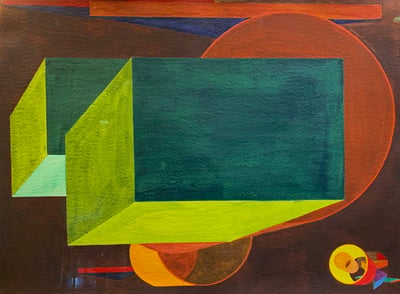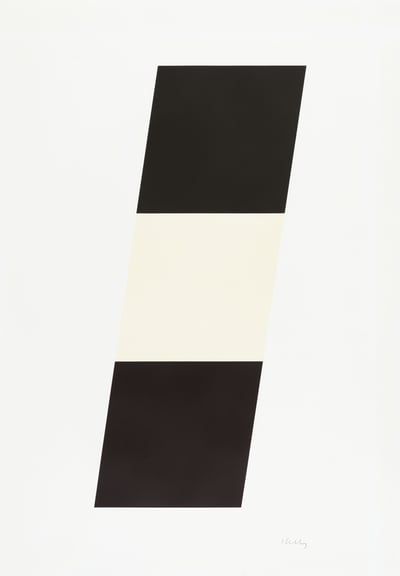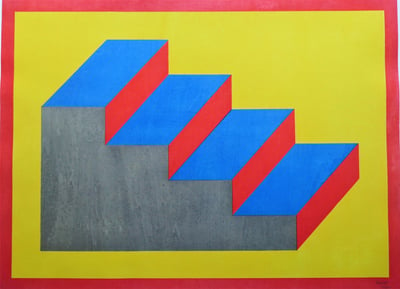
This screenprint was created by the artist in 1991. Signed in pencil and numbered from the edition of 80 measuring 29 x 34 in. (73.7 x 86.4 cm.). Published by The Metropolitan Museum of Art, New York.
Scholes II by Al Held is a vibrant screen print from 1991, filled with dynamic geometric forms and bold colors. The composition features overlapping shapes, including triangles, rectangles, and circles, arranged in a complex interplay of forms that create a sense of depth and movement. Each color is sharply delineated, adding intensity to the contrasts between hues such as green, yellow, pink, and blue. This abstract work exemplifies Held’s interest in spatial illusions and geometric abstraction, inviting the viewer to explore the layered arrangement of shapes and the shifting perception of space within a confined frame. The piece was published by The Metropolitan Museum of Art, New York, and is signed and numbered by the artist in an edition of 80.
Al Held (United States, 1928–2005) was an American painter renowned for his evolution from Abstract Expressionism to Hard-edge abstraction. His large-scale geometric works explored complex spatial relationships, often employing bold colors and precise forms. Held's art challenges perceptions of depth and perspective, contributing significantly to 20th-century abstract art.
ScreenprintScreen printing is a technique where ink is transferred through a mesh onto a substrate, with areas blocked by a stencil to prevent ink from passing through. This method, also known as serigraphy or silkscreen printing, is commonly used to produce prints on posters, T-shirts, vinyl, stickers, wood, and other materials. The process is a type of stencil printing, allowing for vibrant, detailed designs on various surfaces.
This screenprint was created by the artist in 1991. Signed in pencil and numbered from the edition of 80 measuring 29 x 34 in. (73.7 x 86.4 cm.). Published by The Metropolitan Museum of Art, New York.
Scholes II by Al Held is a vibrant screen print from 1991, filled with dynamic geometric forms and bold colors. The composition features overlapping shapes, including triangles, rectangles, and circles, arranged in a complex interplay of forms that create a sense of depth and movement. Each color is sharply delineated, adding intensity to the contrasts between hues such as green, yellow, pink, and blue. This abstract work exemplifies Held’s interest in spatial illusions and geometric abstraction, inviting the viewer to explore the layered arrangement of shapes and the shifting perception of space within a confined frame. The piece was published by The Metropolitan Museum of Art, New York, and is signed and numbered by the artist in an edition of 80.
Al Held (United States, 1928–2005) was an American painter renowned for his evolution from Abstract Expressionism to Hard-edge abstraction. His large-scale geometric works explored complex spatial relationships, often employing bold colors and precise forms. Held's art challenges perceptions of depth and perspective, contributing significantly to 20th-century abstract art.
We’re not going to get rid of chaos and complexity, but we can find a way to live with them.
- Al Held
Al Held was an American artist best known for his complex cube like structures he painted in brightly geometric forms. He studied art at the Art Students' League in New York and Paris. In the 1950's he returned to New York and began painting in an abstract expressionist manner. He then ventured into a more geometric style with his paintings of cube like structures in the 1960's. These structures were painted with heavy layers of paint so it would stand out from the surface. Al Held was a prominent figure with second generation Abstract Expressionists, but he was persistent in his exploration of the potential illusion within abstraction. His attitude of theories often defied many of the labels placed on this generation. His paintings had sharpened contours, geometric forms and an enlarged scale. His earlier work was generally done in black and white and he began to explore the aspect of three dimensional in the late 1970's. Al Held transferred his preference to acrylic paints in the 1980's and created brightly colored geometric shapes in the context of space. His art was considered "concrete abstractions" as he challenged flatness he saw in his painting styles, taking apart pictures with the suggestion of deep space and three dimensional forms. Al Held would then add eye-popping color to his images on canvas. Al's depiction of his work was, "We are not going to get rid of chaos and complexity, but we can find a way to live with them." Al's forms defined clean precision, but he began his paintings with loose improvisation and would later erase the preliminary lines with an electric sander. He received numerous awards including the Frank G. Logan Medal from the Art Institute of Chicago, a six month residency at the American Academy in Rome and was elected to the American Academy of Arts and Letters. (Artist website)
Abstract Expressionism is an art movement that emerged in the United States during the 1940s and 1950s. Characterized by large, abstract canvases, the movement emphasized spontaneous, expressive brushwork and the use of color and form to convey emotion rather than represent reality. Artists like Jackson Pollock, Mark Rothko, and Willem de Kooning are key figures in this movement. Abstract Expressionism marked a shift in the art world, making New York City a center of the international art scene.