

Original aquatint in colors
-Signed in pencil, and numbered (verso) -Edition of 50
Out and In by Al Held, created in 1987, is a vibrant limited edition aquatint that explores spatial relationships through geometric abstraction. The composition features two panels filled with intersecting shapes, including rectangles, triangles, and circles, rendered in bold and contrasting colors. The left panel displays a complex arrangement of overlapping forms in green, yellow, red, and blue, suggesting depth and layering. In the right panel, circular red lines intersect with a central green plane, adding a dynamic sense of motion and balance. Held’s mastery in manipulating forms and perspective draws the viewer’s eye into a playful, almost architectural exploration of space, challenging perceptions of foreground and background.
Artwork Copyright © Al HeldAl Held (United States, 1928–2005) was an American painter renowned for his evolution from Abstract Expressionism to Hard-edge abstraction. His large-scale geometric works explored complex spatial relationships, often employing bold colors and precise forms. Held's art challenges perceptions of depth and perspective, contributing significantly to 20th-century abstract art.
Artwork Copyright © Al HeldOut and In, 1987
Form
Medium
Size
- Inches
- Centimeters
Edition
Price
Available works →
- Authenticity Guaranteed
- Insured Shipping
- Online Since 2005
●
●Inventory 9363
●Signed in pencil
●Comes with gallery invoice and certificate
●Sell Us a Similar Artwork. Learn more.
Original aquatint in colors
-Signed in pencil, and numbered (verso) -Edition of 50
Out and In by Al Held, created in 1987, is a vibrant limited edition aquatint that explores spatial relationships through geometric abstraction. The composition features two panels filled with intersecting shapes, including rectangles, triangles, and circles, rendered in bold and contrasting colors. The left panel displays a complex arrangement of overlapping forms in green, yellow, red, and blue, suggesting depth and layering. In the right panel, circular red lines intersect with a central green plane, adding a dynamic sense of motion and balance. Held’s mastery in manipulating forms and perspective draws the viewer’s eye into a playful, almost architectural exploration of space, challenging perceptions of foreground and background.
Artwork Copyright © Al HeldAl Held (United States, 1928–2005) was an American painter renowned for his evolution from Abstract Expressionism to Hard-edge abstraction. His large-scale geometric works explored complex spatial relationships, often employing bold colors and precise forms. Held's art challenges perceptions of depth and perspective, contributing significantly to 20th-century abstract art.
Artwork Copyright © Al Held- Recently Added
- Price (Low-High)
- Price (High-Low)
- Year (Low-High)
- Year (High-Low)
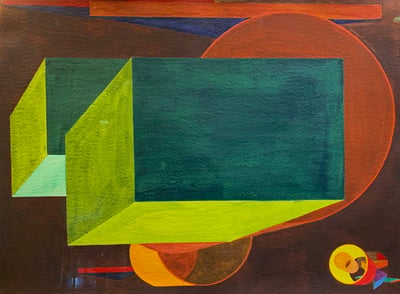
Al Held
Camerata XII, 1989
Drawing / Watercolor
Watercolor
USD 29,500

Al Held
Pachinko, 1989
Limited Edition Print
Woodcut
USD 5,500

Al Held
Pradorama, 1991
Limited Edition Print
Lithograph
EUR 4,200
Available works by Al Held
See all →Al Held
Camerata XII, 1989
Drawing / Watercolor
Watercolor
USD 29,500
Al Held
Pachinko, 1989
Limited Edition Print
Woodcut
USD 5,500
Al Held
Pradorama, 1991
Limited Edition Print
Lithograph
EUR 4,200
Related Artists


Artwork by Eduardo Chillida
What is abstract art?
Abstract art uses form, shape, line, and color to create a visual experience without attempting to represent external reality. The composition exists independently of the world's visual references, focusing on expressing ideas and emotions through non-representational means.


