

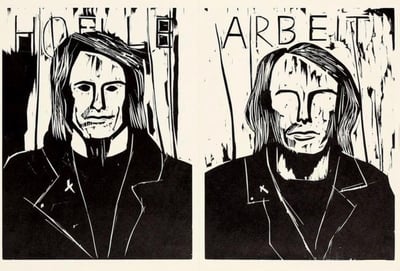
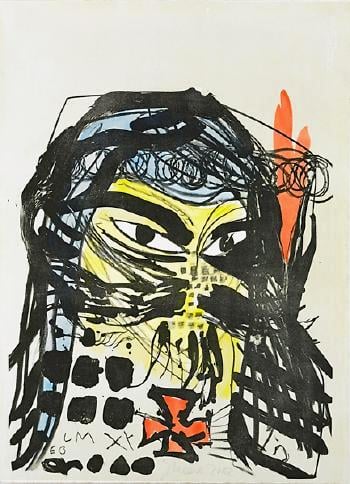
// Albert Oehlen's Hoelle/Arbeit (1989) is a woodcut print that confronts viewers with stark imagery and thematic tension. The composition features two side-by-side portraits of a figure, rendered in bold, black-and-white contrast with rough, expressive lines. Above each figure are the German words “HÖLLE” (Hell) and “ARBEIT” (Work), implying a connection between labor and torment. The facial expressions are almost mask-like, suggesting a detachment or loss of individuality within the context of work. Oehlen's use of woodcut intensifies the raw, graphic quality of the piece, reinforcing its commentary on existential struggle and societal expectations.
Artwork Copyright © Albert OehlenAlbert Oehlen (Germany, 1954) is a contemporary artist known for his dynamic approach to painting, blending abstraction and figuration. A key figure in the Junge Wilde movement, he challenges traditional art norms by integrating digital techniques and unconventional materials. Oehlen's work has been exhibited globally, influencing modern abstract art.
Artwork Copyright © Albert OehlenHoelle/Arbeit, 1989
Form
Medium
Size
- Inches
- Centimeters
Edition
Price
Available works →
- Authenticity Guaranteed
- Insured Shipping
- Online Since 2005
●
●Inventory 8169
●Signed
●Comes with gallery invoice and certificate
●Sell Us a Similar Artwork. Learn more.
// Albert Oehlen's Hoelle/Arbeit (1989) is a woodcut print that confronts viewers with stark imagery and thematic tension. The composition features two side-by-side portraits of a figure, rendered in bold, black-and-white contrast with rough, expressive lines. Above each figure are the German words “HÖLLE” (Hell) and “ARBEIT” (Work), implying a connection between labor and torment. The facial expressions are almost mask-like, suggesting a detachment or loss of individuality within the context of work. Oehlen's use of woodcut intensifies the raw, graphic quality of the piece, reinforcing its commentary on existential struggle and societal expectations.
Artwork Copyright © Albert OehlenAlbert Oehlen (Germany, 1954) is a contemporary artist known for his dynamic approach to painting, blending abstraction and figuration. A key figure in the Junge Wilde movement, he challenges traditional art norms by integrating digital techniques and unconventional materials. Oehlen's work has been exhibited globally, influencing modern abstract art.
Artwork Copyright © Albert Oehlen- Recently Added
- Price (Low-High)
- Price (High-Low)
- Year (Low-High)
- Year (High-Low)
Albert Oehlen
Cezanne, 2021
Limited Edition Print
Pigment print
EUR 1,000

Albert Oehlen
Meditation on bureaucratic tendencies at TZK, 2020
Limited Edition Print
Lithograph
Currently Not Available
Albert Oehlen
Hoelle/Arbeit, 1989
Limited Edition Print
Woodcut
Currently Not Available
Available works by Albert Oehlen
See all →Albert Oehlen
Cezanne, 2021
Limited Edition Print
Pigment print
EUR 1,000
Related Artists


Artwork by Willem de Kooning
What is Gestural?
Gestural art is a term that describes painting with freely sweeping brushstrokes. The primary goal of gestural art is to allow the artist to physically express emotional impulses. The varied, yet expressive paint marks are intended to convey the artist's inner thoughts and emotions, which viewers are believed to understand through the dynamic and spontaneous application of paint.

Albert Oehlen
Hoelle/Arbeit, 1989
40 x 30 cm


