

Pigment print on cardboard
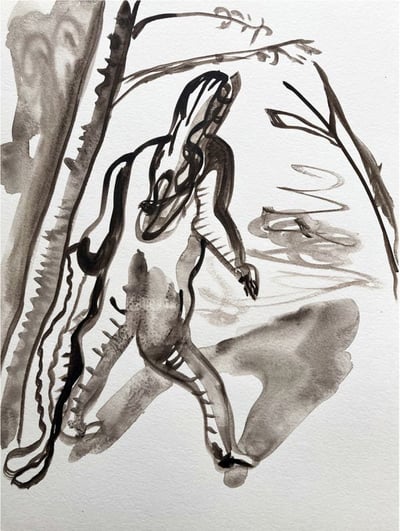
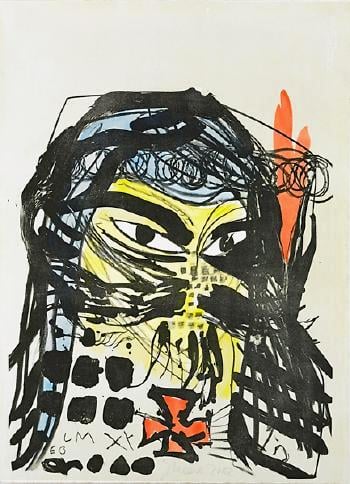
Albert Oehlen’s Cezanne (2021) is a pigment print on cardboard that showcases his distinctive abstract style with a figurative twist. The piece features a sketch-like figure rendered in fluid, expressive black and gray brushstrokes, giving it a spontaneous and almost dreamlike quality. The figure appears to move through a loosely defined natural setting, with gestural lines suggesting trees, branches, and an open space around them. The monochromatic palette and the unrefined brushwork evoke an introspective atmosphere, reminiscent of Cézanne's explorations of form and landscape but interpreted through Oehlen’s modern, abstract lens. This work exemplifies Oehlen’s ability to merge figuration with abstraction, capturing an essence of movement and environment with minimal detail.
Artwork Copyright © Albert OehlenAlbert Oehlen (Germany, 1954) is a contemporary artist known for his dynamic approach to painting, blending abstraction and figuration. A key figure in the Junge Wilde movement, he challenges traditional art norms by integrating digital techniques and unconventional materials. Oehlen's work has been exhibited globally, influencing modern abstract art.
Artwork Copyright © Albert OehlenCezanne, 2021
Form
Medium
Size
- Inches
- Centimeters
Edition
Price
- USD
- EUR
- GBP
- CHF
- Authenticity Guaranteed
- Insured Shipping
- Online Since 2005
●Inventory 15885
●Signed
●Comes with gallery invoice and certificate
●Sell Us a Similar Artwork. Learn more.
Pigment print on cardboard
Albert Oehlen’s Cezanne (2021) is a pigment print on cardboard that showcases his distinctive abstract style with a figurative twist. The piece features a sketch-like figure rendered in fluid, expressive black and gray brushstrokes, giving it a spontaneous and almost dreamlike quality. The figure appears to move through a loosely defined natural setting, with gestural lines suggesting trees, branches, and an open space around them. The monochromatic palette and the unrefined brushwork evoke an introspective atmosphere, reminiscent of Cézanne's explorations of form and landscape but interpreted through Oehlen’s modern, abstract lens. This work exemplifies Oehlen’s ability to merge figuration with abstraction, capturing an essence of movement and environment with minimal detail.
Artwork Copyright © Albert OehlenAlbert Oehlen (Germany, 1954) is a contemporary artist known for his dynamic approach to painting, blending abstraction and figuration. A key figure in the Junge Wilde movement, he challenges traditional art norms by integrating digital techniques and unconventional materials. Oehlen's work has been exhibited globally, influencing modern abstract art.
Artwork Copyright © Albert Oehlen- Recently Added
- Price (Low-High)
- Price (High-Low)
- Year (Low-High)
- Year (High-Low)
Albert Oehlen
Cezanne, 2021
Limited Edition Print
Pigment print
EUR 1,000

Albert Oehlen
Meditation on bureaucratic tendencies at TZK, 2020
Limited Edition Print
Lithograph
Currently Not Available
Albert Oehlen
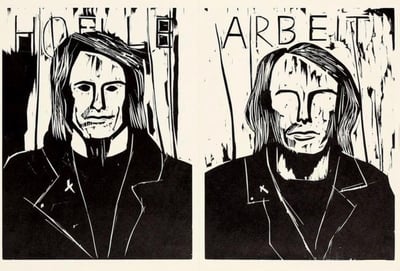
Hoelle/Arbeit, 1989
Limited Edition Print
Woodcut
Currently Not Available
Related Artists

Artwork by Eduardo Chillida
What is abstract art?
Abstract art uses form, shape, line, and color to create a visual experience without attempting to represent external reality. The composition exists independently of the world's visual references, focusing on expressing ideas and emotions through non-representational means.

Albert Oehlen
Cezanne, 2021
30 x 24 cm


