

Van de Loo 230. Color lithograph printed by Beaudet, Paris
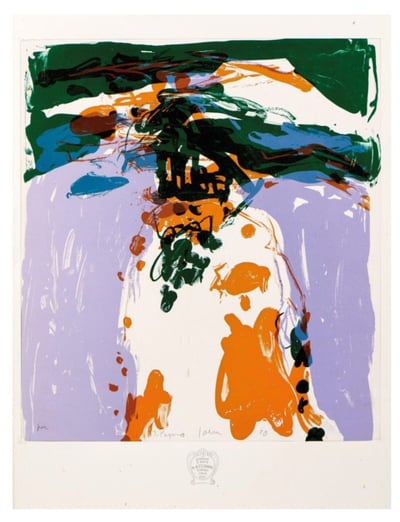
L'oubli by Asger Jorn is a dynamic lithograph created in 1960-61, reflecting the artist's expressive and abstract style. Produced in an edition of 30 and printed by Beaudet in Paris, this piece uses an energetic blend of red, blue, and green strokes layered over a neutral background. The composition is chaotic yet deliberate, with sweeping, gestural lines and splashes of color that suggest a tension between order and spontaneity. Jorn’s technique reflects the influence of the CoBrA movement, which valued raw, unfiltered creativity and often evoked a sense of primal energy. L'oubli captures the essence of forgetting or erasure, evoking layers of memory and emotion through its complex visual interplay.
Artwork Copyright © Asger JornAsger Jorn (Denmark, 1914–1973) was a Danish painter, sculptor, and ceramicist, co-founding the avant-garde movement COBRA and the Situationist International. His dynamic, expressive works often combined abstract forms with vibrant colors, reflecting his interest in spontaneous creation and critique of contemporary society. Jorn's legacy includes a significant influence on European post-war art.
Artwork Copyright © Asger JornL’oubli, 1960/61
Form
Medium
Size
- Inches
- Centimeters
Edition
Price
- USD
- EUR
- GBP
- CHF
- Authenticity Guaranteed
- Insured Shipping
- Online Since 2005
●Inventory 6520
●Signed
●Comes with gallery invoice and certificate
●Sell Us a Similar Artwork. Learn more.
Van de Loo 230. Color lithograph printed by Beaudet, Paris
L'oubli by Asger Jorn is a dynamic lithograph created in 1960-61, reflecting the artist's expressive and abstract style. Produced in an edition of 30 and printed by Beaudet in Paris, this piece uses an energetic blend of red, blue, and green strokes layered over a neutral background. The composition is chaotic yet deliberate, with sweeping, gestural lines and splashes of color that suggest a tension between order and spontaneity. Jorn’s technique reflects the influence of the CoBrA movement, which valued raw, unfiltered creativity and often evoked a sense of primal energy. L'oubli captures the essence of forgetting or erasure, evoking layers of memory and emotion through its complex visual interplay.
Artwork Copyright © Asger JornAsger Jorn (Denmark, 1914–1973) was a Danish painter, sculptor, and ceramicist, co-founding the avant-garde movement COBRA and the Situationist International. His dynamic, expressive works often combined abstract forms with vibrant colors, reflecting his interest in spontaneous creation and critique of contemporary society. Jorn's legacy includes a significant influence on European post-war art.
Artwork Copyright © Asger Jorn- Recently Added
- Price (Low-High)
- Price (High-Low)
- Year (Low-High)
- Year (High-Low)

Asger Jorn
Sans titre, 1967
Limited Edition Print
Lithograph
EUR 2,550
Asger Jorn
Lithographie couleur, 1970
Limited Edition Print
Lithograph
EUR 1,200

Asger Jorn
L’oubli, 1960/61
Limited Edition Print
Lithograph
USD 3,000

Asger Jorn
Dans le Sillage d’if-Aube, 1971
Limited Edition Print
Woodcut
Currently Not Available
Related Artists


Artwork by Wang Guangyi
What is activist art?
Activist Art is a form of art created to address social and political issues. It often involves public engagement and works closely with communities to raise awareness or inspire change. While it can include elements of performance art, it is not limited to this form. Examples include creating and distributing social protest posters or organizing community-based art projects that highlight specific causes.

Asger Jorn
L’oubli, 1960/61
41 x 56 cm


