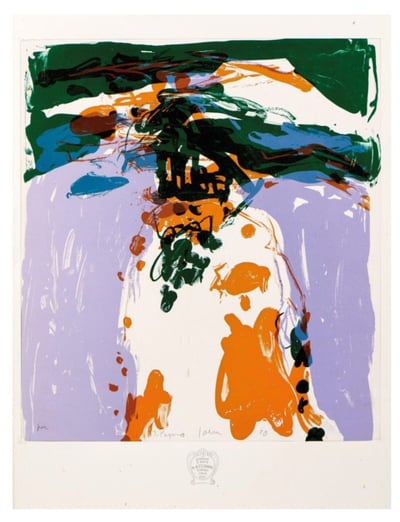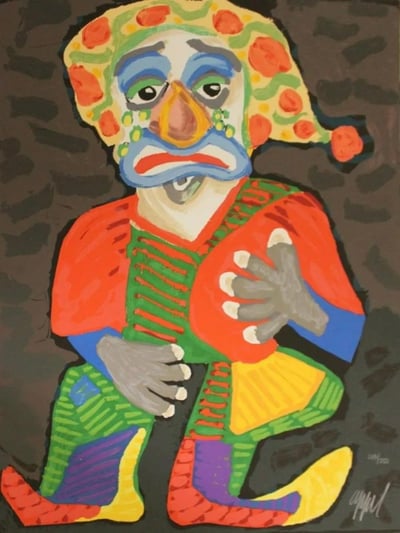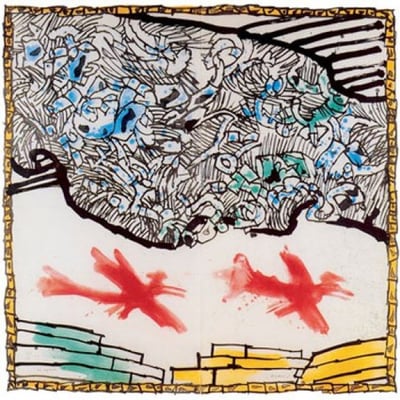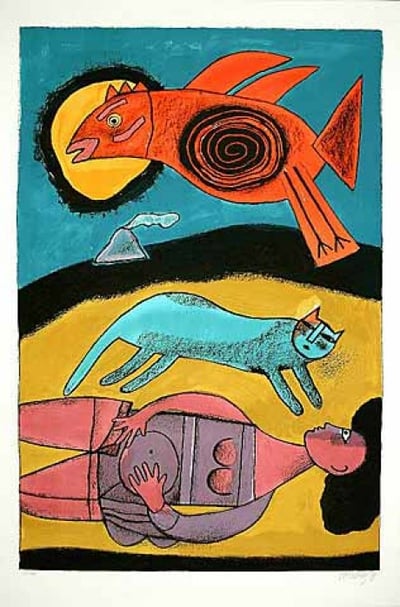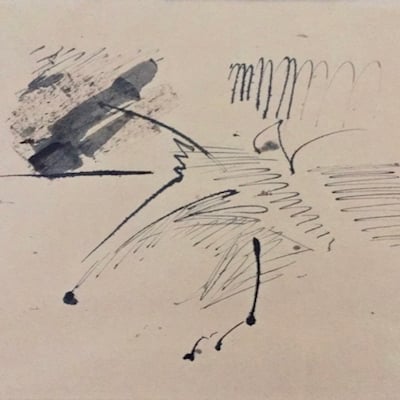
Asger Jorn (Denmark, 1914–1973) was a Danish painter, sculptor, and ceramicist, co-founding the avant-garde movement COBRA and the Situationist International. His dynamic, expressive works often combined abstract forms with vibrant colors, reflecting his interest in spontaneous creation and critique of contemporary society. Jorn's legacy includes a significant influence on European post-war art.
Lithograph Lithography is a printing method based on the principle that water and oil do not mix. It can be used to print artwork or text onto paper or other suitable materials. Traditionally, an image was drawn with wax, fat, or oil onto a lithographic limestone surface or plate. Today, metal plates and other surfaces are also used in lithographic printing.
Asger Jorn (Denmark, 1914–1973) was a Danish painter, sculptor, and ceramicist, co-founding the avant-garde movement COBRA and the Situationist International. His dynamic, expressive works often combined abstract forms with vibrant colors, reflecting his interest in spontaneous creation and critique of contemporary society. Jorn's legacy includes a significant influence on European post-war art.
If you add something to a painting, never let it be for aesthetic reasons. Only let it be for reasons of expression.
- Asger Jorn
Asger Jorn was a Danish painter, ceramic artist, sculptor and author from the years just before World War II into the 1970s. He was a student at the Royal Danish Academy of Fine Arts, from 1937 until 1942, in Copenagen. Later, Asger Jorn was one of the artists who founded the Situationist International and COBRA, an avant-garde movement. The largest collection of Jorn works today appears in Silkeborg, Denmark, in the Museum Jorn. When Asger Jorn painted, he did so in oil on canvas, and over the course of his career he made more than 2,500 total works - including ceramics, drawing, prints, sculptures, collages and tapestries. His books include "Luck and Chance: Dagger and Guitar," "Value and Economy" and "the Natural Order." He spent most of his life railing against establishments, whether in government, the Danish Communist Party or even the world of art. In 1964, he received a Guggenheim Award, but he sent an enraged telegram to Harry F. Guggenheim himself, refusing the prize and wanting "public confirmation not to have participated in [this] ridiculous game
Art Informel is a French term referring to the gestural and improvisational techniques common in abstract painting during the 1940s and 50s. It encompasses various styles that dominated these decades, characterized by informal, spontaneous methods. Artists used this term to describe approaches that moved away from traditional structures and embraced more expressive, unstructured techniques.