


Published by Galerie Im Erker, Saint-Gall.
Signed in pencil and numbered.
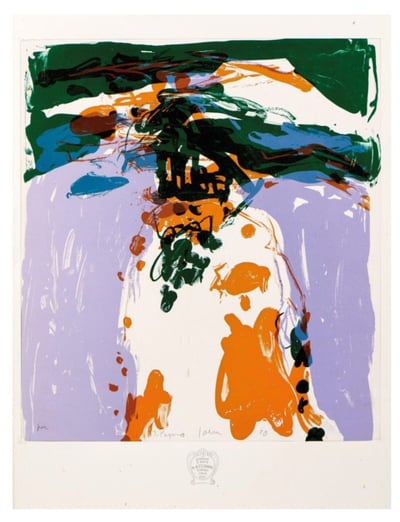
Vivid, instinctual gestures erupt across the surface in a dense interplay of saturated colour and spontaneous mark-making that epitomises the CoBrA spirit at its most concentrated. Jorn's untitled lithograph from 1967, published by the renowned Galerie Im Erker in Saint-Gall, channels the Danish artist's belief in art as a direct expression of creative impulse, unburdened by rational planning. The compact format belies the work's visual intensity: layered strokes of colour build a volatile, shimmering field that evokes both Nordic landscape and subconscious imagery. Signed in pencil and numbered from an edition of 100, this print captures the essence of one of the twentieth century's most influential avant-garde artists.
Artwork Copyright © Asger JornAsger Jorn (Denmark, 1914–1973) was a Danish painter, sculptor, and ceramicist, co-founding the avant-garde movement COBRA and the Situationist International. His dynamic, expressive works often combined abstract forms with vibrant colors, reflecting his interest in spontaneous creation and critique of contemporary society. Jorn's legacy includes a significant influence on European post-war art.
Artwork Copyright © Asger JornSans titre, 1967
Form
Medium
Size
- Inches
- Centimeters
Edition
Price
- USD
- EUR
- GBP
- CHF
- Authenticity Guaranteed
- Insured Shipping
- Online Since 2005
●Inventory 16854
●Signed
●Comes with gallery invoice and certificate
●Sell Us a Similar Artwork. Learn more.
Published by Galerie Im Erker, Saint-Gall.
Signed in pencil and numbered.
Vivid, instinctual gestures erupt across the surface in a dense interplay of saturated colour and spontaneous mark-making that epitomises the CoBrA spirit at its most concentrated. Jorn's untitled lithograph from 1967, published by the renowned Galerie Im Erker in Saint-Gall, channels the Danish artist's belief in art as a direct expression of creative impulse, unburdened by rational planning. The compact format belies the work's visual intensity: layered strokes of colour build a volatile, shimmering field that evokes both Nordic landscape and subconscious imagery. Signed in pencil and numbered from an edition of 100, this print captures the essence of one of the twentieth century's most influential avant-garde artists.
Artwork Copyright © Asger JornAsger Jorn (Denmark, 1914–1973) was a Danish painter, sculptor, and ceramicist, co-founding the avant-garde movement COBRA and the Situationist International. His dynamic, expressive works often combined abstract forms with vibrant colors, reflecting his interest in spontaneous creation and critique of contemporary society. Jorn's legacy includes a significant influence on European post-war art.
Artwork Copyright © Asger Jorn- Recently Added
- Price (Low-High)
- Price (High-Low)
- Year (Low-High)
- Year (High-Low)

Asger Jorn
Sans titre, 1967
Limited Edition Print
Lithograph
EUR 2,550
Asger Jorn
Lithographie couleur, 1970
Limited Edition Print
Lithograph
EUR 1,200

Asger Jorn
L’oubli, 1960/61
Limited Edition Print
Lithograph
USD 3,000

Asger Jorn
Dans le Sillage d’if-Aube, 1971
Limited Edition Print
Woodcut
Currently Not Available
Related Artists


Artwork by Willem de Kooning
What is Gestural?
Gestural art is a term that describes painting with freely sweeping brushstrokes. The primary goal of gestural art is to allow the artist to physically express emotional impulses. The varied, yet expressive paint marks are intended to convey the artist's inner thoughts and emotions, which viewers are believed to understand through the dynamic and spontaneous application of paint.


Asger Jorn
Sans titre, 1967
22.5 x 17 cm


