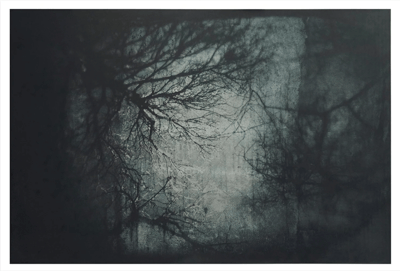
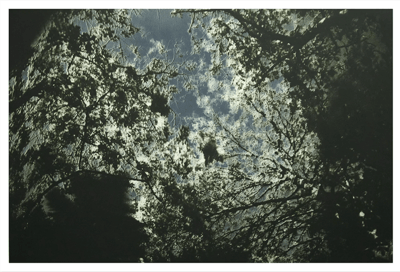
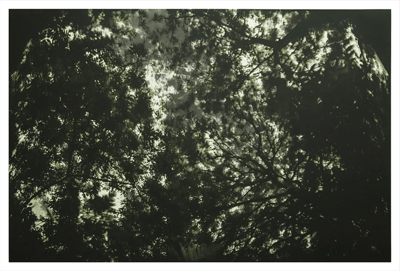
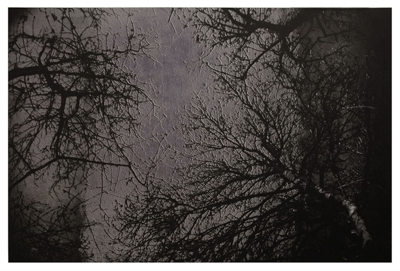
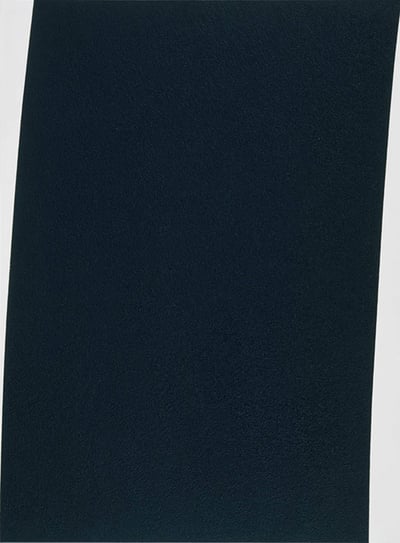
Original aquatint on steel, signed in pencil by the artist. Presses du Jardin Ed., Nîmes.
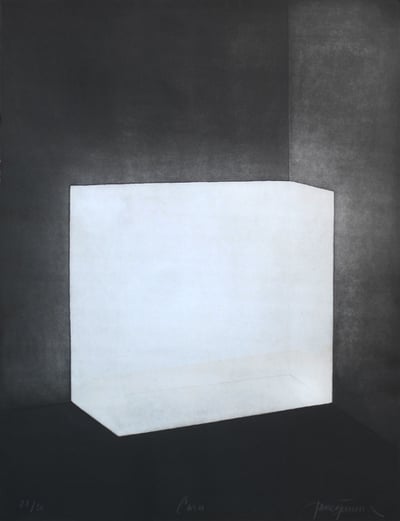
Carn by James Turrell, created in 1988, is an aquatint etching that embodies the artist’s exploration of light, perception, and spatial ambiguity. The artwork presents a stark white, luminous rectangular form suspended against a dark, shadowy background, creating a minimalist yet powerful composition. The floating box-like shape appears to glow, drawing the viewer’s attention and creating a sense of depth and mystery. Turrell, known for his work with light and space, captures an almost metaphysical atmosphere, where the shape feels both tangible and ethereal. This limited edition print, signed by the artist, measures 76 x 56 cm, demonstrating Turrell’s ability to use minimal forms to evoke profound visual and emotional experiences.
James Turrell (USA, 1943) is a leading light and space artist. Renowned for immersive installations, he manipulates perception with color and form, turning light into a tangible medium. His monumental 'Roden Crater' project transforms an extinct volcano into a celestial observatory, blending art, science, and nature.
EtchingEtching is a technique where a design is created on a metal surface by using a strong acid or mordant to eat away the unprotected parts of the metal, leaving the desired pattern in relief (intaglio). In modern art and manufacturing, different chemicals may be used depending on the material being etched.
Original aquatint on steel, signed in pencil by the artist. Presses du Jardin Ed., Nîmes.
Carn by James Turrell, created in 1988, is an aquatint etching that embodies the artist’s exploration of light, perception, and spatial ambiguity. The artwork presents a stark white, luminous rectangular form suspended against a dark, shadowy background, creating a minimalist yet powerful composition. The floating box-like shape appears to glow, drawing the viewer’s attention and creating a sense of depth and mystery. Turrell, known for his work with light and space, captures an almost metaphysical atmosphere, where the shape feels both tangible and ethereal. This limited edition print, signed by the artist, measures 76 x 56 cm, demonstrating Turrell’s ability to use minimal forms to evoke profound visual and emotional experiences.
James Turrell (USA, 1943) is a leading light and space artist. Renowned for immersive installations, he manipulates perception with color and form, turning light into a tangible medium. His monumental 'Roden Crater' project transforms an extinct volcano into a celestial observatory, blending art, science, and nature.
We're part of creating this world in which we live, but we're unaware of how we do that or even that we do that.
- James Turrell
James Turrell (b. 1943, USA) is an American artist celebrated for his groundbreaking work in installation art and light art. His explorations of perception and light challenge the boundaries of human sensory experience. Turrell's works are often large-scale, immersive environments that manipulate light, space, and color to create profound, contemplative experiences. One of his most ambitious projects is the Roden Crater, a monumental land art installation in an extinct volcanic crater in Arizona, designed to engage viewers with the celestial and earthly interplay of light. Influenced by Minimalism and conceptual art, Turrell's art invites viewers to question their own perception of reality. His work has been exhibited in major museums worldwide, affirming his status as a pivotal figure in contemporary art. (Artist website)
Contemporary art refers to avant-garde or innovative art created in the recent past or present day. The exact starting point of contemporary art varies depending on the institution, often tied to the founding year of museums or galleries that showcase the style. Contemporary art is characterized by its focus on current ideas, diverse media, and the exploration of new concepts and techniques.