


With certificate signed by the artist
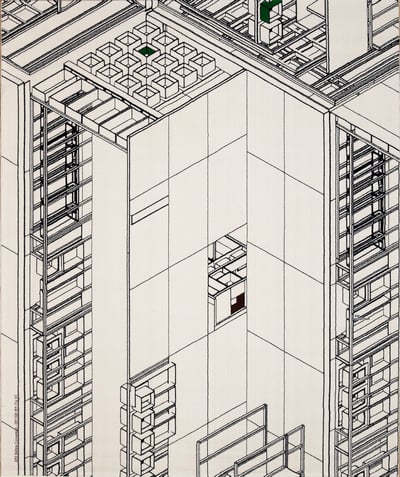
D53 Before Conversation Fig.154 by Jan De Cock, created in 2006, is a tapestry that captures the complexity of architectural forms in a striking, minimalist style. The composition resembles a detailed architectural drawing, showcasing structured grids and intersecting lines that form the façade of a modernist building. Small colored squares in green and burgundy punctuate the predominantly monochromatic design, adding focal points within the intricate geometry. This tapestry reflects De Cock's exploration of space, structure, and repetition, highlighting the tension between rigid form and visual depth. The piece invites viewers to consider the nuances of constructed environments and the rhythm of architectural elements, blurring the line between visual art and architectural design.
Artwork Copyright © Jan De CockJan De Cock (Belgium, 1976) is a contemporary visual artist known for his large-scale, site-specific installations that explore the relationship between art, architecture, and space. His work often references modernist aesthetics and challenges traditional notions of sculpture. De Cock founded The Brussels Art_ Institute, a multidisciplinary workspace fostering collaboration between artists and educational institutions.
Artwork Copyright © Jan De CockD53 Before Conversation Fig.154, 2006
Form
Medium
Size
- Inches
- Centimeters
Edition
Price
- USD
- EUR
- GBP
- CHF
- Authenticity Guaranteed
- Insured Shipping
- Online Since 2005
●Inventory 3483
●Signed
●Comes with gallery invoice and certificate
●Any questions?
With certificate signed by the artist
D53 Before Conversation Fig.154 by Jan De Cock, created in 2006, is a tapestry that captures the complexity of architectural forms in a striking, minimalist style. The composition resembles a detailed architectural drawing, showcasing structured grids and intersecting lines that form the façade of a modernist building. Small colored squares in green and burgundy punctuate the predominantly monochromatic design, adding focal points within the intricate geometry. This tapestry reflects De Cock's exploration of space, structure, and repetition, highlighting the tension between rigid form and visual depth. The piece invites viewers to consider the nuances of constructed environments and the rhythm of architectural elements, blurring the line between visual art and architectural design.
Artwork Copyright © Jan De CockJan De Cock (Belgium, 1976) is a contemporary visual artist known for his large-scale, site-specific installations that explore the relationship between art, architecture, and space. His work often references modernist aesthetics and challenges traditional notions of sculpture. De Cock founded The Brussels Art_ Institute, a multidisciplinary workspace fostering collaboration between artists and educational institutions.
Artwork Copyright © Jan De CockAvailability
Form
Medium
SORT BY

Jan De Cock
Nature morte with monument, 2013
Sculpture / Object
Mixed Media
EUR 19,500

Jan De Cock
Nature morte with broken necklace, 2013
Sculpture / Object
Mixed Media
EUR 19,500
Jan De Cock
D53 Before Conversation Fig.154, 2006
Tapestry
Tapestry
EUR 11,000

Jan De Cock
D53 Before Converdation Fig.271, 2006
Tapestry
Tapestry
EUR 7,500

Jan De Cock
D53 Before Conversation Fig.267, 2006
Tapestry
Tapestry
EUR 7,500

Jan De Cock
D53 Before Conversation - fig323, 2006
Tapestry
Tapestry
EUR 6,500

Jan De Cock
D53 Before Conversation - Fig275, 2006
Tapestry
Tapestry
EUR 6,500

Jan De Cock
D53 Before Conversation - Fig252, 2006
Tapestry
Tapestry
EUR 6,500
Related Artists

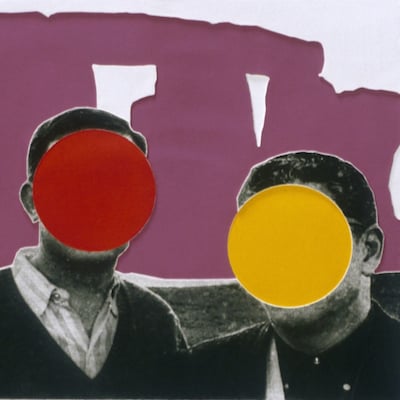
Artwork by John Baldessari
What is conceptual art?
Sometimes referred to as Conceptualism, this is an art form where the idea(s) or concept(s) behind the work take precedence over material concerns and traditional aesthetics. Many conceptual artworks can be created by anyone simply by following written instructions. The concept or idea is the most essential aspect of the artwork.

Jan De Cock
D53 Before Conversation Fig.154, 2006
365 x 300 cm


