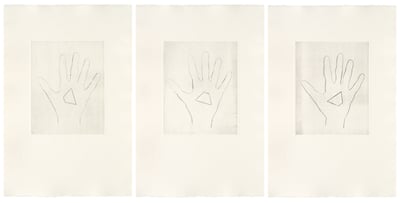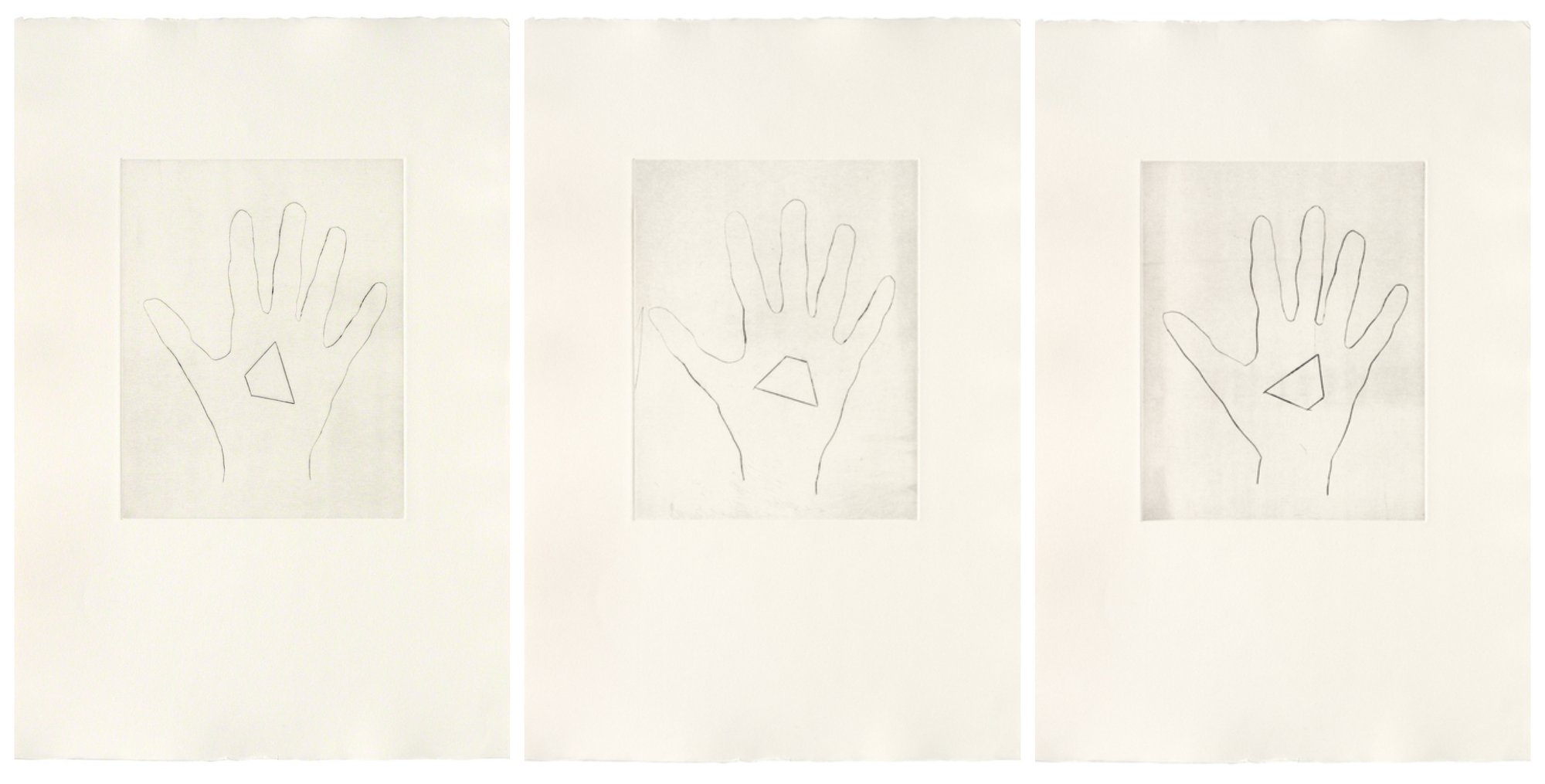
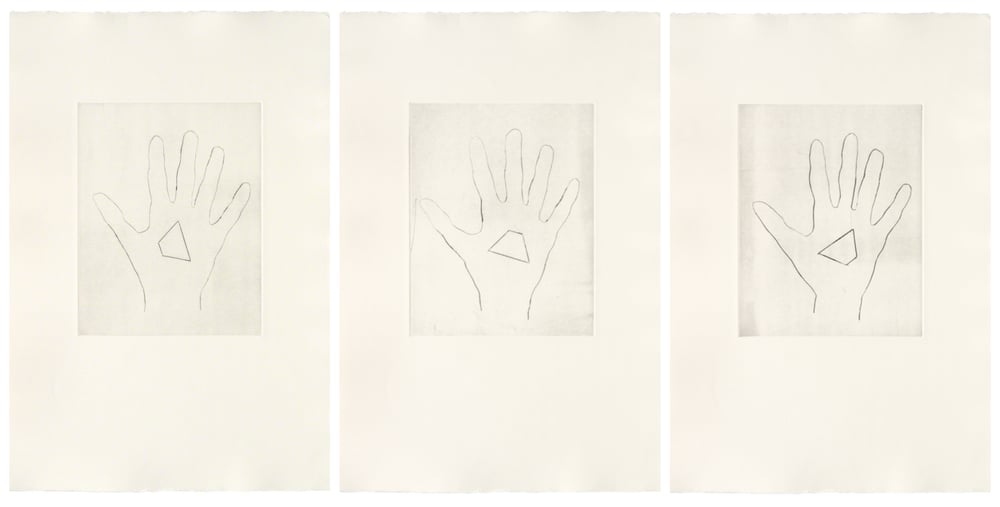
My Left Hand Holding a Piece 3 by Jonathan Monk is a limited edition set of 3 drypoint prints from 2008, produced in an edition of 40. Each print in this triptych presents a simple, linear depiction of Monk’s left hand with a triangular shape positioned in its palm. The repetition of the hand and triangle across the three prints creates subtle variations, prompting viewers to observe minor differences in texture and line quality. This minimalist approach reflects Monk’s exploration of self-representation and the concept of holding onto something both physically and metaphorically. The straightforward, almost meditative quality of the images invites reflections on identity, presence, and the nuances of perception.
Jonathan Monk (UK, 1969) is a conceptual artist whose work reinterprets and challenges art history with wit and irony. Using diverse media, including photography, sculpture, and performance, he engages in playful dialogues with iconic artists and movements. Monk’s works blur originality and appropriation, inviting viewers to question the boundaries of contemporary art.
Set 3 Dry pointsDrypoint is an intaglio printmaking technique where an image is incised onto a plate using a sharp, pointed tool, typically a needle made of metal or diamond. Traditionally, copper plates were used, but today zinc, plexiglass, or acetate are also common. Drypoint is easier for drawing artists to master compared to engraving, as the needle technique resembles drawing with a pencil rather than the more complex burin used in engraving.
My Left Hand Holding a Piece 3 by Jonathan Monk is a limited edition set of 3 drypoint prints from 2008, produced in an edition of 40. Each print in this triptych presents a simple, linear depiction of Monk’s left hand with a triangular shape positioned in its palm. The repetition of the hand and triangle across the three prints creates subtle variations, prompting viewers to observe minor differences in texture and line quality. This minimalist approach reflects Monk’s exploration of self-representation and the concept of holding onto something both physically and metaphorically. The straightforward, almost meditative quality of the images invites reflections on identity, presence, and the nuances of perception.
Jonathan Monk (UK, 1969) is a conceptual artist whose work reinterprets and challenges art history with wit and irony. Using diverse media, including photography, sculpture, and performance, he engages in playful dialogues with iconic artists and movements. Monk’s works blur originality and appropriation, inviting viewers to question the boundaries of contemporary art.
Is it or is it not or can it or can it not be?
- Jonathan Monk
Jonathan Monk is a British artist living and working in Berlin, Germany. He creates photographs, film, sculpture and installation pieces which are thought to be humorous reinterpretations of works by Sol LeWitt, Ed Ruscha, and John Baldessari to name some. Monk often uses quotations to give new ideas to works viewed as seminal in their time, adding quirkiness to challenge the value of the artwork. Jonathan Monk's upbringing in a working class environment is viewed by some as his source for taking the artistic and adding the mundane in ways that encourage viewers to think differently about specific art pieces than they may have before. Jonathan Monk has works exhibited throughout the world. His Tears, 2005 photograph shows a passport photo with the eyes completely covered by a pair of drop earrings placed to represent tears. His Painting of a photo of a photo of a painting, 2008, has images of a purple vase filled with yellow sunflowers, both in photograph image and then drawn in markers. The greeting “Get Well Soon” is one of three witty, hand-lettered greetings included. These are only two of the pieces which have established Jonathan Monk's reputation as a humorist in the art world.
Appropriation in art involves using pre-existing images or objects with little or no modification. This technique has played a significant role across various art forms, including visual arts, music, performance, and literature. In visual arts, appropriation refers to the practice of adopting, sampling, recycling, or borrowing elements—or even entire forms—of existing visual culture, integrating them into new works to create meaning or critique.