

// Wirtschaftspaket (Economic Package) by Joseph Beuys is a mixed media sculpture created in 1984. This work features a modestly wrapped package bound with string, resembling a parcel ready for shipment. The brown paper wrapping, postal stamps, and hand-written address add authenticity, evoking themes of austerity, resourcefulness, and the economy of post-war Germany. Beuys, known for his socially and politically charged art, likely used this simple, everyday object to comment on material scarcity and the value of modest resources in times of hardship. By presenting an ordinary parcel as art, Beuys transforms the mundane into a powerful symbol of resilience and adaptation, questioning the boundaries of art and utility.
Artwork Copyright © Joseph BeuysJoseph Beuys (Germany, 1921–1986) was a groundbreaking German conceptual artist, sculptor, and performance artist. Known for his use of unconventional materials such as felt and fat, Beuys explored themes of humanism, ecology, and social change. His famous mantra, 'Everyone is an artist,' emphasized creativity as a universal force. A leader in Fluxus, his works remain profoundly influential.
Artwork Copyright © Joseph BeuysWirtschaftspaket, 1984
Form
Medium
Size
- Inches
- Centimeters
Edition
Price
- USD
- EUR
- GBP
- CHF
- Authenticity Guaranteed
- Insured Shipping
- Online Since 2005
●Inventory 3683
●Signed
●Comes with gallery invoice and certificate
●Sell Us a Similar Artwork. Learn more.
// Wirtschaftspaket (Economic Package) by Joseph Beuys is a mixed media sculpture created in 1984. This work features a modestly wrapped package bound with string, resembling a parcel ready for shipment. The brown paper wrapping, postal stamps, and hand-written address add authenticity, evoking themes of austerity, resourcefulness, and the economy of post-war Germany. Beuys, known for his socially and politically charged art, likely used this simple, everyday object to comment on material scarcity and the value of modest resources in times of hardship. By presenting an ordinary parcel as art, Beuys transforms the mundane into a powerful symbol of resilience and adaptation, questioning the boundaries of art and utility.
Artwork Copyright © Joseph BeuysJoseph Beuys (Germany, 1921–1986) was a groundbreaking German conceptual artist, sculptor, and performance artist. Known for his use of unconventional materials such as felt and fat, Beuys explored themes of humanism, ecology, and social change. His famous mantra, 'Everyone is an artist,' emphasized creativity as a universal force. A leader in Fluxus, his works remain profoundly influential.
Artwork Copyright © Joseph BeuysAvailability
Size
Form
Medium
SORT BY
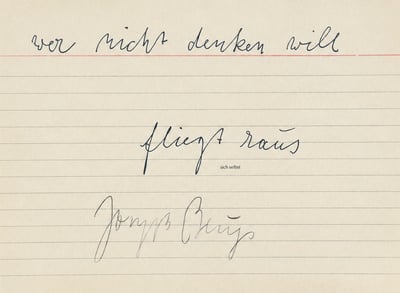
Joseph Beuys
Sich selbst (wer nicht denken will fliegt raus), 1977
Drawing / Watercolor
Mixed Media
EUR 700

Joseph Beuys
Eine Rose für direkte Demokratie, 1968
Sculpture / Object
Mixed Media
EUR 2,800

Joseph Beuys
Ja Ja Ja Ja Nee Nee Nee, 1970
Sculpture / Object
Mixed Media
EUR 2,500

Joseph Beuys
Beuys for Lothar, 1973
Photography
Photograph
EUR 5,500

Joseph Beuys
Wirtschaftspaket, 1984
Sculpture / Object
Mixed Media
EUR 16,600
Related Artists


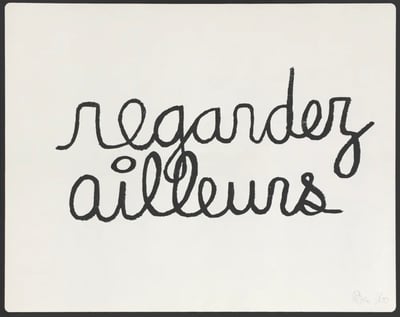


Artwork by On Kawara
What is mail art?
Mail Art is a populist art movement centered on the creation and exchange of small-scale artworks through the postal service. It developed out of the Fluxus movement in the 1950s and 1960s and has since evolved into a global art movement. Ray Johnson is recognized as the first mail artist, and his New York School is considered the first network of mail artists. Mail artists rely heavily on a network to exchange their works, often creating a community of artists connected through the postal system.



