

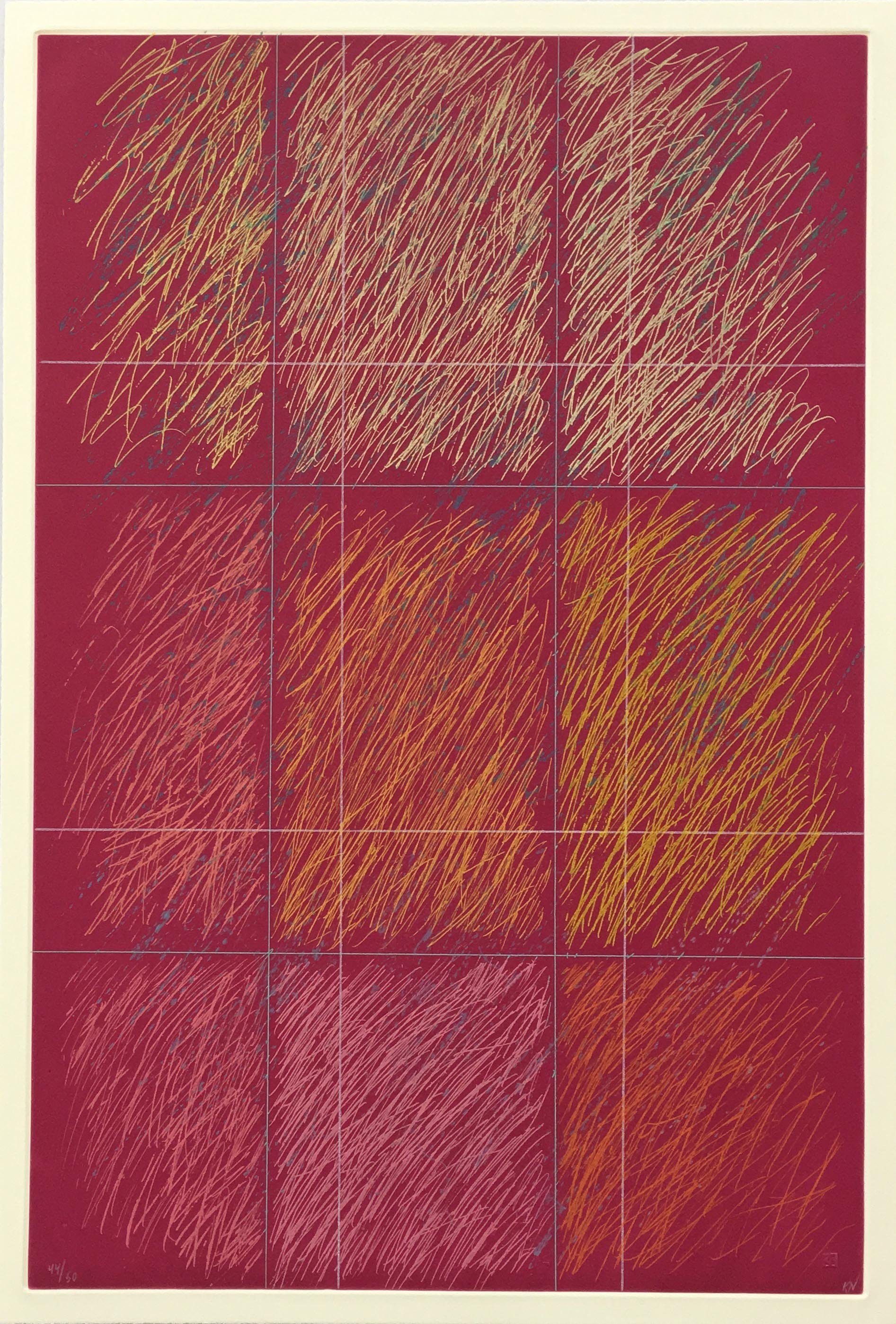
// Roy by Kenneth Noland is an etching and aquatint print from 1990, created in a limited edition of 50. This vibrant piece features a grid of nine panels filled with dense, crosshatched strokes in varying shades of red, orange, and yellow, set against a deep maroon background. The interplay of warm colors and layered textures generates a pulsating rhythm across the grid, with each panel offering subtle shifts in tone and intensity. Noland’s abstract approach invites the viewer to explore the composition’s energy and depth, as the repetitive yet slightly varied strokes suggest both unity and individuality within each section. Roy exemplifies Noland's skillful manipulation of color and form to evoke movement and emotion.
Artwork Copyright © Kenneth NolandKenneth Noland (United States, 1924–2010) was a leading figure in Color Field painting, renowned for his exploration of geometric forms and vibrant hues. His signature motifs include concentric circles, chevrons, and stripes, often created using a staining technique on unprimed canvas. Noland's work significantly influenced abstract art in the mid-20th century.
Artwork Copyright © Kenneth NolandRoy, 1990
Form
Medium
Size
- Inches
- Centimeters
Edition
Price
- USD
- EUR
- GBP
- CHF
- Authenticity Guaranteed
- Insured Shipping
- Online Since 2005
●Inventory 3895
●Hand Signed
●Comes with gallery invoice and certificate
●Sell Us a Similar Artwork. Learn more.
// Roy by Kenneth Noland is an etching and aquatint print from 1990, created in a limited edition of 50. This vibrant piece features a grid of nine panels filled with dense, crosshatched strokes in varying shades of red, orange, and yellow, set against a deep maroon background. The interplay of warm colors and layered textures generates a pulsating rhythm across the grid, with each panel offering subtle shifts in tone and intensity. Noland’s abstract approach invites the viewer to explore the composition’s energy and depth, as the repetitive yet slightly varied strokes suggest both unity and individuality within each section. Roy exemplifies Noland's skillful manipulation of color and form to evoke movement and emotion.
Artwork Copyright © Kenneth NolandKenneth Noland (United States, 1924–2010) was a leading figure in Color Field painting, renowned for his exploration of geometric forms and vibrant hues. His signature motifs include concentric circles, chevrons, and stripes, often created using a staining technique on unprimed canvas. Noland's work significantly influenced abstract art in the mid-20th century.
Artwork Copyright © Kenneth NolandAvailability
Size
Medium
SORT BY
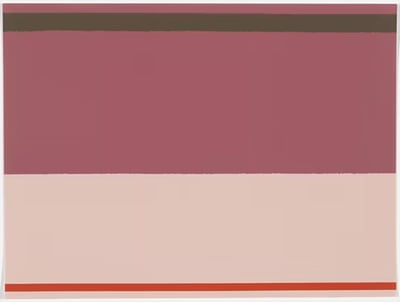
Kenneth Noland
Untitled from The New York Collection for Stockholm, 1973
Limited Edition Print
Screen-print
GBP 1,800

Kenneth Noland
Marron, 1990
Limited Edition Print
Etching and Aquatint
USD 1,500

Kenneth Noland
Rey, 1990
Limited Edition Print
Lithograph
USD 1,500

Kenneth Noland
Roy, 1990
Limited Edition Print
Etching and Aquatint
USD 1,500

Kenneth Noland
Untitled (Target), 2004
Limited Edition Print
Lithograph
Currently Not Available
Related Artists


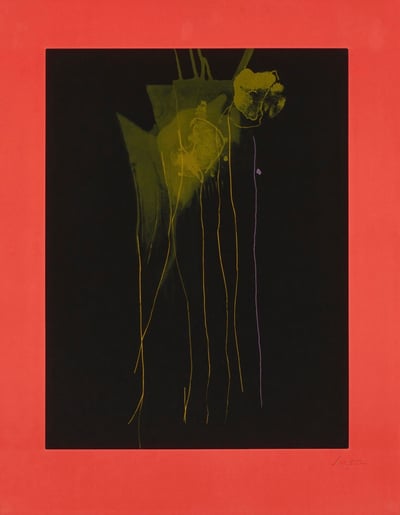

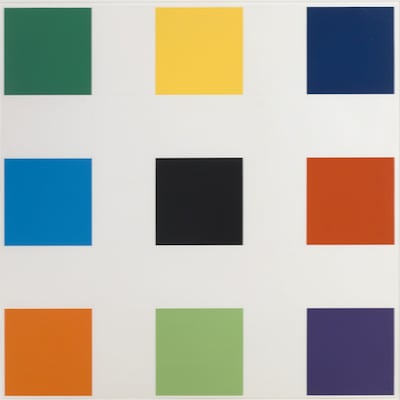
Artwork by Ellsworth Kelly
What is Hard Edge Art?
Hard Edge art is a style of abstract painting that became popular in the 1960s. It features areas of color separated by crisp, sharp edges that are painted with geometric precision. The term hard-edge painting was coined by art critic Jules Langsner to describe this approach, which contrasts with the softer, more fluid forms of other abstract styles.
Kenneth Noland
Roy, 1990
56 x 37 cm


