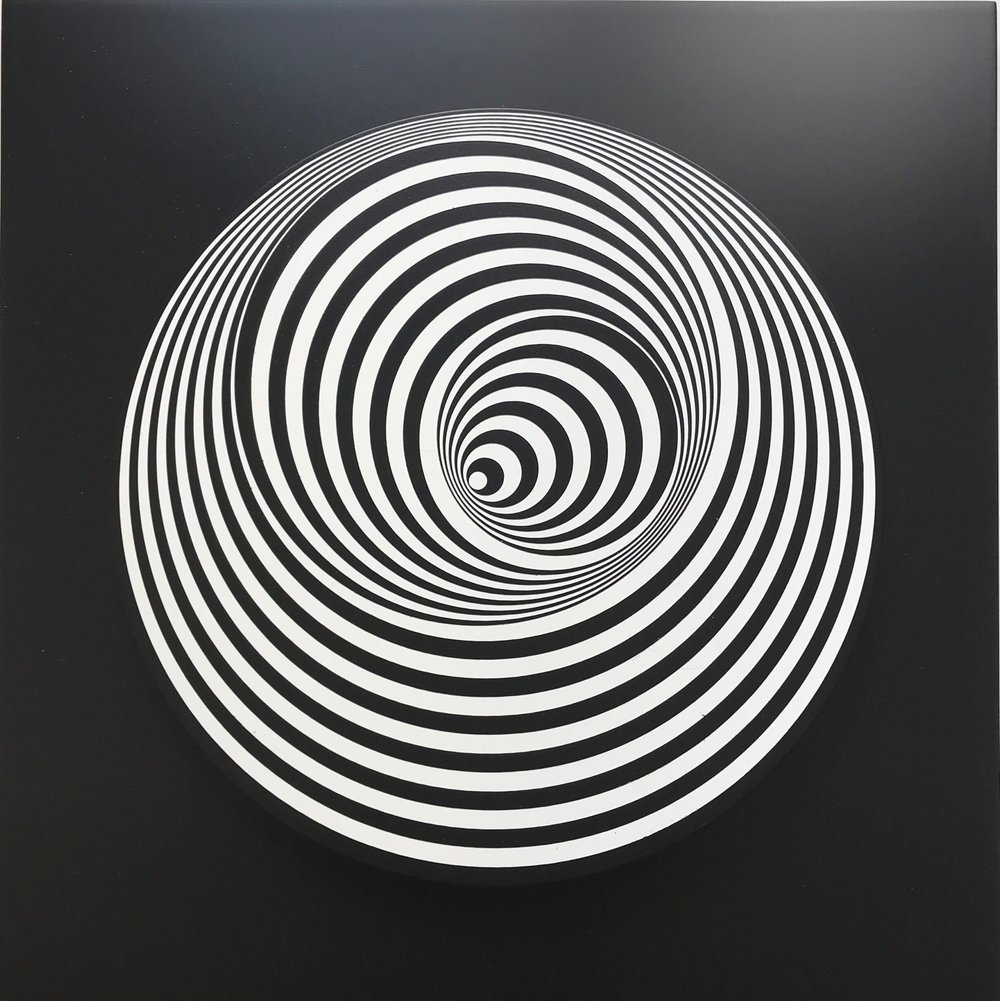
Edition of 20 - Wood and turning circle - In mint condition - executed in 2020
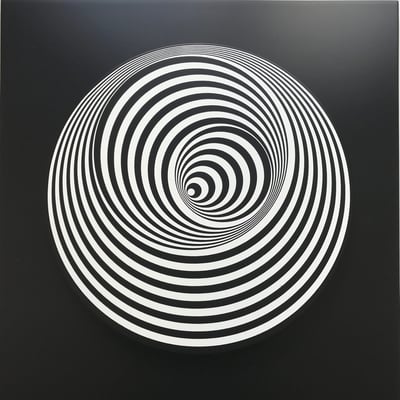
Dinamica Circolare 6B Ruotato by Marina Apollonio, originally conceived in 1968 and executed in 2020, is an optical artwork crafted from wood with a turning mechanism, limited to an edition of 20. This piece features a rotating spiral pattern in black and white, creating a mesmerizing vortex effect that seems to pull the viewer’s gaze into the center. The tightly spaced, concentric rings gradually expand outward, producing an illusion of depth and dynamic movement. The stark contrast between black and white amplifies the hypnotic quality, embodying Apollonio’s dedication to exploring visual perception and kinetic interaction. This work exemplifies her contribution to the Op Art movement, drawing viewers into a captivating visual experience.
Marina Apollonio (Italy, 1940) is a prominent figure in the Op Art and Kinetic Art movements, celebrated for her precise, dynamic works that explore optical illusion and viewer perception. Using concentric circles, geometric patterns, and vibrant colors, Apollonio’s art challenges spatial boundaries, creating immersive visual experiences. Her innovative contributions continue to influence contemporary abstract art.
WoodWood is one of the most ancient and versatile materials used in creating art. It has served as a base for paintings, brush handles, pens, and pencils, as well as for easels, wood engraving, woodcut, woodblock printing, and sculpting. Various types of wood, such as oak, maple, and pine, are commonly used in these artistic applications.
Edition of 20 - Wood and turning circle - In mint condition - executed in 2020
Dinamica Circolare 6B Ruotato by Marina Apollonio, originally conceived in 1968 and executed in 2020, is an optical artwork crafted from wood with a turning mechanism, limited to an edition of 20. This piece features a rotating spiral pattern in black and white, creating a mesmerizing vortex effect that seems to pull the viewer’s gaze into the center. The tightly spaced, concentric rings gradually expand outward, producing an illusion of depth and dynamic movement. The stark contrast between black and white amplifies the hypnotic quality, embodying Apollonio’s dedication to exploring visual perception and kinetic interaction. This work exemplifies her contribution to the Op Art movement, drawing viewers into a captivating visual experience.
Marina Apollonio (Italy, 1940) is a prominent figure in the Op Art and Kinetic Art movements, celebrated for her precise, dynamic works that explore optical illusion and viewer perception. Using concentric circles, geometric patterns, and vibrant colors, Apollonio’s art challenges spatial boundaries, creating immersive visual experiences. Her innovative contributions continue to influence contemporary abstract art.
I trained as a painter, but I never really liked it.
- Marina Apollonio
Marina Apollonio is an Italian optical artist and painter who executes her work based on mathematical systems. She received her artistic education at the Venice Academy of Fine Arts, where she followed Professor Giuseppe Santomaso’s painting courses. She desired depersonalization in art, which is opposed to the idea of expressive abstraction. As a result, she started designing illusionistic visual experiences using industrial materials.
Marina adopts basic shapes, such as the circle, and then finds structural devices that bring the figures to life. The end result of her artwork is structures that seem to transform into dynamic, fluctuating spaces to a viewer’s eye.
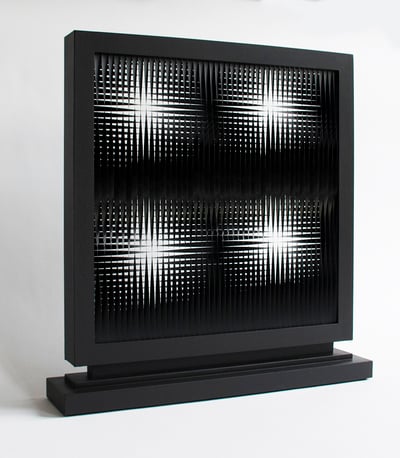
In many of her works, she creates concentric circles with alternating color sequences, such as black and white. As the viewer’s gaze rotates around the circular planes, a robust optical effect is created. The artist has also done works based on the orthogonal interaction of parallel horizontal and vertical colored lines on black backgrounds. Her works achieve a precise communicative function, but on a strictly visual level.
Marina Apollonio is a member of the international Op Art movement. She has participated in a variety of Optical Arts events across the globe.
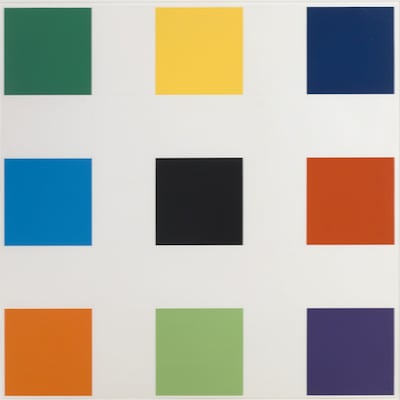
Hard Edge art is a style of abstract painting that became popular in the 1960s. It features areas of color separated by crisp, sharp edges that are painted with geometric precision. The term hard-edge painting was coined by art critic Jules Langsner to describe this approach, which contrasts with the softer, more fluid forms of other abstract styles.