


Hand-signed at the back.
Dinamica Circolare Ellisse Prospettico by Marina Apollonio is an optical relief in wood, conceived in 1969 and realized in 2025. The elliptical form compresses a sequence of black-and-white concentric bands into a perspectival field that appears to recede and expand simultaneously. Unlike the frontal symmetry of her circular works, the elongated ellipse introduces directional tension, intensifying the illusion of depth and rotation. The surface seems to pulse as the viewer shifts position, activating perception through precise geometry and rhythmic contrast. Rooted in Italian Op Art and perceptual research, the work prioritizes sensory experience over representation. Measuring 50.6 × 25.6 cm, produced in an edition of 20, and hand-signed on the reverse, it exemplifies Apollonio’s sustained exploration of visual dynamics across decades.
Artwork Copyright © Marina ApollonioMarina Apollonio (Italy, 1940) is a prominent figure in the Op Art and Kinetic Art movements, celebrated for her precise, dynamic works that explore optical illusion and viewer perception. Using concentric circles, geometric patterns, and vibrant colors, Apollonio’s art challenges spatial boundaries, creating immersive visual experiences. Her innovative contributions continue to influence contemporary abstract art.
Artwork Copyright © Marina ApollonioDinamica Circolare Ellisse Prospettico, 1969-2025
Form
Medium
Size
- Inches
- Centimeters
Edition
Price
- USD
- EUR
- GBP
- CHF
- Authenticity Guaranteed
- Insured Shipping
- Online Since 2005
●Inventory 16509
●Signed
●Comes with gallery invoice and certificate
●Sell Us a Similar Artwork. Learn more.
Hand-signed at the back.
Dinamica Circolare Ellisse Prospettico by Marina Apollonio is an optical relief in wood, conceived in 1969 and realized in 2025. The elliptical form compresses a sequence of black-and-white concentric bands into a perspectival field that appears to recede and expand simultaneously. Unlike the frontal symmetry of her circular works, the elongated ellipse introduces directional tension, intensifying the illusion of depth and rotation. The surface seems to pulse as the viewer shifts position, activating perception through precise geometry and rhythmic contrast. Rooted in Italian Op Art and perceptual research, the work prioritizes sensory experience over representation. Measuring 50.6 × 25.6 cm, produced in an edition of 20, and hand-signed on the reverse, it exemplifies Apollonio’s sustained exploration of visual dynamics across decades.
Artwork Copyright © Marina ApollonioMarina Apollonio (Italy, 1940) is a prominent figure in the Op Art and Kinetic Art movements, celebrated for her precise, dynamic works that explore optical illusion and viewer perception. Using concentric circles, geometric patterns, and vibrant colors, Apollonio’s art challenges spatial boundaries, creating immersive visual experiences. Her innovative contributions continue to influence contemporary abstract art.
Artwork Copyright © Marina ApollonioAvailability
Size
Medium
SORT BY

Marina Apollonio
Dinamica Circolare Ellisse Prospettico, 1969-2025
Sculpture / Object
Wood
EUR 1,500

Marina Apollonio
Dinamica Circolare 6S, 1966-2025
Sculpture / Object
Wood
EUR 3,000

Marina Apollonio
Dinamica Circolare Ellisse 6Z, 1969-2022
Sculpture / Object
Wood
EUR 1,500

Marina Apollonio
Dinamica Circolare 6Z+R, 1965-2021
Sculpture / Object
Mixed Media
EUR 3,000

Marina Apollonio
Dinamica Circolare 6 S+S, 1966-2020
Sculpture / Object
Wood
EUR 3,500
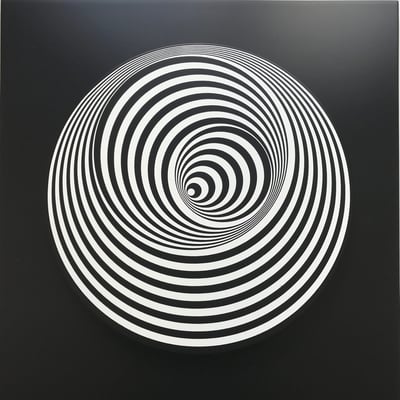
Marina Apollonio
Dinamica Circolare 6B Ruotato, 1968-2020
Sculpture / Object
Wood
Currently Not Available
Related Artists
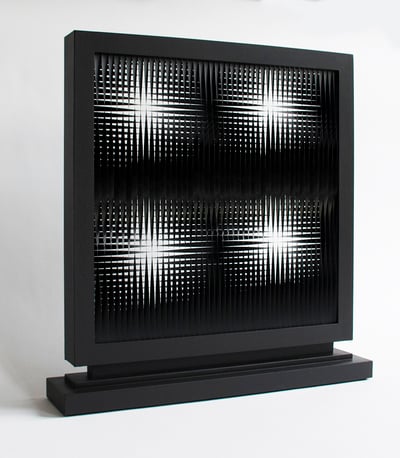
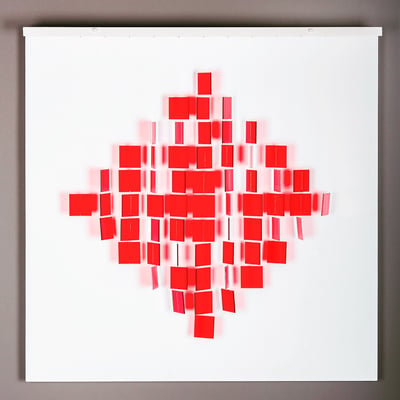


Artwork by Francois Morellet
What is geometric abstract art?
Geometric abstraction is a form of abstract art that uses geometric shapes arranged in a non-illusionistic space (though not always) and combined into non-representational (non-objective) compositions. Based on years of artistic research, some artists have proposed that geometric abstraction offers a solution to modern challenges by rejecting traditional illusionistic practices in favor of clarity and simplicity.



