
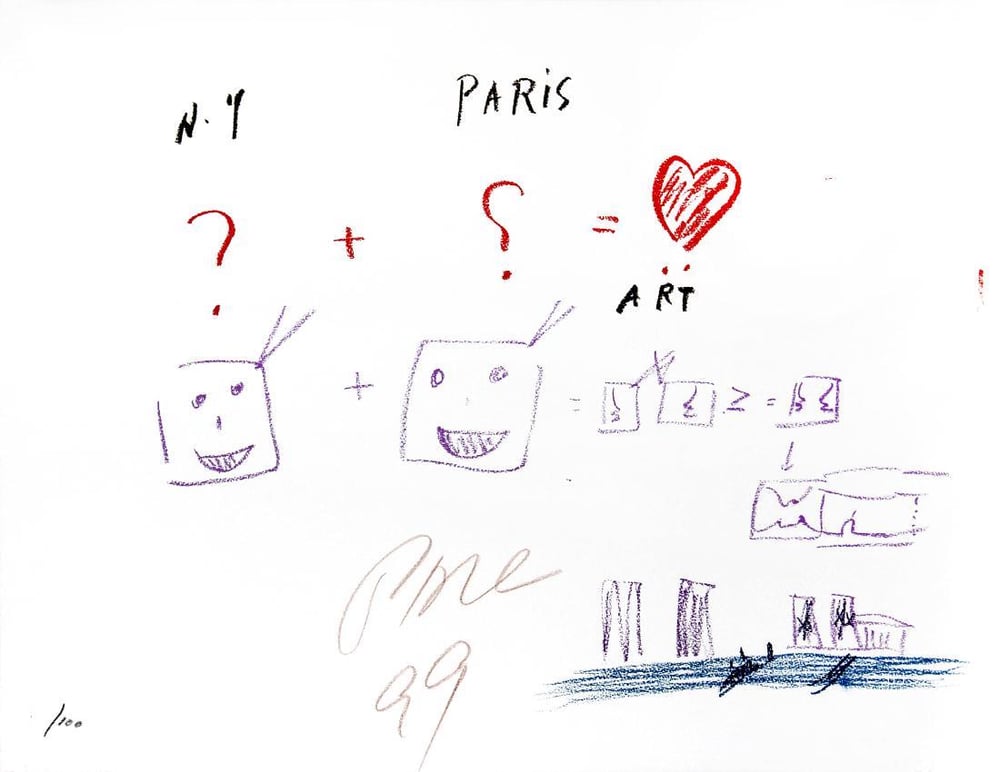
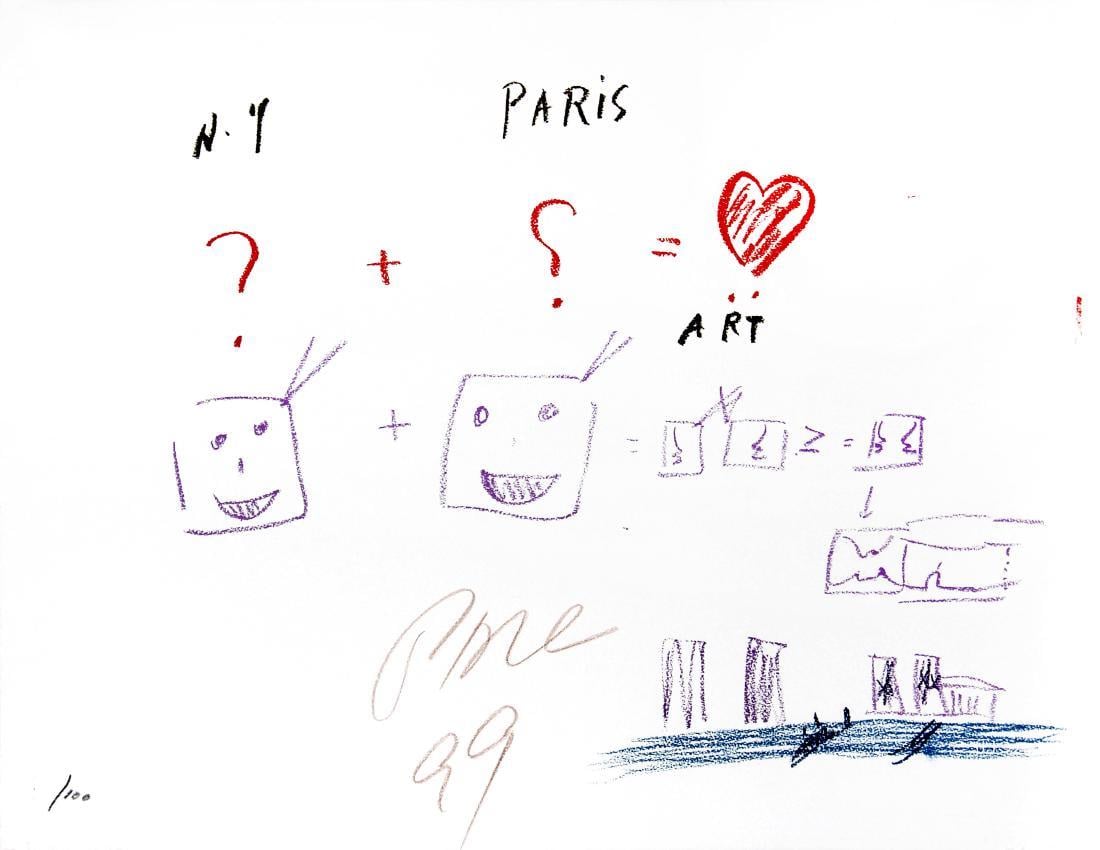
// NY + Paris = Art by Nam June Paik is a playful and thought-provoking lithograph that explores the concept of art through simple, almost childlike drawings. Created in 1999, the composition features a series of sketched elements, including smiling faces, question marks, and a heart symbol, with handwritten text that reads NY + Paris = Art. Paik, a pioneer in multimedia art, often blended humor and philosophical ideas in his work. Here, he suggests a formula where two iconic cities combine to create something greater—art. The minimalist and whimsical style conveys a sense of spontaneity, inviting viewers to interpret the playful symbols and perhaps question the universal language of art itself.
Artwork Copyright © Nam June PaikNam June Paik (South Korea/USA, 1932–2006) was a pioneering video artist and a key figure in the Fluxus movement. Often called the 'father of video art,' his innovative works combined technology, performance, and visual media. Iconic creations like TV Buddha and Electronic Superhighway redefined art in the digital age.
Artwork Copyright © Nam June PaikNY + Paris = Art, 1999
Form
Medium
Size
- Inches
- Centimeters
Edition
Price
Available works →
- Authenticity Guaranteed
- Insured Shipping
- Online Since 2005
●
●Inventory 4405
●Signed
●Comes with gallery invoice and certificate
●Sell Us a Similar Artwork. Learn more.
// NY + Paris = Art by Nam June Paik is a playful and thought-provoking lithograph that explores the concept of art through simple, almost childlike drawings. Created in 1999, the composition features a series of sketched elements, including smiling faces, question marks, and a heart symbol, with handwritten text that reads NY + Paris = Art. Paik, a pioneer in multimedia art, often blended humor and philosophical ideas in his work. Here, he suggests a formula where two iconic cities combine to create something greater—art. The minimalist and whimsical style conveys a sense of spontaneity, inviting viewers to interpret the playful symbols and perhaps question the universal language of art itself.
Artwork Copyright © Nam June PaikNam June Paik (South Korea/USA, 1932–2006) was a pioneering video artist and a key figure in the Fluxus movement. Often called the 'father of video art,' his innovative works combined technology, performance, and visual media. Iconic creations like TV Buddha and Electronic Superhighway redefined art in the digital age.
Artwork Copyright © Nam June Paik- Recently Added
- Price (Low-High)
- Price (High-Low)
- Year (Low-High)
- Year (High-Low)
Nam June Paik
NY + Paris = Art, 1999
Limited Edition Print
Lithograph
Currently Not Available
Related Artists


Artwork by Eduardo Kac
What is New Media Art?
New Media Art is a genre that includes all artworks created using new technologies, such as computer graphics, digital art, virtual art, internet art, computer animation, video games, 3D printing, and robotics. This genre often explores themes related to mass media, telecommunications, and digital electronics. The methods for presenting New Media Art range from installations and performances to virtual and conceptual art

Nam June Paik
NY + Paris = Art, 1999
56 x 76 cm


