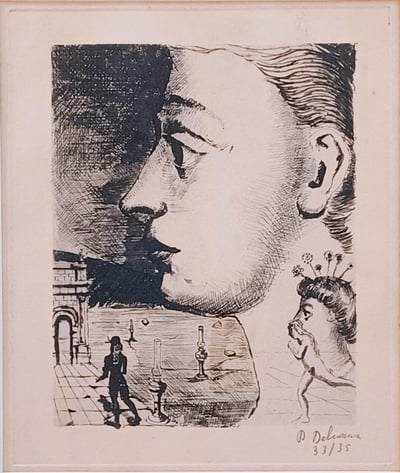
// Figure by Paul Delvaux, created circa 1960-1965, is an etching that reflects the artist's signature surrealist style, blending elements of dreamlike fantasy with classical themes. The composition is dominated by a large profile of a woman's face, whose gaze is directed beyond the scene. In the lower half of the image, a smaller figure stands within an open space, accompanied by a few architectural elements such as arches and columns, enhancing the sense of an enigmatic setting. The presence of a figure dressed in formal attire and another unusual figure with exaggerated features adds a layer of surrealism and mystery. Delvaux's work often features juxtapositions of classical architecture and figures placed in peculiar, dreamlike environments, and this etching captures that essence. The intricate details of the face and the fantastical scene evoke both curiosity and introspection. Signed and numbered by the artist, this print is part of a limited edition of 35.
Paul Delvaux (Belgium, 1897–1994) was a prominent surrealist painter known for his dreamlike, enigmatic scenes. His works often feature deserted cityscapes, classical architecture, and mysterious female figures, blending realism with a sense of timelessness. Delvaux’s art evokes wonder and introspection, making him a central figure in 20th-century surrealism.
EtchingEtching is a technique where a design is created on a metal surface by using a strong acid or mordant to eat away the unprotected parts of the metal, leaving the desired pattern in relief (intaglio). In modern art and manufacturing, different chemicals may be used depending on the material being etched.
// Figure by Paul Delvaux, created circa 1960-1965, is an etching that reflects the artist's signature surrealist style, blending elements of dreamlike fantasy with classical themes. The composition is dominated by a large profile of a woman's face, whose gaze is directed beyond the scene. In the lower half of the image, a smaller figure stands within an open space, accompanied by a few architectural elements such as arches and columns, enhancing the sense of an enigmatic setting. The presence of a figure dressed in formal attire and another unusual figure with exaggerated features adds a layer of surrealism and mystery. Delvaux's work often features juxtapositions of classical architecture and figures placed in peculiar, dreamlike environments, and this etching captures that essence. The intricate details of the face and the fantastical scene evoke both curiosity and introspection. Signed and numbered by the artist, this print is part of a limited edition of 35.
Paul Delvaux (Belgium, 1897–1994) was a prominent surrealist painter known for his dreamlike, enigmatic scenes. His works often feature deserted cityscapes, classical architecture, and mysterious female figures, blending realism with a sense of timelessness. Delvaux’s art evokes wonder and introspection, making him a central figure in 20th-century surrealism.
I have always wanted my colours to sing.
- Paul Delvaux
Surrealist painter Paul Delvaux was born in Belgium in 1897. His love for art began as a child after he read classic works like Homer. These stories inspired Delvaux to create sketches depicting mythological scenes. Delvaux was accepted into and studied at the Belgian Royal Academy of Arts in Brussels. Fearing a career as an artist would not be a suitable profession for their son, Delvaux's parents encouraged him to study architecture. Delvaux, however, defied their wishes, enrolled in several art classes and began to hone his creative skills. Early in Delvaux's career, he painted naturalistic landscapes, which sometimes also included nude people. However, as time progressed, his work took on a much more sensual overtone and would often feature naked women in seemingly trance-like states wandering through establishments like train stations and buildings. Some of Delvaux's most famous paintings include 'The Hands," completed in 1941, 'Venus Asleep,' completed in 1944 and 'The Great Sirens,' completed in 1947. Delvaux was heavily influenced by painters Rene Margritte, Giorgio de Chirico, Constant Permeke and Gustave de Smet. Though not considered as famous as Surrealist painters like Salvador Dali, Delvaux is thought of as a key contributor to the modern art movement of the mid-twentieth century. Paul Delvaux died in 1994 at age 96. A museum celebrating his work and legacy is located in Sint-Idesbald, Belgium. (Artist website)
Surrealism began in the 1920s as an art and literary movement with the goal of revealing the unconscious mind and unleashing the imagination by exploring unusual and dream-like imagery. Influenced by Sigmund Freud’s theories of psychoanalysis, Surrealist artists and writers sought to bring the unconscious into rational life, blurring the lines between reality and dreams. The movement aimed to challenge conventional perceptions and express the irrational aspects of the human experience.