- Image 46.5 x 66 cm / 18 1/4 x 26 inches
- Sheet 62 x 90 cm / 24 1/2 x 35 1/2 inch
- Catalog - Paul Delvaux notebook n° 3, Galerie Le Bateau-Lavoir, Paris, 1972, n° 37
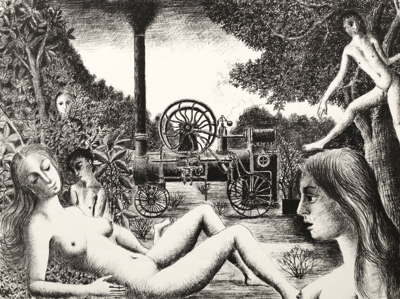
Paul Delvaux’s Le Sommeil (1970) is a lithograph that captures a serene, intimate moment between two women. One woman lies asleep on a bed, her body relaxed, while the other leans over her with a tender, watchful expression. The setting appears to be an interior space, with furniture in the background, subtly detailed. The composition juxtaposes wakefulness and sleep, consciousness and vulnerability, rendered in Delvaux's soft, detailed lines. His exploration of the female form and psychological depth is evident in the quiet tension between the two figures, creating a dreamlike atmosphere that invites introspection.
Paul Delvaux (Belgium, 1897–1994) was a prominent surrealist painter known for his dreamlike, enigmatic scenes. His works often feature deserted cityscapes, classical architecture, and mysterious female figures, blending realism with a sense of timelessness. Delvaux’s art evokes wonder and introspection, making him a central figure in 20th-century surrealism.
Lithograph Lithography is a printing method based on the principle that water and oil do not mix. It can be used to print artwork or text onto paper or other suitable materials. Traditionally, an image was drawn with wax, fat, or oil onto a lithographic limestone surface or plate. Today, metal plates and other surfaces are also used in lithographic printing.
- Image 46.5 x 66 cm / 18 1/4 x 26 inches
- Sheet 62 x 90 cm / 24 1/2 x 35 1/2 inch
- Catalog - Paul Delvaux notebook n° 3, Galerie Le Bateau-Lavoir, Paris, 1972, n° 37
Paul Delvaux’s Le Sommeil (1970) is a lithograph that captures a serene, intimate moment between two women. One woman lies asleep on a bed, her body relaxed, while the other leans over her with a tender, watchful expression. The setting appears to be an interior space, with furniture in the background, subtly detailed. The composition juxtaposes wakefulness and sleep, consciousness and vulnerability, rendered in Delvaux's soft, detailed lines. His exploration of the female form and psychological depth is evident in the quiet tension between the two figures, creating a dreamlike atmosphere that invites introspection.
Paul Delvaux (Belgium, 1897–1994) was a prominent surrealist painter known for his dreamlike, enigmatic scenes. His works often feature deserted cityscapes, classical architecture, and mysterious female figures, blending realism with a sense of timelessness. Delvaux’s art evokes wonder and introspection, making him a central figure in 20th-century surrealism.
I have always wanted my colours to sing.
- Paul Delvaux
Surrealist painter Paul Delvaux was born in Belgium in 1897. His love for art began as a child after he read classic works like Homer. These stories inspired Delvaux to create sketches depicting mythological scenes. Delvaux was accepted into and studied at the Belgian Royal Academy of Arts in Brussels. Fearing a career as an artist would not be a suitable profession for their son, Delvaux's parents encouraged him to study architecture. Delvaux, however, defied their wishes, enrolled in several art classes and began to hone his creative skills. Early in Delvaux's career, he painted naturalistic landscapes, which sometimes also included nude people. However, as time progressed, his work took on a much more sensual overtone and would often feature naked women in seemingly trance-like states wandering through establishments like train stations and buildings. Some of Delvaux's most famous paintings include 'The Hands," completed in 1941, 'Venus Asleep,' completed in 1944 and 'The Great Sirens,' completed in 1947. Delvaux was heavily influenced by painters Rene Margritte, Giorgio de Chirico, Constant Permeke and Gustave de Smet. Though not considered as famous as Surrealist painters like Salvador Dali, Delvaux is thought of as a key contributor to the modern art movement of the mid-twentieth century. Paul Delvaux died in 1994 at age 96. A museum celebrating his work and legacy is located in Sint-Idesbald, Belgium. (Artist website)
Hyperrealism is a genre of sculpture and painting that closely resembles high-resolution photographs. It is an evolution of Photorealism and is often applied to an independent art style or movement that became prominent in Europe and the United States in the early 2000s. Hyperrealist artists focus on extreme detail and precision, creating works that are often indistinguishable from real-life images.