Etching on Rives Artist & BFK Rives
- Image 38.5 x 51 cm / 15 1/8 x 20 in
- Sheet 61 x 80 cm / 24 x 31 1/2 in
- Proof on Japon Kozu, annotated E.A. outside the edition of 50 copies on Rives and 10 copies on Japon or Chine
- Literature: Paul Delvaux notebook n°3, Le Bateau Lavoir, Paris, 1972, n°31
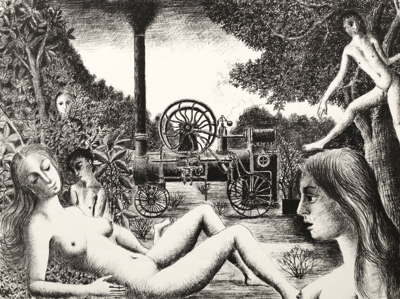
Paul Delvaux's La Dispute (1969) is an etching and aquatint that depicts two nude women engaged in a discussion in a serene, natural setting. The scene is framed by lush foliage, with the sun setting or rising in the background, casting rays over the landscape. The woman on the left appears calm, while the woman on the right gestures animatedly, suggesting a moment of disagreement or conversation. Delvaux’s characteristic attention to the female form is evident, with both figures drawn in soft lines that contrast with the detailed environment. The artwork reflects his fascination with classical themes and surreal elements, creating a dreamlike interaction between the figures.
Paul Delvaux (Belgium, 1897–1994) was a prominent surrealist painter known for his dreamlike, enigmatic scenes. His works often feature deserted cityscapes, classical architecture, and mysterious female figures, blending realism with a sense of timelessness. Delvaux’s art evokes wonder and introspection, making him a central figure in 20th-century surrealism.
Etching and AquatintEtching and aquatint are printmaking techniques. In aquatint, the printing plate is etched with a pattern of tiny pits and cracks to create a wide range of tonal gradations. This technique allows artists to replicate the broad, flat tones found in watercolor paintings and ink washes.
Etching on Rives Artist & BFK Rives
- Image 38.5 x 51 cm / 15 1/8 x 20 in
- Sheet 61 x 80 cm / 24 x 31 1/2 in
- Proof on Japon Kozu, annotated E.A. outside the edition of 50 copies on Rives and 10 copies on Japon or Chine
- Literature: Paul Delvaux notebook n°3, Le Bateau Lavoir, Paris, 1972, n°31
Paul Delvaux's La Dispute (1969) is an etching and aquatint that depicts two nude women engaged in a discussion in a serene, natural setting. The scene is framed by lush foliage, with the sun setting or rising in the background, casting rays over the landscape. The woman on the left appears calm, while the woman on the right gestures animatedly, suggesting a moment of disagreement or conversation. Delvaux’s characteristic attention to the female form is evident, with both figures drawn in soft lines that contrast with the detailed environment. The artwork reflects his fascination with classical themes and surreal elements, creating a dreamlike interaction between the figures.
Paul Delvaux (Belgium, 1897–1994) was a prominent surrealist painter known for his dreamlike, enigmatic scenes. His works often feature deserted cityscapes, classical architecture, and mysterious female figures, blending realism with a sense of timelessness. Delvaux’s art evokes wonder and introspection, making him a central figure in 20th-century surrealism.
I have always wanted my colours to sing.
- Paul Delvaux
Surrealist painter Paul Delvaux was born in Belgium in 1897. His love for art began as a child after he read classic works like Homer. These stories inspired Delvaux to create sketches depicting mythological scenes. Delvaux was accepted into and studied at the Belgian Royal Academy of Arts in Brussels. Fearing a career as an artist would not be a suitable profession for their son, Delvaux's parents encouraged him to study architecture. Delvaux, however, defied their wishes, enrolled in several art classes and began to hone his creative skills. Early in Delvaux's career, he painted naturalistic landscapes, which sometimes also included nude people. However, as time progressed, his work took on a much more sensual overtone and would often feature naked women in seemingly trance-like states wandering through establishments like train stations and buildings. Some of Delvaux's most famous paintings include 'The Hands," completed in 1941, 'Venus Asleep,' completed in 1944 and 'The Great Sirens,' completed in 1947. Delvaux was heavily influenced by painters Rene Margritte, Giorgio de Chirico, Constant Permeke and Gustave de Smet. Though not considered as famous as Surrealist painters like Salvador Dali, Delvaux is thought of as a key contributor to the modern art movement of the mid-twentieth century. Paul Delvaux died in 1994 at age 96. A museum celebrating his work and legacy is located in Sint-Idesbald, Belgium. (Artist website)
Postmodernism is an art movement that emerged as a reaction against authority and traditional boundaries, seeking to blur the lines between art and everyday life. It aimed to bridge the gap between the cultural elite and the general public by embracing eclectic mixtures of earlier conventions and styles. Postmodernist art often challenges established norms and celebrates diversity, irony, and pastiche, making it a movement that reflects the complexities of contemporary culture.