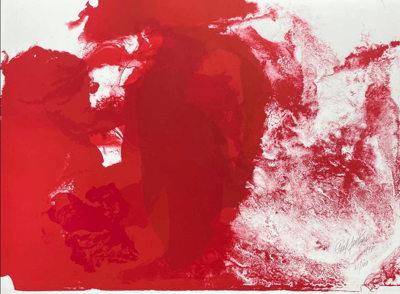
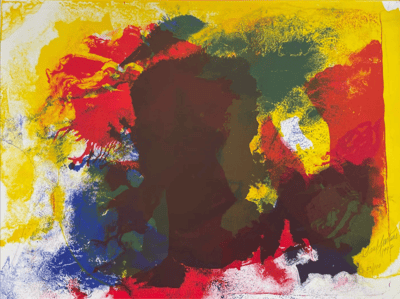
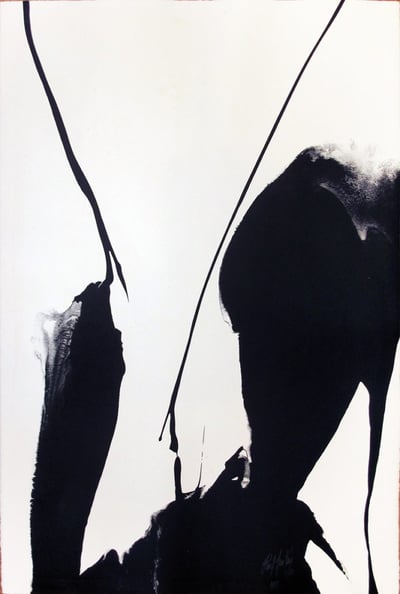
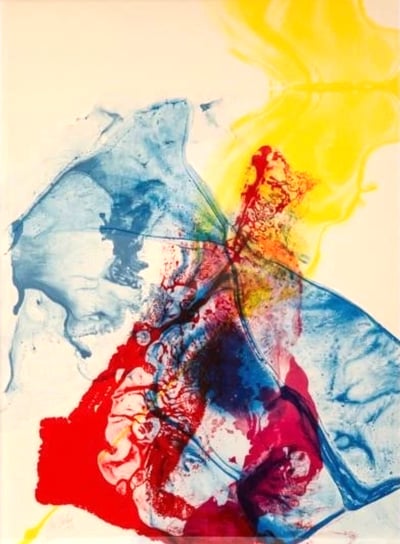
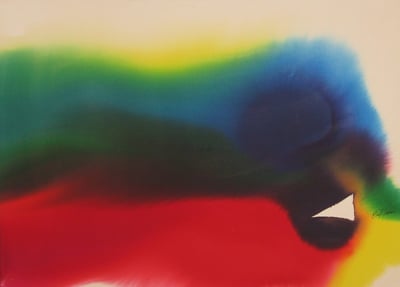
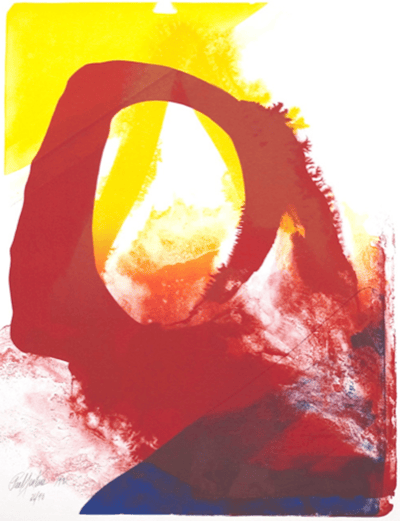
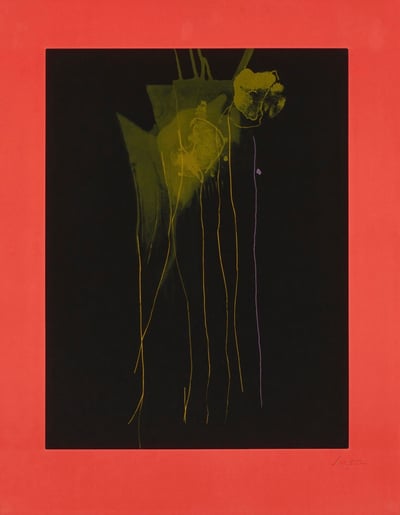
Five Invocations II is a powerful lithograph by Paul Jenkins from 1997, presenting a vortex of rich, saturated colors that converge into a dark, almost mystical center. Brilliant yellows, fiery reds, deep blues, and emerald greens swirl around a dense core of mingled pigments, creating a composition that evokes both cosmic energy and intimate emotional depth. Jenkins’s mastery of controlled fluidity is evident in the way each chromatic layer interacts with its neighbors, producing luminous edges where colors meet and merge. The work demonstrates the artist’s lifelong exploration of phenomena — the behavior of light and color in motion — that established him as a vital figure in postwar abstraction.
Paul Jenkins (United States, 1923–2012) was an American abstract expressionist painter renowned for his vibrant, fluid paintings created through a unique paint-pouring technique. His 'Phenomena' series exemplifies his exploration of color and form, contributing significantly to post-war American abstraction.
Lithograph Lithography is a printing method based on the principle that water and oil do not mix. It can be used to print artwork or text onto paper or other suitable materials. Traditionally, an image was drawn with wax, fat, or oil onto a lithographic limestone surface or plate. Today, metal plates and other surfaces are also used in lithographic printing.
Five Invocations II is a powerful lithograph by Paul Jenkins from 1997, presenting a vortex of rich, saturated colors that converge into a dark, almost mystical center. Brilliant yellows, fiery reds, deep blues, and emerald greens swirl around a dense core of mingled pigments, creating a composition that evokes both cosmic energy and intimate emotional depth. Jenkins’s mastery of controlled fluidity is evident in the way each chromatic layer interacts with its neighbors, producing luminous edges where colors meet and merge. The work demonstrates the artist’s lifelong exploration of phenomena — the behavior of light and color in motion — that established him as a vital figure in postwar abstraction.
Paul Jenkins (United States, 1923–2012) was an American abstract expressionist painter renowned for his vibrant, fluid paintings created through a unique paint-pouring technique. His 'Phenomena' series exemplifies his exploration of color and form, contributing significantly to post-war American abstraction.
I try to paint like a crapshooter throwing dice, utilizing past experience and my knowledge of the odds.
- Paul Jenkins
A painter of the abstract expressionist vein, Paul Jenkins is renowned for his unorthodox approach to paint application and control upon the canvas – he eventually ceased to use a paintbrush, and would instead manipulate his paint with the use of an ivory knife. Jenkins was initially inspired by the works of Jackson Pollock and Mark Tobey and took a great interest in eastern mysticism – a theme that permeated his work: always open to interpretation, rarely easy to make sweeping generalisations about. One of Jenkins most famous works, Phenomena Anderson, serves as a prime example of his ability to manipulate the outcome of the paint; his choice to abandon the paintbrush allowed him to coerce the paint into pooling or rolling across the canvas, creating fields of abstract colour. Jenkins began his working life in a ceramics factory, a job that always stayed with him and provided the inspiration for his substantial means of painting. (Artist website)
Art Informel is a French term referring to the gestural and improvisational techniques common in abstract painting during the 1940s and 50s. It encompasses various styles that dominated these decades, characterized by informal, spontaneous methods. Artists used this term to describe approaches that moved away from traditional structures and embraced more expressive, unstructured techniques.