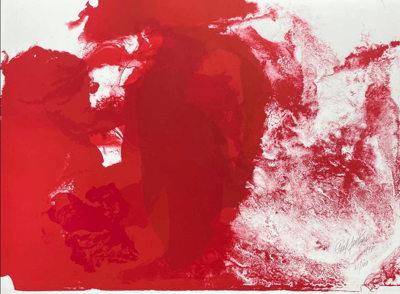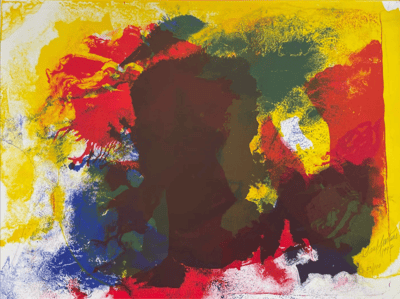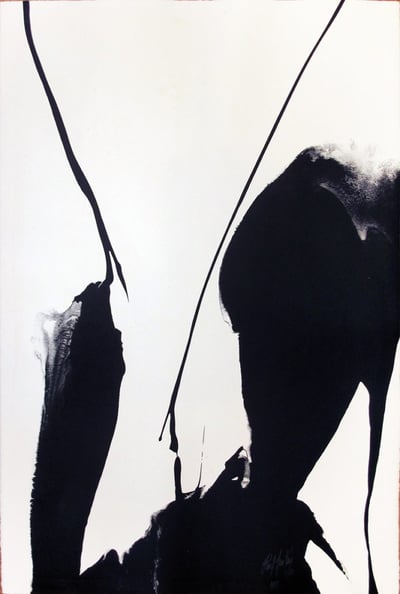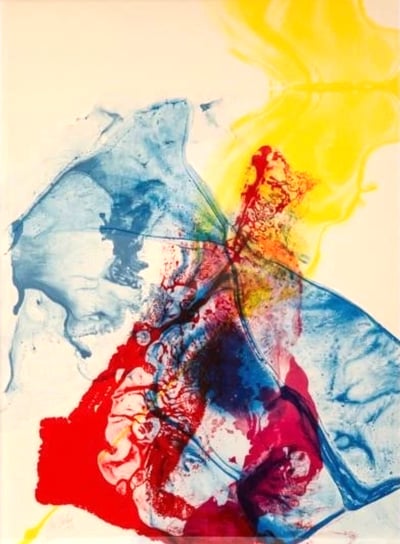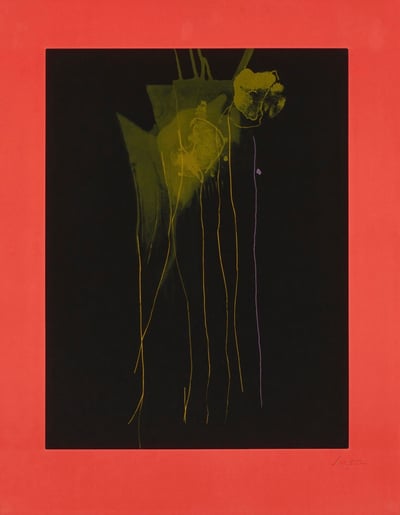
Color monoprint, on handmade TGL paper.
Signed and dated in pencil.
Published by Tyler Graphics, New York, and with their blindstamp.
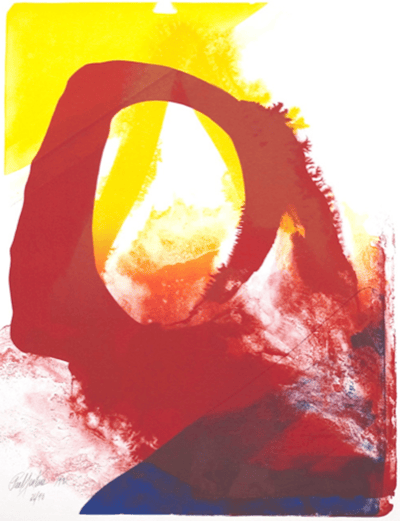
Four Winds (I) (1980) by Paul Jenkins is a striking color monoprint produced on handmade TGL paper and published by Tyler Graphics Ltd.. Known for his fluid approach to abstraction, Jenkins often allowed pigments to flow and interact organically on the paper, creating compositions that balance spontaneity with control.
In this work, broad areas of luminous color—particularly the dominant yellow field—interact with bold black brush-like forms and vibrant areas of red, orange, and turquoise. The sweeping black gesture that cuts diagonally across the composition introduces movement and tension, guiding the viewer’s eye through the image. The layered pigments and irregular edges of color emphasize the physical process of the monoprint technique, in which each impression is unique.
The title Four Winds suggests forces of nature or directional movement, reinforcing the dynamic energy of the composition. Jenkins frequently explored themes of flow, light, and natural phenomena, and this work reflects his interest in the expressive potential of color and gesture.
Paul Jenkins (United States, 1923–2012) was an American abstract expressionist painter renowned for his vibrant, fluid paintings created through a unique paint-pouring technique. His 'Phenomena' series exemplifies his exploration of color and form, contributing significantly to post-war American abstraction.
MonoprintMonoprinting is a printmaking technique where a single impression is created from a re-printable surface, such as a lithographic stone, wood block, or metal plate. Unlike traditional printmaking, where multiple copies are produced, monoprinting results in a unique image. Techniques used in monoprinting include etching, lithography, and woodcut, but the key characteristic is that each print is one-of-a-kind.
Color monoprint, on handmade TGL paper.
Signed and dated in pencil.
Published by Tyler Graphics, New York, and with their blindstamp.
Four Winds (I) (1980) by Paul Jenkins is a striking color monoprint produced on handmade TGL paper and published by Tyler Graphics Ltd.. Known for his fluid approach to abstraction, Jenkins often allowed pigments to flow and interact organically on the paper, creating compositions that balance spontaneity with control.
In this work, broad areas of luminous color—particularly the dominant yellow field—interact with bold black brush-like forms and vibrant areas of red, orange, and turquoise. The sweeping black gesture that cuts diagonally across the composition introduces movement and tension, guiding the viewer’s eye through the image. The layered pigments and irregular edges of color emphasize the physical process of the monoprint technique, in which each impression is unique.
The title Four Winds suggests forces of nature or directional movement, reinforcing the dynamic energy of the composition. Jenkins frequently explored themes of flow, light, and natural phenomena, and this work reflects his interest in the expressive potential of color and gesture.
Paul Jenkins (United States, 1923–2012) was an American abstract expressionist painter renowned for his vibrant, fluid paintings created through a unique paint-pouring technique. His 'Phenomena' series exemplifies his exploration of color and form, contributing significantly to post-war American abstraction.
I try to paint like a crapshooter throwing dice, utilizing past experience and my knowledge of the odds.
- Paul Jenkins
A painter of the abstract expressionist vein, Paul Jenkins is renowned for his unorthodox approach to paint application and control upon the canvas – he eventually ceased to use a paintbrush, and would instead manipulate his paint with the use of an ivory knife. Jenkins was initially inspired by the works of Jackson Pollock and Mark Tobey and took a great interest in eastern mysticism – a theme that permeated his work: always open to interpretation, rarely easy to make sweeping generalisations about. One of Jenkins most famous works, Phenomena Anderson, serves as a prime example of his ability to manipulate the outcome of the paint; his choice to abandon the paintbrush allowed him to coerce the paint into pooling or rolling across the canvas, creating fields of abstract colour. Jenkins began his working life in a ceramics factory, a job that always stayed with him and provided the inspiration for his substantial means of painting. (Artist website)
Art Informel is a French term referring to the gestural and improvisational techniques common in abstract painting during the 1940s and 50s. It encompasses various styles that dominated these decades, characterized by informal, spontaneous methods. Artists used this term to describe approaches that moved away from traditional structures and embraced more expressive, unstructured techniques.