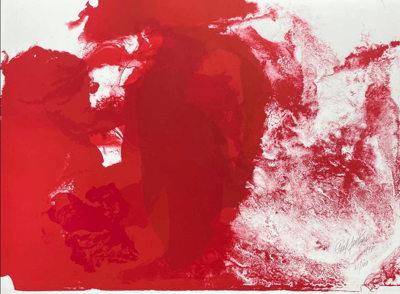
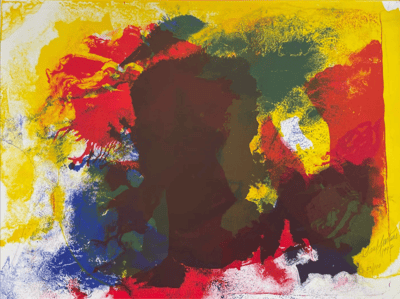
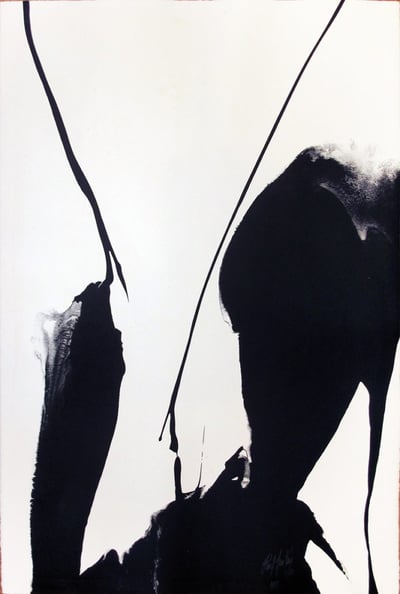
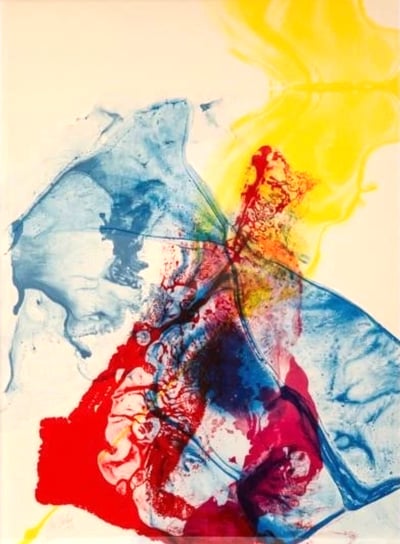
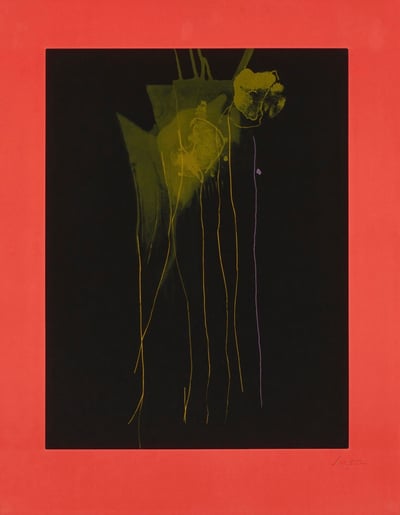
Watercolor on paper, mounted on masonite.
Signed on Front, also Signed, Dated and inscribed on reverse.
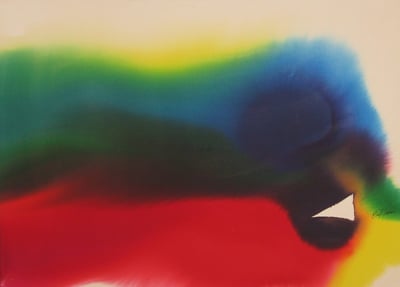
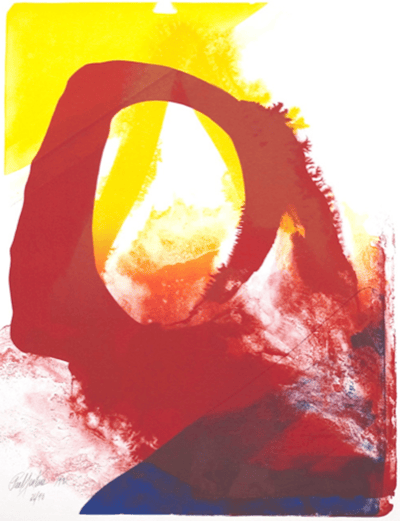
Paul Jenkins’ Untitled (1960) exemplifies his signature style of lyrical abstraction through the use of flowing watercolor. The composition is a delicate interplay of translucent layers in purples, oranges, reds, and soft whites, creating a sense of motion and spontaneity. Jenkins was known for his controlled pouring technique, guiding pigment with intuition and gravity rather than the brush, resulting in organic forms that feel both spiritual and atmospheric. This small-scale work retains his meditative, expressive power and is signed both on the front and reverse, with additional date and inscription.
Paul Jenkins (United States, 1923–2012) was an American abstract expressionist painter renowned for his vibrant, fluid paintings created through a unique paint-pouring technique. His 'Phenomena' series exemplifies his exploration of color and form, contributing significantly to post-war American abstraction.
WatercolorWatercolor refers to both the medium and the resulting artwork created using pigments suspended in a water-soluble vehicle. Watercolors are known for their luminous, transparent appearance because the pigments are applied in pure form with minimal fillers. By adding Chinese white, the watercolor can become opaque, resembling gouache.
Watercolor on paper, mounted on masonite.
Signed on Front, also Signed, Dated and inscribed on reverse.
Paul Jenkins’ Untitled (1960) exemplifies his signature style of lyrical abstraction through the use of flowing watercolor. The composition is a delicate interplay of translucent layers in purples, oranges, reds, and soft whites, creating a sense of motion and spontaneity. Jenkins was known for his controlled pouring technique, guiding pigment with intuition and gravity rather than the brush, resulting in organic forms that feel both spiritual and atmospheric. This small-scale work retains his meditative, expressive power and is signed both on the front and reverse, with additional date and inscription.
Paul Jenkins (United States, 1923–2012) was an American abstract expressionist painter renowned for his vibrant, fluid paintings created through a unique paint-pouring technique. His 'Phenomena' series exemplifies his exploration of color and form, contributing significantly to post-war American abstraction.
I try to paint like a crapshooter throwing dice, utilizing past experience and my knowledge of the odds.
- Paul Jenkins
A painter of the abstract expressionist vein, Paul Jenkins is renowned for his unorthodox approach to paint application and control upon the canvas – he eventually ceased to use a paintbrush, and would instead manipulate his paint with the use of an ivory knife. Jenkins was initially inspired by the works of Jackson Pollock and Mark Tobey and took a great interest in eastern mysticism – a theme that permeated his work: always open to interpretation, rarely easy to make sweeping generalisations about. One of Jenkins most famous works, Phenomena Anderson, serves as a prime example of his ability to manipulate the outcome of the paint; his choice to abandon the paintbrush allowed him to coerce the paint into pooling or rolling across the canvas, creating fields of abstract colour. Jenkins began his working life in a ceramics factory, a job that always stayed with him and provided the inspiration for his substantial means of painting. (Artist website)
Colour Field Painting is an abstract style characterized by large areas of a single color or simple, solid colors. The term was first used in the 1950s to describe the work of three American Abstract Expressionist painters—Barnett Newman, Mark Rothko, and Clyfford Still. Their work emphasized the emotional power of color and the creation of vast, meditative spaces through expansive color fields.