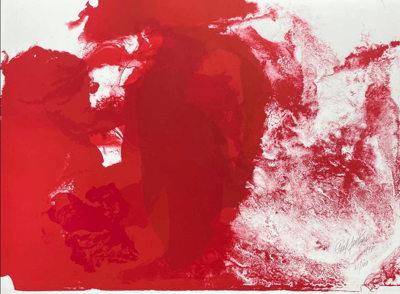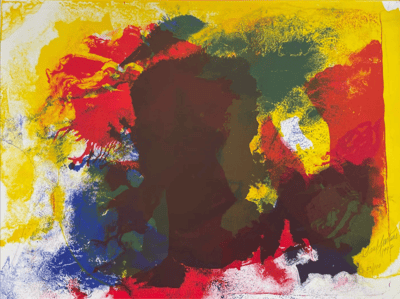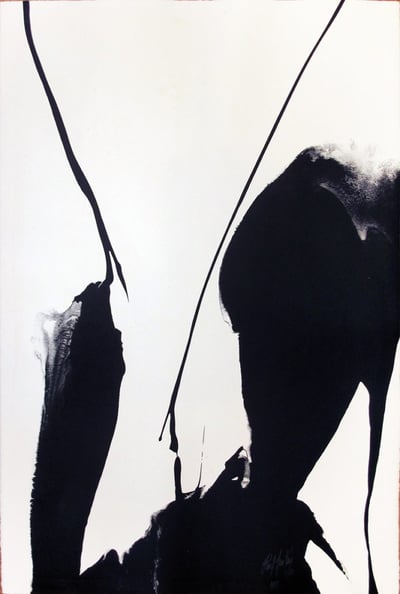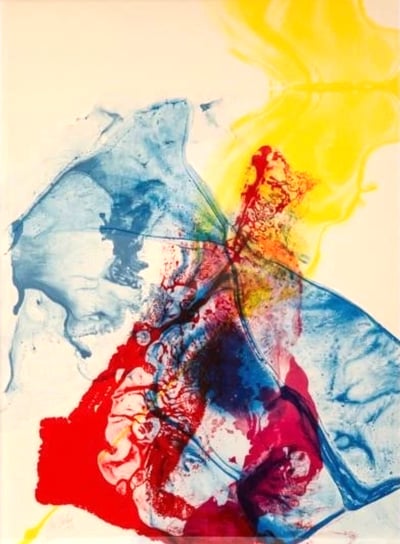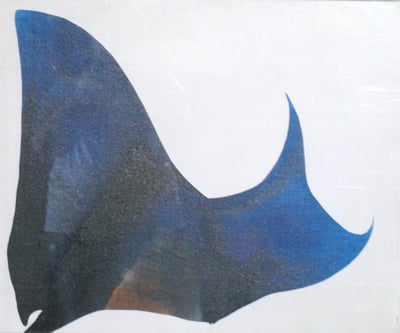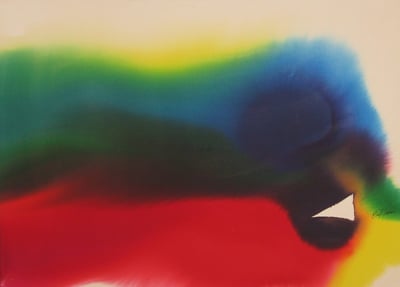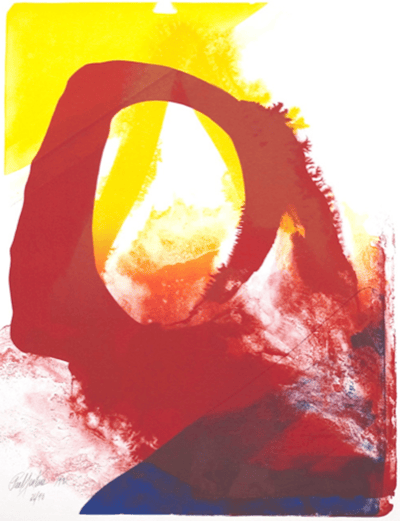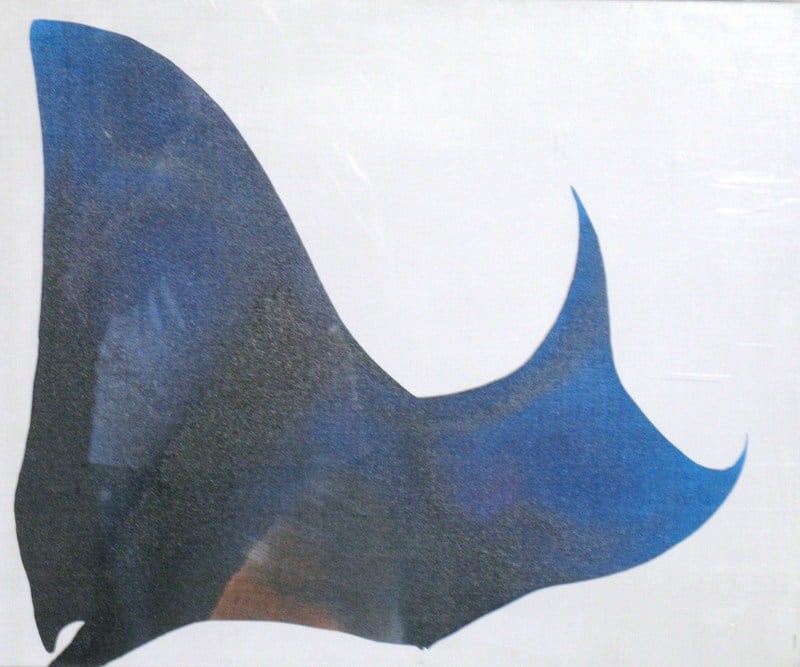
// Phenomena Wing Cut by Paul Jenkins is an oil painting on canvas that captures Jenkins' signature approach to fluid and expressive color. Painted in 1979, this work reflects his fascination with organic forms and dynamic movement. The composition features a large, abstract shape reminiscent of a wing or manta ray, rendered in deep blues and subtle hints of purple and brown. The smooth, sweeping lines and gradations of color suggest a sense of motion, as if the form is gliding gracefully across the canvas. Jenkins' technique, which often involves pouring and manipulating paint, gives the surface a mesmerizing texture, inviting the viewer to explore the interplay between light, color, and form.
Paul Jenkins (United States, 1923–2012) was an American abstract expressionist painter renowned for his vibrant, fluid paintings created through a unique paint-pouring technique. His 'Phenomena' series exemplifies his exploration of color and form, contributing significantly to post-war American abstraction.
Oil on canvasOil paint is a slow-drying type of paint made from pigment particles suspended in a drying oil, typically linseed oil. The viscosity of the paint can be adjusted by adding a solvent like turpentine, and varnish can be added to increase the glossiness of the dried paint film. Oil painting has been used since the 12th century in Europe, initially for decoration, but it was not widely adopted as a primary painting medium until the 15th century.
// Phenomena Wing Cut by Paul Jenkins is an oil painting on canvas that captures Jenkins' signature approach to fluid and expressive color. Painted in 1979, this work reflects his fascination with organic forms and dynamic movement. The composition features a large, abstract shape reminiscent of a wing or manta ray, rendered in deep blues and subtle hints of purple and brown. The smooth, sweeping lines and gradations of color suggest a sense of motion, as if the form is gliding gracefully across the canvas. Jenkins' technique, which often involves pouring and manipulating paint, gives the surface a mesmerizing texture, inviting the viewer to explore the interplay between light, color, and form.
Paul Jenkins (United States, 1923–2012) was an American abstract expressionist painter renowned for his vibrant, fluid paintings created through a unique paint-pouring technique. His 'Phenomena' series exemplifies his exploration of color and form, contributing significantly to post-war American abstraction.
I try to paint like a crapshooter throwing dice, utilizing past experience and my knowledge of the odds.
- Paul Jenkins
A painter of the abstract expressionist vein, Paul Jenkins is renowned for his unorthodox approach to paint application and control upon the canvas – he eventually ceased to use a paintbrush, and would instead manipulate his paint with the use of an ivory knife. Jenkins was initially inspired by the works of Jackson Pollock and Mark Tobey and took a great interest in eastern mysticism – a theme that permeated his work: always open to interpretation, rarely easy to make sweeping generalisations about. One of Jenkins most famous works, Phenomena Anderson, serves as a prime example of his ability to manipulate the outcome of the paint; his choice to abandon the paintbrush allowed him to coerce the paint into pooling or rolling across the canvas, creating fields of abstract colour. Jenkins began his working life in a ceramics factory, a job that always stayed with him and provided the inspiration for his substantial means of painting. (Artist website)
Abstract Expressionism is an art movement that emerged in the United States during the 1940s and 1950s. Characterized by large, abstract canvases, the movement emphasized spontaneous, expressive brushwork and the use of color and form to convey emotion rather than represent reality. Artists like Jackson Pollock, Mark Rothko, and Willem de Kooning are key figures in this movement. Abstract Expressionism marked a shift in the art world, making New York City a center of the international art scene.