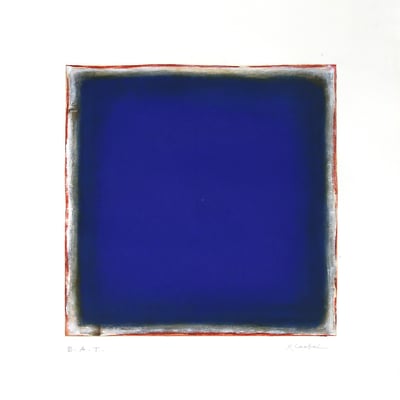
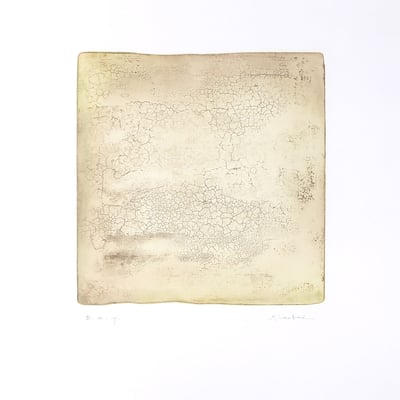
Su Xiaobai's Intellectual Aristocracy (2013) is a powerful etching that uses aquatint and carborundum to create a complex, textured surface. The work features a series of dark, overlapping panels with subtle variations in tone and texture, forming an abstract, layered composition. The restrained color palette, primarily dark with hints of rough, grey textures, gives the piece a sense of depth and quiet intensity. This limited edition print exudes a contemplative, almost architectural quality, inviting viewers to explore the intricate surface as if it were an ancient wall or weathered artifact. Su's technique, which emphasizes material and texture over form, reflects an approach that values the tactile experience and visual richness of the medium.
Su Xiaobai (China, 1949) is a contemporary artist known for his abstract works that explore color, texture, and form. After studying at the Kunstakademie Düsseldorf, he developed a unique style incorporating traditional Chinese lacquer techniques with modern abstraction. Su's art often reflects themes of existence and perception, bridging Eastern and Western artistic philosophies.
Etching, aquatint and carborundumEtching is a technique where a design is created on a metal surface by using a strong acid or mordant to eat away the unprotected parts of the metal, leaving the desired pattern in relief (intaglio). In modern art and manufacturing, different chemicals may be used depending on the material being etched.
Su Xiaobai's Intellectual Aristocracy (2013) is a powerful etching that uses aquatint and carborundum to create a complex, textured surface. The work features a series of dark, overlapping panels with subtle variations in tone and texture, forming an abstract, layered composition. The restrained color palette, primarily dark with hints of rough, grey textures, gives the piece a sense of depth and quiet intensity. This limited edition print exudes a contemplative, almost architectural quality, inviting viewers to explore the intricate surface as if it were an ancient wall or weathered artifact. Su's technique, which emphasizes material and texture over form, reflects an approach that values the tactile experience and visual richness of the medium.
Su Xiaobai (China, 1949) is a contemporary artist known for his abstract works that explore color, texture, and form. After studying at the Kunstakademie Düsseldorf, he developed a unique style incorporating traditional Chinese lacquer techniques with modern abstraction. Su's art often reflects themes of existence and perception, bridging Eastern and Western artistic philosophies.
My object is the surface layer presented on the painting.
- Xiaobai Su
Xiaobai Su, a sculptor, painter and printmaker, was born in the Republic of China. He studied art in Wuhan School of Arts and Craft in 1965, Wuhan School of Painting and Hubei Institute of Fine Arts. Later on in 1985, he joined the Beijing Central Academy of Fine Arts. He was awarded a scholarship to study in Germany in 1987 by the Dusseldorf Academy of Fine Arts where he undertook his graduate program. In 2003, Xiaobai Su moved back to china, and was inspired by a millennium-old plant material that acted as the symbol of Oriental culture. He was diverse in his painting tools experimenting on clay, oils, sack cloths, vines and even wood. Xiaobai Su's work after studying in Germany was deeply instigated by modernism and abstraction. Xiaobai Su was celebrated with an exhibition of his work from 2006-2010 at the National Taiwan Museum of Fine Arts.
Colour Field Painting is an abstract style characterized by large areas of a single color or simple, solid colors. The term was first used in the 1950s to describe the work of three American Abstract Expressionist painters—Barnett Newman, Mark Rothko, and Clyfford Still. Their work emphasized the emotional power of color and the creation of vast, meditative spaces through expansive color fields.