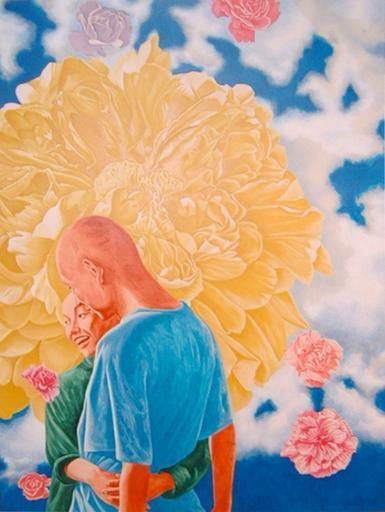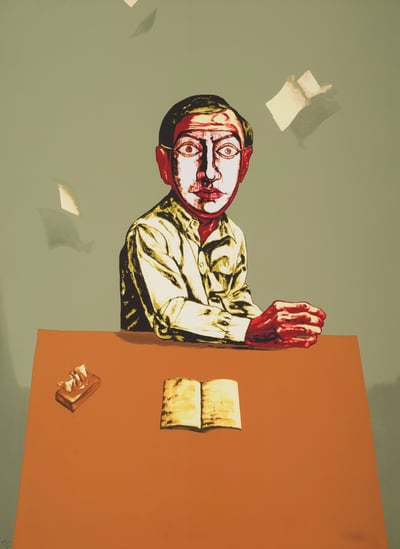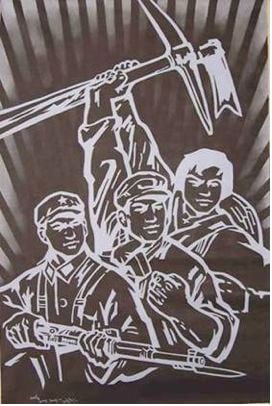
Yue Minjun (China, 1962) is a renowned contemporary artist celebrated for his satirical self-portraits featuring exaggerated laughter. His works, rooted in Cynical Realism, critique societal norms and political issues with humor and irony. Using bold colors and repetitive imagery, Yue’s paintings are iconic representations of post-Tiananmen Chinese art.
screenprintScreen printing is a technique where ink is transferred through a mesh onto a substrate, with areas blocked by a stencil to prevent ink from passing through. This method, also known as serigraphy or silkscreen printing, is commonly used to produce prints on posters, T-shirts, vinyl, stickers, wood, and other materials. The process is a type of stencil printing, allowing for vibrant, detailed designs on various surfaces.
Yue Minjun (China, 1962) is a renowned contemporary artist celebrated for his satirical self-portraits featuring exaggerated laughter. His works, rooted in Cynical Realism, critique societal norms and political issues with humor and irony. Using bold colors and repetitive imagery, Yue’s paintings are iconic representations of post-Tiananmen Chinese art.
I’m actually trying to make sense of the world.
- Yue Minjun
Yue Minjun is a contemporary Chinese artist who works in Beijing. He is most widely known for his oil paintings that show himself laughing in a variety of different settings. He has also copied this image in watercolor, prints and sculpture. Critics have labeled him a part of the "Cynical Realism" movement in China, although he has distanced himself from that group personally. Yue Minjun takes his inspiration from the work of Geng Jianyi, who had used his own laughing visage as a central focus in his work. Yue studied painting from 1985 to 1989 at Hebei Normal University. Yue Minjun’s work has appeared in many galleries in Beijing, Hong Kong and Singapore. His work Executiondrew the highest price of any Chinese contemporary artwork ever when it went for US$5.9 million at Sotheby's in London. By 2007, 13 of his paintings had sold for more than US$1 million. His "Hat" series remains one of his most widely admired.
Appropriation in art involves using pre-existing images or objects with little or no modification. This technique has played a significant role across various art forms, including visual arts, music, performance, and literature. In visual arts, appropriation refers to the practice of adopting, sampling, recycling, or borrowing elements—or even entire forms—of existing visual culture, integrating them into new works to create meaning or critique.