
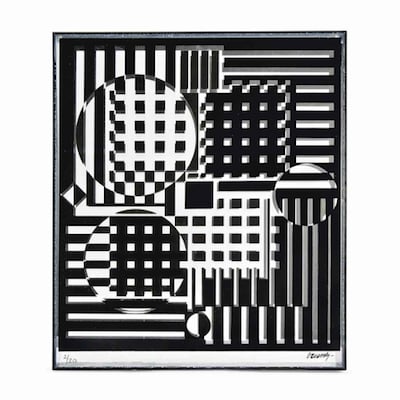
What is Op Art?
- Show All
- Established
- Discoveries
- Show All
Artworks Related to Op Art

Yaacov Agam
Geometric 3 Agam, c. 1975-1980
Limited Edition Print
Screen-print
EUR 2,900

Yaacov Agam
Star of Hope, Agamograph, 1975
Limited Edition Print
Screen-print
EUR 2,800

Julio Le Parc
Mobile Translucide Bleu, 2017
Sculpture / Object
Mixed Media
EUR 15,000

Yaacov Agam
Tactile painting, 2013
Digital Art
Mixed Media
EUR 3,000

Yaacov Agam
Night-Lights Prismagraph, 1991
Limited Edition Print
Mixed Media
EUR 5,900

Yaacov Agam
Magic Raindrops II
Limited Edition Print
Silkscreen
Currently Not Available

Carlos Cruz-Diez
Inducción Cromática a doble frecuencia Toledo., 2017
Limited Edition Print
Lithograph
Currently Not Available
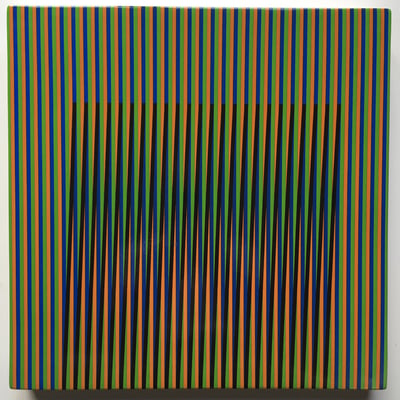
Carlos Cruz-Diez
Cerámico #4
Ceramics
Ceramic
EUR 12,000

Antonio Asis
Asistype 20 - boule sur cercle, 2016
Sculpture / Object
Monotype
EUR 3,500
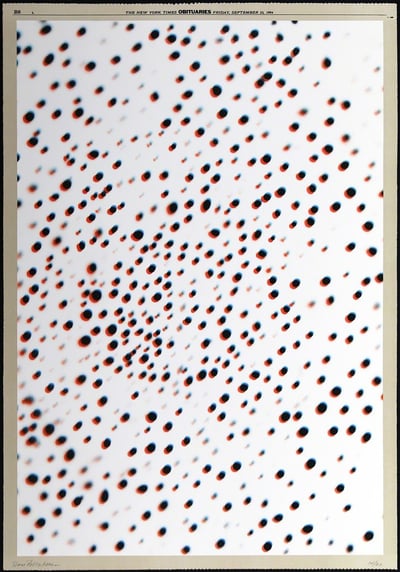
Ross Bleckner
September 23rd, 2016
Limited Edition Print
Lithograph
EUR 1,800
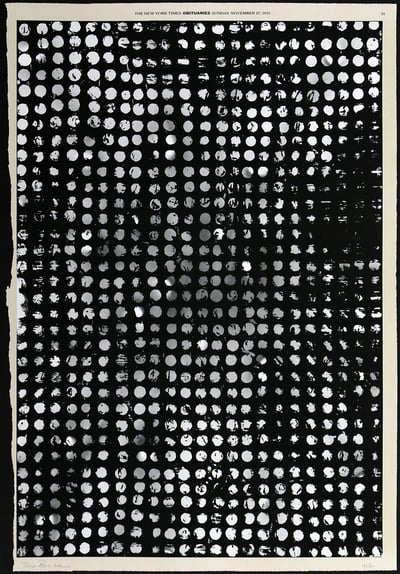
Ross Bleckner
November 27th, 2016
Limited Edition Print
Lithograph
EUR 1,800

Ross Bleckner
November 29th, 2016
Limited Edition Print
Lithograph
EUR 1,800

Dario Perez-Flores
Prochromatique yc1, 2013
Painting
Mixed Media
EUR 3,500

Francois Morellet
Ondes parasites 3, 2014
Limited Edition Print
Screen-print
EUR 2,150

Francois Morellet
Ondes parasites 2, 2014
Limited Edition Print
Screen-print
EUR 2,150

Francois Morellet
Ondes parasites 1, 2014
Limited Edition Print
Screen-print
EUR 2,150
Related Articles
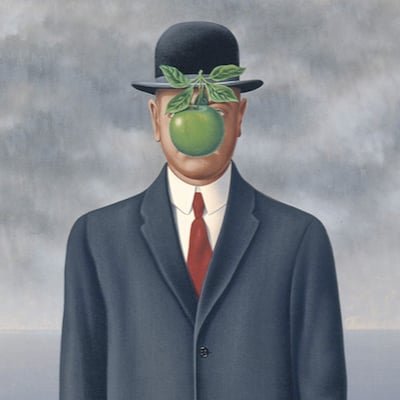
Surrealism began in the 1920s as an art and literary movement with the goal of revealing the unconscious mind and unleashing the imagination by exploring unusual and dream-like imagery. Influenced by Sigmund Freud’s theories of psychoanalysis, Surrealist artists and writers sought to bring the unconscious into rational life, blurring the lines between reality and dreams. The movement aimed to challenge conventional perceptions and express the irrational aspects of the human experience.

Emulation is the process of recreating digital art to ensure it remains accessible and functional, even when the original technology used to create it becomes obsolete. This is done by using newer technology to replicate the experience and functionality of the original artwork, preserving art made with early cameras, software, and computers.

Photography is the process of creating an image on light sensitive materials. The image is produced by using a camera, which has a lens that focuses on light either reflected or emitted from an object. These visible wavelengths are used to reproduce the image seen.
Can't find your Answer?
Thank you! Your question has been sent — we'll get back to you shortly.
