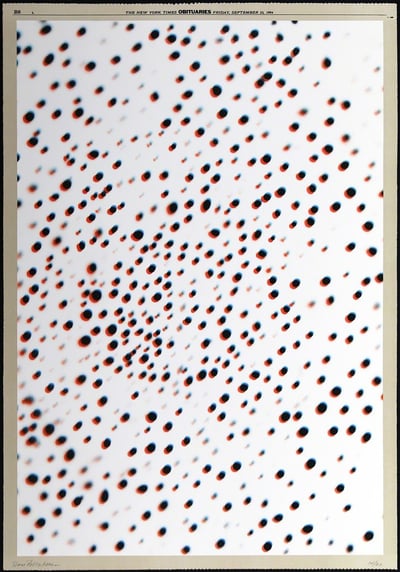
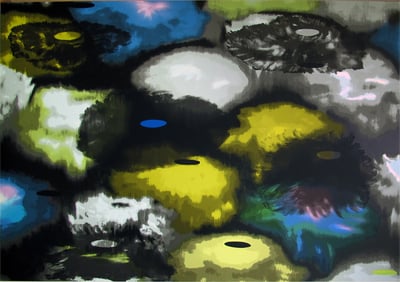
// September 23rd by Ross Bleckner, created in 2016, is a limited edition lithograph that employs an abstract approach to evoke a sense of depth and movement. The artwork features a pattern of dispersed dots in varying shades of red and black against a stark white background. These dots, arranged in a gradient-like formation, give the impression of floating or drifting across the surface, drawing the viewer’s eye into a seemingly infinite space. Bleckner’s work often contemplates themes of memory, loss, and the ephemeral, and this piece subtly suggests these concepts, perhaps hinting at transience and the passage of time.
Ross Bleckner (USA, 1949) is a contemporary painter celebrated for his ethereal, meditative works exploring memory, loss, and transcendence. Known for his use of light, blurred imagery, and recurring motifs like flowers and chandeliers, his art often bridges abstraction and representation. Bleckner's work reflects deep emotional resonance, with themes of mortality and healing.
LithographLithography is a printing method based on the principle that water and oil do not mix. It can be used to print artwork or text onto paper or other suitable materials. Traditionally, an image was drawn with wax, fat, or oil onto a lithographic limestone surface or plate. Today, metal plates and other surfaces are also used in lithographic printing.
Size
Inches
Centimeters
100 X 70 cm
Edition
Edition of 20
Price
USD
EUR
GBP
CHF
1,800EUR
?
+ VAT/import Duties (if applicable)
Authenticity Guaranteed
Insured Shipping
Online Since 2005
Share
●Inventory 3609
●Signed
●Comes with gallery invoice and certificate
●Any questions?
// September 23rd by Ross Bleckner, created in 2016, is a limited edition lithograph that employs an abstract approach to evoke a sense of depth and movement. The artwork features a pattern of dispersed dots in varying shades of red and black against a stark white background. These dots, arranged in a gradient-like formation, give the impression of floating or drifting across the surface, drawing the viewer’s eye into a seemingly infinite space. Bleckner’s work often contemplates themes of memory, loss, and the ephemeral, and this piece subtly suggests these concepts, perhaps hinting at transience and the passage of time.
Ross Bleckner (USA, 1949) is a contemporary painter celebrated for his ethereal, meditative works exploring memory, loss, and transcendence. Known for his use of light, blurred imagery, and recurring motifs like flowers and chandeliers, his art often bridges abstraction and representation. Bleckner's work reflects deep emotional resonance, with themes of mortality and healing.
I see my studio like a laboratory, where I work like an investigator - it's almost forensic. I love the discovery process in painting.
- Ross Bleckner
Known for his large-scale, evocative and immersive paintings, Ross Bleckner is an artist whose work blends abstraction and recognisable motifs to create a final result that analyses the notions of transcendence and perception. Central to a lot of Bleckner’s work was human disease, notably AIDS – such paintings as 8,122+ are so titled to reflect the number of people who had died of AIDS up until that point in history. His Cell paintings are another series that highlights the condition of the diseased human body – the series of paintings was comprised of several volumetric, multi-coloured circles or ‘cells’ against a dark, gray background; the final result looked like molecules or droplet of bloods viewed under the microscope. Although Bleckner’s work focuses on disease and ultimately death, he has stated that he does no find it to be morbid, but more of a study on life and the ups and downs of death - “we’re born, we live, we die.” (Artist website)
Op Art is a visual art style that uses optical illusions to create the impression of movement, vibrating patterns, flashing, or hidden images. The works are typically abstract, with many well-known pieces in black and white. The roots of Op Art can be traced back to earlier movements like Futurism, Constructivism, Dada, and Neo-Impressionism, particularly in their use of color effects and graphic design.