Oil, Wax, Encaustic on canvas.
Signed and Dated on Reverse.
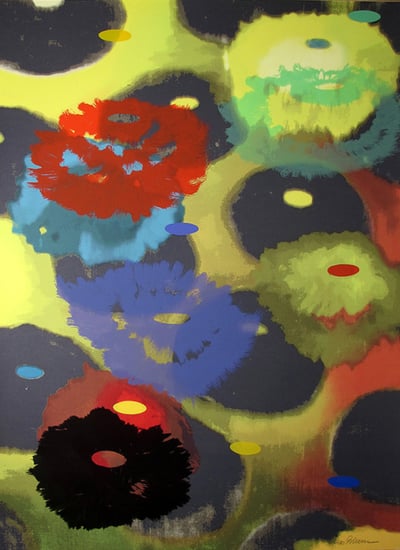
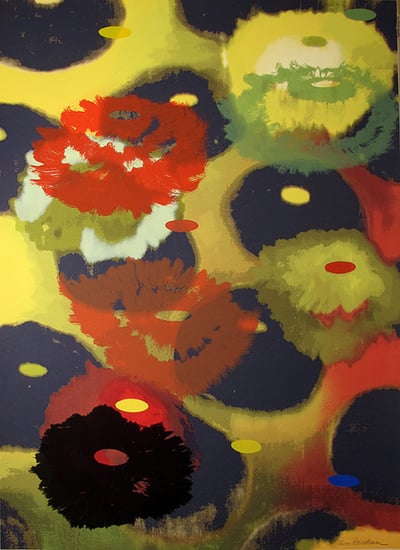
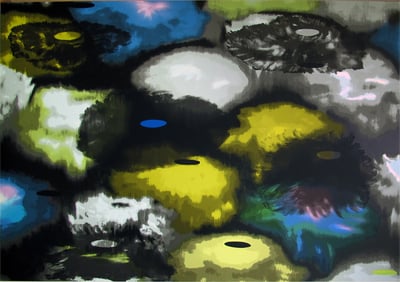
Untitled (2001) by Ross Bleckner is a 36 x 36 inch canvas executed in oil, wax, and encaustic, a medium that imparts both luminosity and texture. The composition features an array of glowing, spherical forms in vibrant reds, yellows, blues, greens, and silvers, floating against a white background. These biomorphic orbs—some overlapping, some isolated—evoke cellular structures, molecules, or celestial bodies, inviting interpretations that range from the microscopic to the cosmic. Bleckner, known for blending abstraction with metaphorical depth, often explores themes of memory, fragility, and regeneration. This painting, signed and dated on the reverse, exemplifies his meditative and subtly scientific visual language.
Ross Bleckner (USA, 1949) is a contemporary painter celebrated for his ethereal, meditative works exploring memory, loss, and transcendence. Known for his use of light, blurred imagery, and recurring motifs like flowers and chandeliers, his art often bridges abstraction and representation. Bleckner's work reflects deep emotional resonance, with themes of mortality and healing.
Mixed MediaMixed media refers to artwork that incorporates more than one medium within a single piece. Unlike multimedia art, which combines distinct forms of visual art and often includes elements like sound, video, or digital media, mixed media focuses on combining traditional art materials, such as paint, ink, and collage. Mixed media art allows artists to achieve a wide range of effects and textures by layering and blending different materials.
Oil, Wax, Encaustic on canvas.
Signed and Dated on Reverse.
Untitled (2001) by Ross Bleckner is a 36 x 36 inch canvas executed in oil, wax, and encaustic, a medium that imparts both luminosity and texture. The composition features an array of glowing, spherical forms in vibrant reds, yellows, blues, greens, and silvers, floating against a white background. These biomorphic orbs—some overlapping, some isolated—evoke cellular structures, molecules, or celestial bodies, inviting interpretations that range from the microscopic to the cosmic. Bleckner, known for blending abstraction with metaphorical depth, often explores themes of memory, fragility, and regeneration. This painting, signed and dated on the reverse, exemplifies his meditative and subtly scientific visual language.
Ross Bleckner (USA, 1949) is a contemporary painter celebrated for his ethereal, meditative works exploring memory, loss, and transcendence. Known for his use of light, blurred imagery, and recurring motifs like flowers and chandeliers, his art often bridges abstraction and representation. Bleckner's work reflects deep emotional resonance, with themes of mortality and healing.
I see my studio like a laboratory, where I work like an investigator - it's almost forensic. I love the discovery process in painting.
- Ross Bleckner
Known for his large-scale, evocative and immersive paintings, Ross Bleckner is an artist whose work blends abstraction and recognisable motifs to create a final result that analyses the notions of transcendence and perception. Central to a lot of Bleckner’s work was human disease, notably AIDS – such paintings as 8,122+ are so titled to reflect the number of people who had died of AIDS up until that point in history. His Cell paintings are another series that highlights the condition of the diseased human body – the series of paintings was comprised of several volumetric, multi-coloured circles or ‘cells’ against a dark, gray background; the final result looked like molecules or droplet of bloods viewed under the microscope. Although Bleckner’s work focuses on disease and ultimately death, he has stated that he does no find it to be morbid, but more of a study on life and the ups and downs of death - “we’re born, we live, we die.” (Artist website)
Contemporary art refers to avant-garde or innovative art created in the recent past or present day. The exact starting point of contemporary art varies depending on the institution, often tied to the founding year of museums or galleries that showcase the style. Contemporary art is characterized by its focus on current ideas, diverse media, and the exploration of new concepts and techniques.