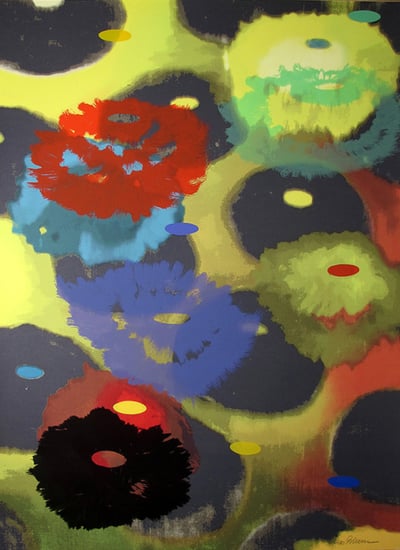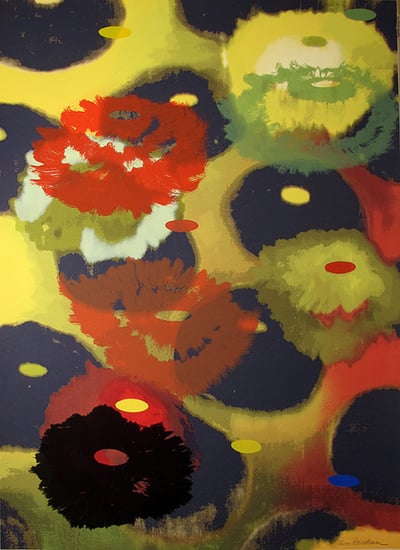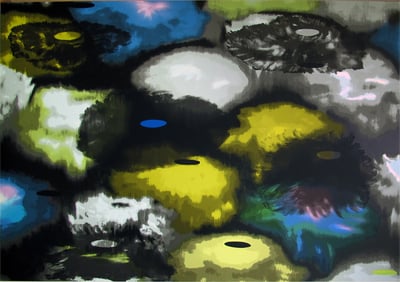
This 17-color screenprint was created by the artist in 1997. Signed in pencil and numbered, from the edition of 75 measuring 42 X 32 in. (106.7 x 81.3 cm.)
Happiness For Instance I by Ross Bleckner, produced in 1997, is a 17-color screen print that captures a contemplative, almost meditative quality through abstract forms and muted colors. The composition features overlapping circular shapes in shades of lavender, black, grey, and hints of yellow, some of which appear translucent, creating a layered, floating effect. The forms resemble blurred orbs or cells, adding a sense of organic fluidity. Bleckner’s work often delves into themes of memory and the ephemeral nature of life, and this piece invites viewers to explore the delicate interplay between clarity and ambiguity. Signed and numbered by the artist, this print is part of a limited edition of 75 and measures 42 x 32 inches.
Ross Bleckner (USA, 1949) is a contemporary painter celebrated for his ethereal, meditative works exploring memory, loss, and transcendence. Known for his use of light, blurred imagery, and recurring motifs like flowers and chandeliers, his art often bridges abstraction and representation. Bleckner's work reflects deep emotional resonance, with themes of mortality and healing.
ScreenprintScreen printing is a technique where ink is transferred through a mesh onto a substrate, with areas blocked by a stencil to prevent ink from passing through. This method, also known as serigraphy or silkscreen printing, is commonly used to produce prints on posters, T-shirts, vinyl, stickers, wood, and other materials. The process is a type of stencil printing, allowing for vibrant, detailed designs on various surfaces.
This 17-color screenprint was created by the artist in 1997. Signed in pencil and numbered, from the edition of 75 measuring 42 X 32 in. (106.7 x 81.3 cm.)
Happiness For Instance I by Ross Bleckner, produced in 1997, is a 17-color screen print that captures a contemplative, almost meditative quality through abstract forms and muted colors. The composition features overlapping circular shapes in shades of lavender, black, grey, and hints of yellow, some of which appear translucent, creating a layered, floating effect. The forms resemble blurred orbs or cells, adding a sense of organic fluidity. Bleckner’s work often delves into themes of memory and the ephemeral nature of life, and this piece invites viewers to explore the delicate interplay between clarity and ambiguity. Signed and numbered by the artist, this print is part of a limited edition of 75 and measures 42 x 32 inches.
Ross Bleckner (USA, 1949) is a contemporary painter celebrated for his ethereal, meditative works exploring memory, loss, and transcendence. Known for his use of light, blurred imagery, and recurring motifs like flowers and chandeliers, his art often bridges abstraction and representation. Bleckner's work reflects deep emotional resonance, with themes of mortality and healing.
I see my studio like a laboratory, where I work like an investigator - it's almost forensic. I love the discovery process in painting.
- Ross Bleckner
Known for his large-scale, evocative and immersive paintings, Ross Bleckner is an artist whose work blends abstraction and recognisable motifs to create a final result that analyses the notions of transcendence and perception. Central to a lot of Bleckner’s work was human disease, notably AIDS – such paintings as 8,122+ are so titled to reflect the number of people who had died of AIDS up until that point in history. His Cell paintings are another series that highlights the condition of the diseased human body – the series of paintings was comprised of several volumetric, multi-coloured circles or ‘cells’ against a dark, gray background; the final result looked like molecules or droplet of bloods viewed under the microscope. Although Bleckner’s work focuses on disease and ultimately death, he has stated that he does no find it to be morbid, but more of a study on life and the ups and downs of death - “we’re born, we live, we die.” (Artist website)
Sometimes referred to as Conceptualism, this is an art form where the idea(s) or concept(s) behind the work take precedence over material concerns and traditional aesthetics. Many conceptual artworks can be created by anyone simply by following written instructions. The concept or idea is the most essential aspect of the artwork.