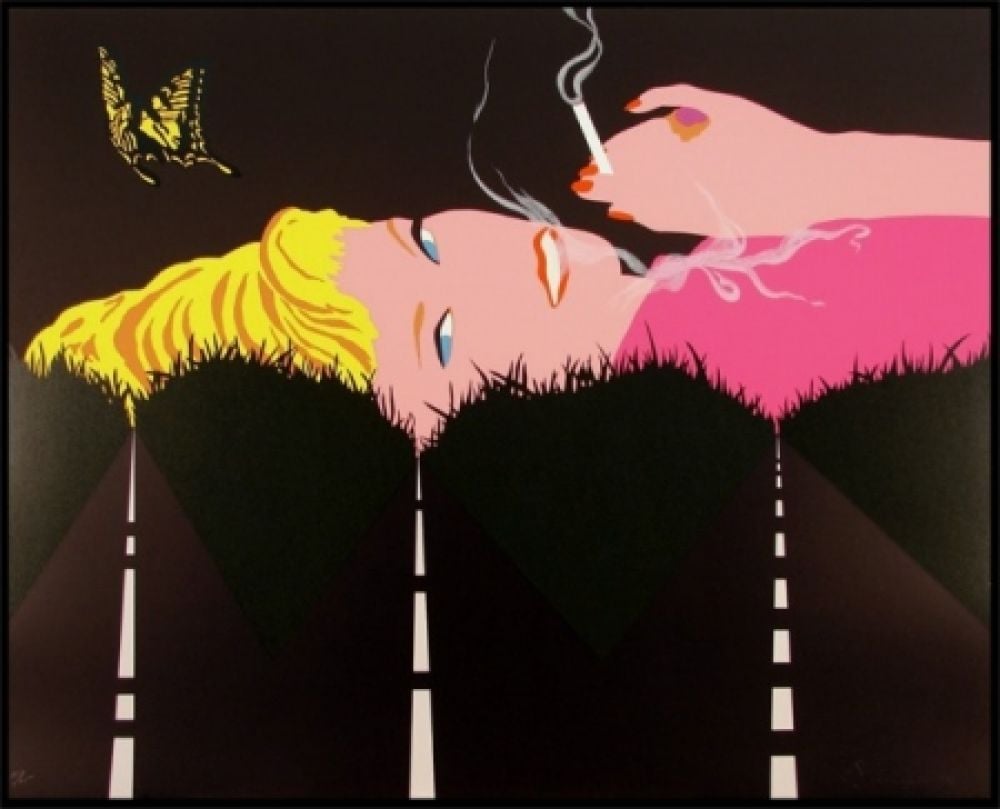
SMOKING BLONDE, 1990, color screenprint, signed in pencil, from the numbered edition of 65, sheet 37 ½ x 47”, In Perfect Condition
Smoking Blond by Allan D'Arcangelo is a 1990 serigraph that encapsulates a blend of pop art aesthetics and symbolic Americana. The composition features a reclining blonde woman, her head resting in the foreground while she smokes a cigarette, her gaze directed upward in a contemplative manner. The scene is framed by a dark road receding into the background, divided by white dashed lines, symbolizing a journey or passage. The surreal touch of a butterfly floating near her head adds a delicate contrast to the otherwise bold and graphic style. The colors are striking, with the bright yellow of her hair and the pink of her skin set against the deep blacks and greens of the landscape. This work embodies themes of escapism, introspection, and the transient nature of life, with the open road representing both freedom and the unknown. D'Arcangelo's style and use of sharp lines reflect the influence of pop art, merging everyday imagery with deeper, reflective undertones.
Allan D’Arcangelo (USA, 1930–1998) was a prominent painter known for his striking depictions of American highways, road signs, and landscapes. Associated with Pop Art, his works blend bold graphic elements with themes of modernity and isolation. D’Arcangelo’s unique style captures the essence of 20th-century American culture and its symbols.
Serigraph Serigraph is a printmaking process that uses silk screen techniques to create an image. The image is digitally separated into individual colors, each of which is assigned to a separate silk screen. These screens are then used to apply each color by hand, layer by layer, to replicate the original artwork, often based on an oil painting.
SMOKING BLONDE, 1990, color screenprint, signed in pencil, from the numbered edition of 65, sheet 37 ½ x 47”, In Perfect Condition
Smoking Blond by Allan D'Arcangelo is a 1990 serigraph that encapsulates a blend of pop art aesthetics and symbolic Americana. The composition features a reclining blonde woman, her head resting in the foreground while she smokes a cigarette, her gaze directed upward in a contemplative manner. The scene is framed by a dark road receding into the background, divided by white dashed lines, symbolizing a journey or passage. The surreal touch of a butterfly floating near her head adds a delicate contrast to the otherwise bold and graphic style. The colors are striking, with the bright yellow of her hair and the pink of her skin set against the deep blacks and greens of the landscape. This work embodies themes of escapism, introspection, and the transient nature of life, with the open road representing both freedom and the unknown. D'Arcangelo's style and use of sharp lines reflect the influence of pop art, merging everyday imagery with deeper, reflective undertones.
Allan D’Arcangelo (USA, 1930–1998) was a prominent painter known for his striking depictions of American highways, road signs, and landscapes. Associated with Pop Art, his works blend bold graphic elements with themes of modernity and isolation. D’Arcangelo’s unique style captures the essence of 20th-century American culture and its symbols.
My most profound experiences of landscape were looking through the windshield.
- Allan D'Arcangelo
Allan D'Arcangelo was an American artist and printmaker who was part of the Pop Art movement. Like other Pop artists, he drew his inspiration from the cultural (and, in his case, often literal) landscape. His best known works are acrylic paintings of highway imagery, including iconic roads (such as Route 66), street signs, and road barriers. These pieces in particular demonstrate his "hard edge," or constructivist, style, in which Allan used bold colors and sharp geometrical figures to transform deep perspective fields into stark and simplified two-dimensional images. With this technique he was able to both portray and transcend spatial relationships, allowing the images to be experienced as representative of both direct experience and more general symbolism. Allan D'Arcangelo's work was included in a number of important Pop Art exhibitions, including Mixed Media and Pop Art at the Albright-Knox Museum in 1963. His paintings are in the permanent collections of a number of museums, such as the Tate Britain in London and the Whitney Museum of American Art in New York. (Artist website)
Appropriation in art involves using pre-existing images or objects with little or no modification. This technique has played a significant role across various art forms, including visual arts, music, performance, and literature. In visual arts, appropriation refers to the practice of adopting, sampling, recycling, or borrowing elements—or even entire forms—of existing visual culture, integrating them into new works to create meaning or critique.