Edition of PrintersProof2 + 1AP - Hand Printed Stone Lithograph - Hand-signed by artist - In excellent condition
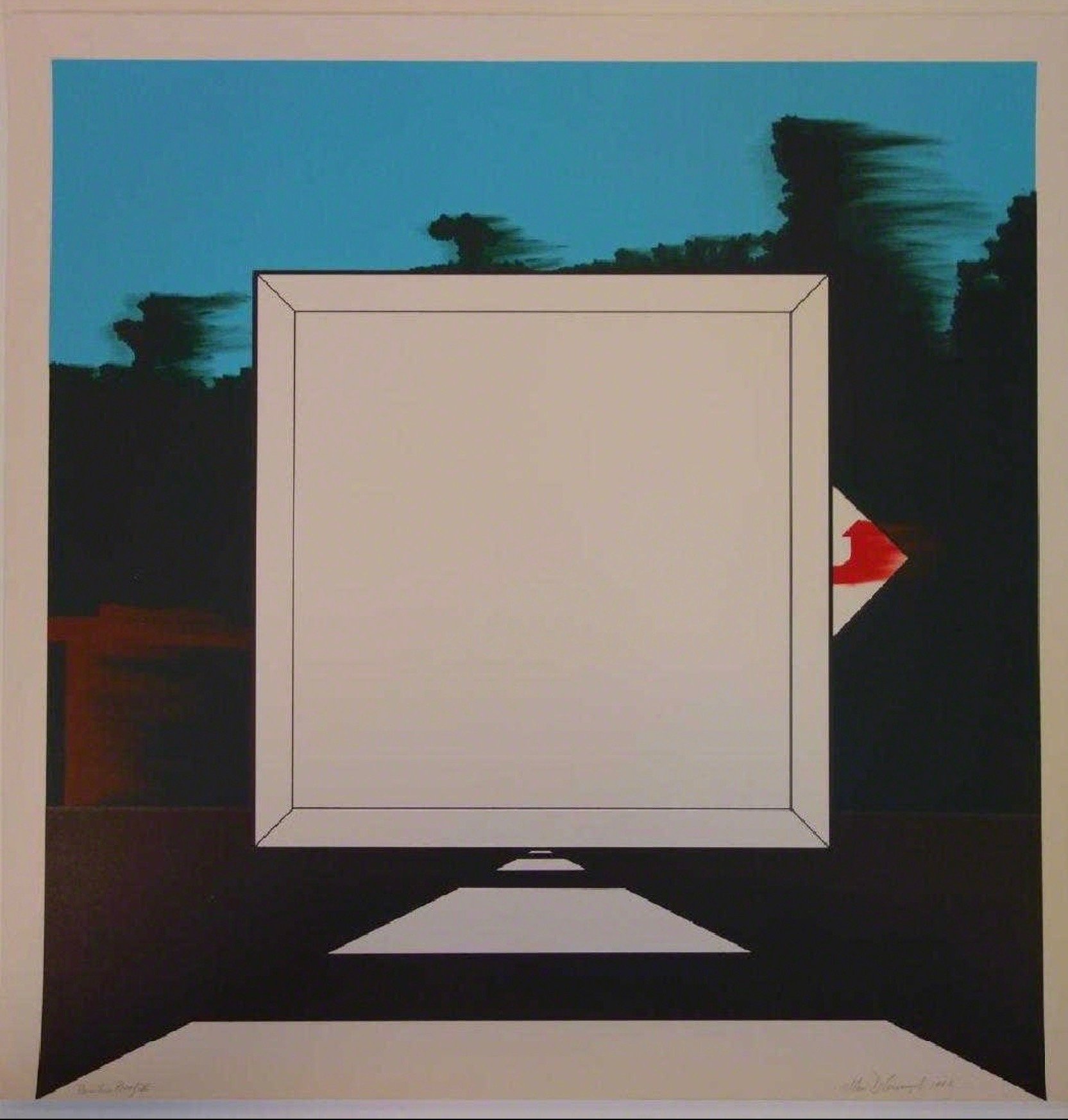
This untitled lithograph by Allan D'Arcangelo, created in 1966, is a minimalist and surreal exploration of form and perspective. The central element is a large, white geometric square that resembles a highway sign or road barrier, set against a dark roadway that recedes into the distance. The scene is framed by a sky of vibrant blue with blurred trees or landscape elements in the background, suggesting motion or a fleeting moment. A red triangular shape, partially obscured and cutting into the white square, adds a striking contrast and focal point to the composition. D'Arcangelo’s work often explores themes of American highways and landscapes, transforming familiar road signs into symbolic, almost abstract forms. This lithograph captures a sense of stillness within movement, invoking a meditative reflection on travel and the open road.
Allan D’Arcangelo (USA, 1930–1998) was a prominent painter known for his striking depictions of American highways, road signs, and landscapes. Associated with Pop Art, his works blend bold graphic elements with themes of modernity and isolation. D’Arcangelo’s unique style captures the essence of 20th-century American culture and its symbols.
Lithograph Lithography is a printing method based on the principle that water and oil do not mix. It can be used to print artwork or text onto paper or other suitable materials. Traditionally, an image was drawn with wax, fat, or oil onto a lithographic limestone surface or plate. Today, metal plates and other surfaces are also used in lithographic printing.
Edition of PrintersProof2 + 1AP - Hand Printed Stone Lithograph - Hand-signed by artist - In excellent condition
This untitled lithograph by Allan D'Arcangelo, created in 1966, is a minimalist and surreal exploration of form and perspective. The central element is a large, white geometric square that resembles a highway sign or road barrier, set against a dark roadway that recedes into the distance. The scene is framed by a sky of vibrant blue with blurred trees or landscape elements in the background, suggesting motion or a fleeting moment. A red triangular shape, partially obscured and cutting into the white square, adds a striking contrast and focal point to the composition. D'Arcangelo’s work often explores themes of American highways and landscapes, transforming familiar road signs into symbolic, almost abstract forms. This lithograph captures a sense of stillness within movement, invoking a meditative reflection on travel and the open road.
Allan D’Arcangelo (USA, 1930–1998) was a prominent painter known for his striking depictions of American highways, road signs, and landscapes. Associated with Pop Art, his works blend bold graphic elements with themes of modernity and isolation. D’Arcangelo’s unique style captures the essence of 20th-century American culture and its symbols.
My most profound experiences of landscape were looking through the windshield.
- Allan D'Arcangelo
Allan D'Arcangelo was an American artist and printmaker who was part of the Pop Art movement. Like other Pop artists, he drew his inspiration from the cultural (and, in his case, often literal) landscape. His best known works are acrylic paintings of highway imagery, including iconic roads (such as Route 66), street signs, and road barriers. These pieces in particular demonstrate his "hard edge," or constructivist, style, in which Allan used bold colors and sharp geometrical figures to transform deep perspective fields into stark and simplified two-dimensional images. With this technique he was able to both portray and transcend spatial relationships, allowing the images to be experienced as representative of both direct experience and more general symbolism. Allan D'Arcangelo's work was included in a number of important Pop Art exhibitions, including Mixed Media and Pop Art at the Albright-Knox Museum in 1963. His paintings are in the permanent collections of a number of museums, such as the Tate Britain in London and the Whitney Museum of American Art in New York. (Artist website)
Appropriation in art involves using pre-existing images or objects with little or no modification. This technique has played a significant role across various art forms, including visual arts, music, performance, and literature. In visual arts, appropriation refers to the practice of adopting, sampling, recycling, or borrowing elements—or even entire forms—of existing visual culture, integrating them into new works to create meaning or critique.