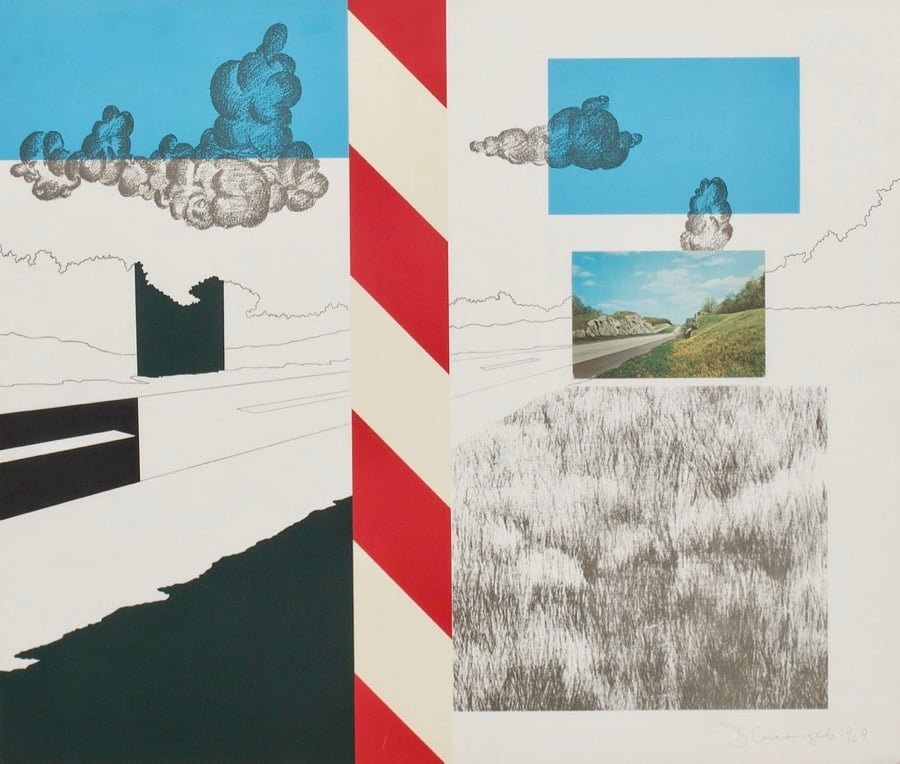
Color Screenprint with Collaged Postcard - Signed and dated lower right in the artists hand in pencil - numbered lower left in the black area
Super Highway by Allan D'Arcangelo, created in 1969, is a vibrant and complex screenprint that captures the aesthetics of American roadways and the expansive landscape. The composition juxtaposes various elements: a red-and-white diagonal stripe that bisects the piece, a series of outlined clouds against blue skies, and collaged postcard images of a highway and countryside. The structured lines and blocks of color give the piece a graphic quality, emphasizing the geometry of roads and highways. The mix of natural and man-made imagery reflects D'Arcangelo’s interest in the cultural significance of the American highway as both a literal and metaphorical path through the landscape. This work speaks to themes of movement, travel, and the intersection of nature and infrastructure, capturing the essence of mid-20th-century American life.
Allan D’Arcangelo (USA, 1930–1998) was a prominent painter known for his striking depictions of American highways, road signs, and landscapes. Associated with Pop Art, his works blend bold graphic elements with themes of modernity and isolation. D’Arcangelo’s unique style captures the essence of 20th-century American culture and its symbols.
Silkscreen Silkscreen is a printmaking method that uses a screen made of silk or other mesh fabric. The screen is treated with a substance that blocks ink in certain areas, allowing ink to pass through only in the desired sections. Each color in the print requires a separate screen.
Color Screenprint with Collaged Postcard - Signed and dated lower right in the artists hand in pencil - numbered lower left in the black area
Super Highway by Allan D'Arcangelo, created in 1969, is a vibrant and complex screenprint that captures the aesthetics of American roadways and the expansive landscape. The composition juxtaposes various elements: a red-and-white diagonal stripe that bisects the piece, a series of outlined clouds against blue skies, and collaged postcard images of a highway and countryside. The structured lines and blocks of color give the piece a graphic quality, emphasizing the geometry of roads and highways. The mix of natural and man-made imagery reflects D'Arcangelo’s interest in the cultural significance of the American highway as both a literal and metaphorical path through the landscape. This work speaks to themes of movement, travel, and the intersection of nature and infrastructure, capturing the essence of mid-20th-century American life.
Allan D’Arcangelo (USA, 1930–1998) was a prominent painter known for his striking depictions of American highways, road signs, and landscapes. Associated with Pop Art, his works blend bold graphic elements with themes of modernity and isolation. D’Arcangelo’s unique style captures the essence of 20th-century American culture and its symbols.
My most profound experiences of landscape were looking through the windshield.
- Allan D'Arcangelo
Allan D'Arcangelo was an American artist and printmaker who was part of the Pop Art movement. Like other Pop artists, he drew his inspiration from the cultural (and, in his case, often literal) landscape. His best known works are acrylic paintings of highway imagery, including iconic roads (such as Route 66), street signs, and road barriers. These pieces in particular demonstrate his "hard edge," or constructivist, style, in which Allan used bold colors and sharp geometrical figures to transform deep perspective fields into stark and simplified two-dimensional images. With this technique he was able to both portray and transcend spatial relationships, allowing the images to be experienced as representative of both direct experience and more general symbolism. Allan D'Arcangelo's work was included in a number of important Pop Art exhibitions, including Mixed Media and Pop Art at the Albright-Knox Museum in 1963. His paintings are in the permanent collections of a number of museums, such as the Tate Britain in London and the Whitney Museum of American Art in New York. (Artist website)
Hard Edge art is a style of abstract painting that became popular in the 1960s. It features areas of color separated by crisp, sharp edges that are painted with geometric precision. The term hard-edge painting was coined by art critic Jules Langsner to describe this approach, which contrasts with the softer, more fluid forms of other abstract styles.