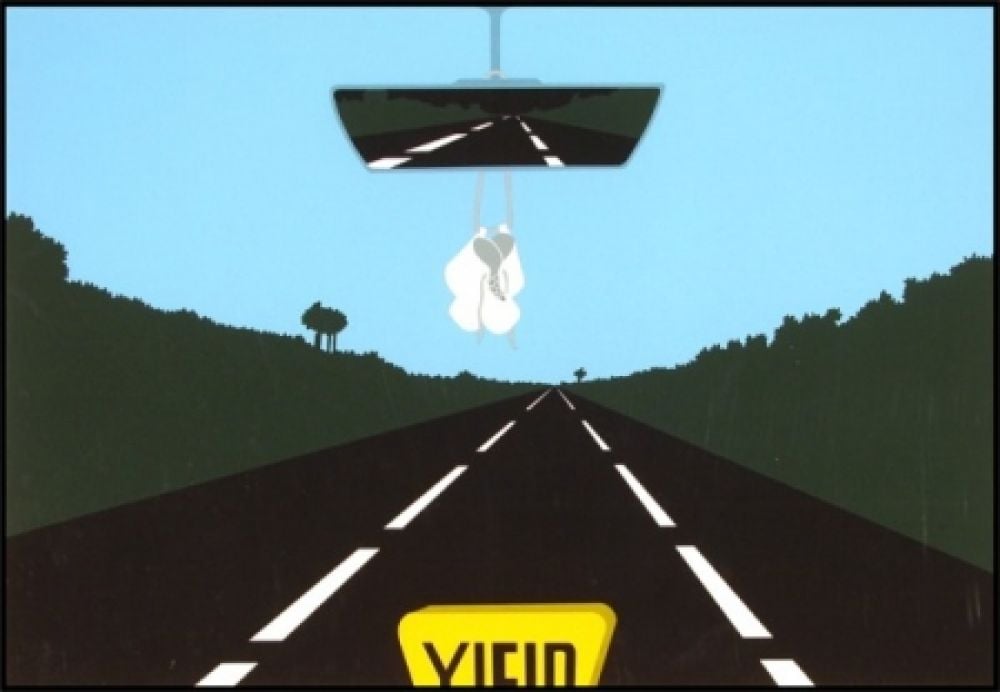
The Holy Family by Allan D'Arcangelo is a 1980 serigraph that juxtaposes minimalistic road imagery with a hint of symbolic interpretation. The artwork presents an open road stretching towards a distant horizon, framed by silhouettes of trees under a clear blue sky. A “YIELD” sign is prominently displayed in the lower foreground, adding a note of caution. Above the road, a rearview mirror hangs, reflecting the road behind and featuring a pair of dangling air fresheners shaped like hearts—a subtle, perhaps ironic reference to the concept of The Holy Family. D'Arcangelo’s use of sharp, clean lines and a simplified color palette lends the piece a calm, meditative quality, while also alluding to the themes of journey, nostalgia, and reflection. The interplay between the road as a symbol of life’s path and the invocation of familial love or guidance invites viewers to consider the delicate balance between direction and caution in their own lives.
Allan D’Arcangelo (USA, 1930–1998) was a prominent painter known for his striking depictions of American highways, road signs, and landscapes. Associated with Pop Art, his works blend bold graphic elements with themes of modernity and isolation. D’Arcangelo’s unique style captures the essence of 20th-century American culture and its symbols.
Serigraph Serigraph is a printmaking process that uses silk screen techniques to create an image. The image is digitally separated into individual colors, each of which is assigned to a separate silk screen. These screens are then used to apply each color by hand, layer by layer, to replicate the original artwork, often based on an oil painting.
The Holy Family by Allan D'Arcangelo is a 1980 serigraph that juxtaposes minimalistic road imagery with a hint of symbolic interpretation. The artwork presents an open road stretching towards a distant horizon, framed by silhouettes of trees under a clear blue sky. A “YIELD” sign is prominently displayed in the lower foreground, adding a note of caution. Above the road, a rearview mirror hangs, reflecting the road behind and featuring a pair of dangling air fresheners shaped like hearts—a subtle, perhaps ironic reference to the concept of The Holy Family. D'Arcangelo’s use of sharp, clean lines and a simplified color palette lends the piece a calm, meditative quality, while also alluding to the themes of journey, nostalgia, and reflection. The interplay between the road as a symbol of life’s path and the invocation of familial love or guidance invites viewers to consider the delicate balance between direction and caution in their own lives.
Allan D’Arcangelo (USA, 1930–1998) was a prominent painter known for his striking depictions of American highways, road signs, and landscapes. Associated with Pop Art, his works blend bold graphic elements with themes of modernity and isolation. D’Arcangelo’s unique style captures the essence of 20th-century American culture and its symbols.
My most profound experiences of landscape were looking through the windshield.
- Allan D'Arcangelo
Allan D'Arcangelo was an American artist and printmaker who was part of the Pop Art movement. Like other Pop artists, he drew his inspiration from the cultural (and, in his case, often literal) landscape. His best known works are acrylic paintings of highway imagery, including iconic roads (such as Route 66), street signs, and road barriers. These pieces in particular demonstrate his "hard edge," or constructivist, style, in which Allan used bold colors and sharp geometrical figures to transform deep perspective fields into stark and simplified two-dimensional images. With this technique he was able to both portray and transcend spatial relationships, allowing the images to be experienced as representative of both direct experience and more general symbolism. Allan D'Arcangelo's work was included in a number of important Pop Art exhibitions, including Mixed Media and Pop Art at the Albright-Knox Museum in 1963. His paintings are in the permanent collections of a number of museums, such as the Tate Britain in London and the Whitney Museum of American Art in New York. (Artist website)
Minimalism is a style in music and visual arts characterized by pared-down designs and simplicity. It began in Western art after World War II, gaining prominence particularly in American visual arts. Minimalism draws heavily on aspects of modernism and is often viewed as a reaction against Abstract Expressionism, as well as a precursor to post-minimal art practices. Prominent minimalist artists include Agnes Martin, Donald Judd, Robert Morris, Frank Stella, and Dan Flavin.