Screenprint on paper.
Unsigned, stamped by artist’s estate. Hand-numbered with Banksy’s stamp.
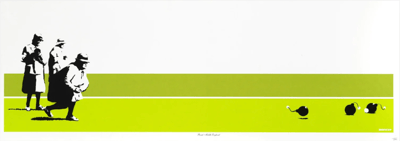
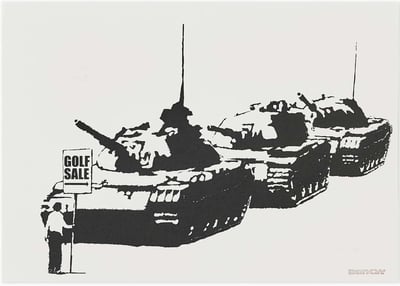
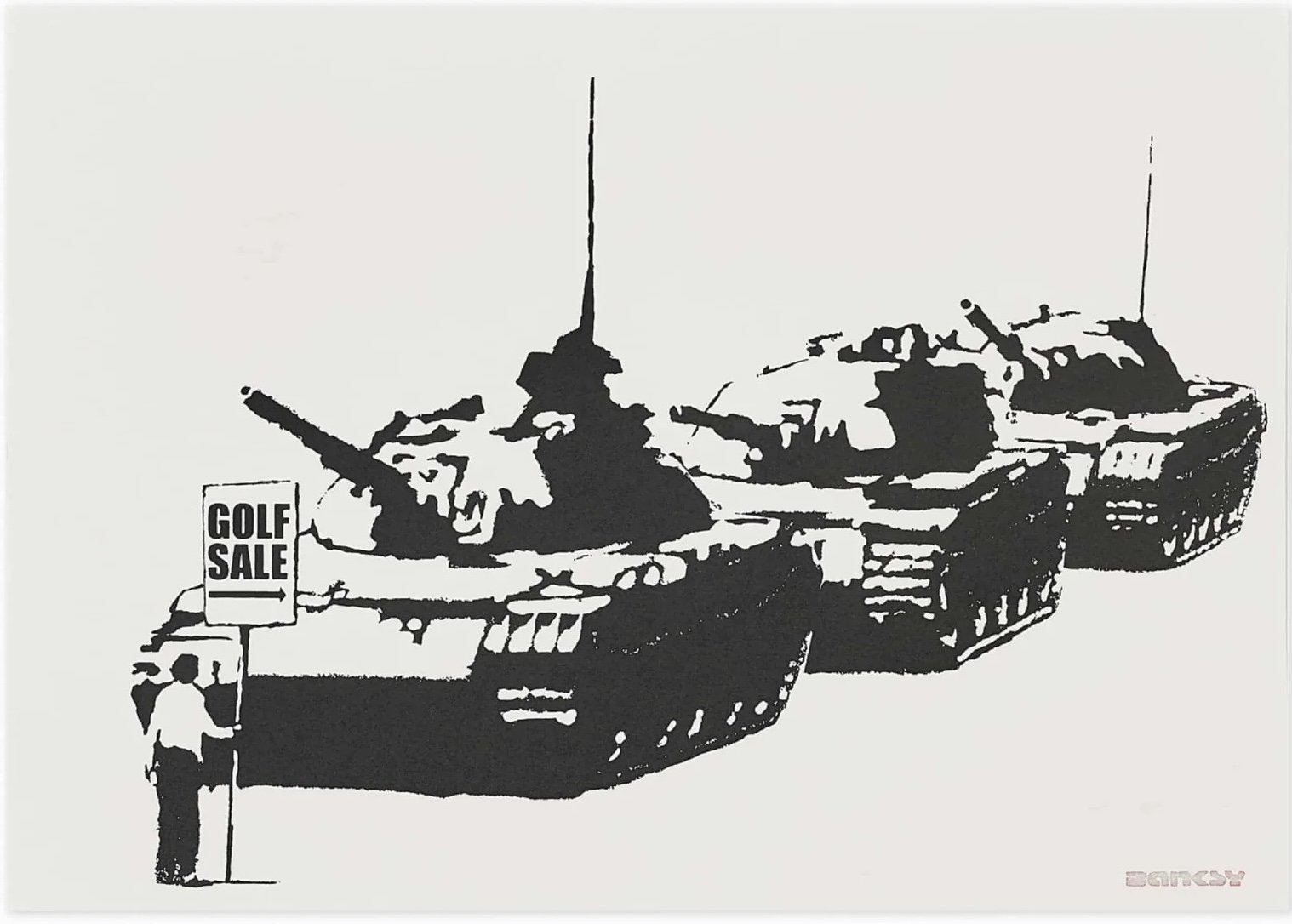
Golf Sale captures Banksy at a pivotal moment in his artistic trajectory: the early 2000s, when he was transitioning from the streets of London to the gallery system while maintaining his identity as a subversive social commentator. This monochrome screenprint presents a deceptively simple scene rendered with surgical precision: military tanks positioned outside a storefront sporting a crude "GOLF SALE" sign, an absurdist collision of warfare and leisure that exposes the class anxieties embedded in consumer culture. The visual economy of Banksy's composition — the austere geometry of the tanks contrasted with the everyday mundanity of commercial retail signage — creates a profound conceptual tension. The work operates on multiple registers: as literal political commentary on militarism and imperial projection, as satirical observation on the triviality with which Western consumer culture distracts itself from global violence, and as a formal investigation into the power of juxtaposition and scale. Unsigned and authenticated by Banksy's Pest Control stamping system, this work carries the cachet of works created during his most productive and politically charged period. Though produced in an edition of 750, the unsigned status and the work's conceptual rigour have made it increasingly sought after by collectors who value Banksy's early transitional work. This print encapsulates the essence of Banksy's method: making sophisticated political critique accessible through the visual language of popular culture.
Banksy (United Kingdom, active since the 1990s) is an anonymous street artist and activist renowned for his satirical and politically charged graffiti. His works, often created with stencils, critique social injustice, consumerism, and war, blending humor with powerful messages. Banksy’s art has gained global acclaim, sparking debates about the role of street art in contemporary culture.
Screen-print Screen printing is a technique where ink is transferred through a mesh onto a substrate, with areas blocked by a stencil to prevent ink from passing through. This method, also known as serigraphy or silkscreen printing, is commonly used to produce prints on posters, T-shirts, vinyl, stickers, wood, and other materials. The process is a type of stencil printing, allowing for vibrant, detailed designs on various surfaces.
Screenprint on paper.
Unsigned, stamped by artist’s estate. Hand-numbered with Banksy’s stamp.
Golf Sale captures Banksy at a pivotal moment in his artistic trajectory: the early 2000s, when he was transitioning from the streets of London to the gallery system while maintaining his identity as a subversive social commentator. This monochrome screenprint presents a deceptively simple scene rendered with surgical precision: military tanks positioned outside a storefront sporting a crude "GOLF SALE" sign, an absurdist collision of warfare and leisure that exposes the class anxieties embedded in consumer culture. The visual economy of Banksy's composition — the austere geometry of the tanks contrasted with the everyday mundanity of commercial retail signage — creates a profound conceptual tension. The work operates on multiple registers: as literal political commentary on militarism and imperial projection, as satirical observation on the triviality with which Western consumer culture distracts itself from global violence, and as a formal investigation into the power of juxtaposition and scale. Unsigned and authenticated by Banksy's Pest Control stamping system, this work carries the cachet of works created during his most productive and politically charged period. Though produced in an edition of 750, the unsigned status and the work's conceptual rigour have made it increasingly sought after by collectors who value Banksy's early transitional work. This print encapsulates the essence of Banksy's method: making sophisticated political critique accessible through the visual language of popular culture.
Banksy (United Kingdom, active since the 1990s) is an anonymous street artist and activist renowned for his satirical and politically charged graffiti. His works, often created with stencils, critique social injustice, consumerism, and war, blending humor with powerful messages. Banksy’s art has gained global acclaim, sparking debates about the role of street art in contemporary culture.
Banksy is a street artist that is best known for his graffiti work. He has a distinctive stenciling technique that makes his work easily identifiable. The fact that all of his work is carried out in public means that he is an artist that can really connect with people and make them think about the messages that are contained in his work. His work has been influenced by the underground scene in Bristol, and comparisons have been drawn between his work and that of French artist Blek le Rat. His stenciling career began when he was almost caught by police painting graffiti on a railway bridge, and he began to think about ways that his art work could be carried out faster. His work is usually carried out somewhere in a public place. He has been known to use walls and bridges as canvases for his work. This has led to people actually trying to take these things apart in order to be able to own a piece of his art. He does not produce reproductions of his art for members of the public to buy which means that his street work is always in high demand. Banksy was in the public eye recently due to his involvement in the alternative theme park Dismaland. Although this did not feature much of his trademark artwork, it is certainly a piece of social commentary, something which he is also well known for. Demand for tickets was far more than was expected, and when tickets were released each day they sold out within minutes. (Artist website)
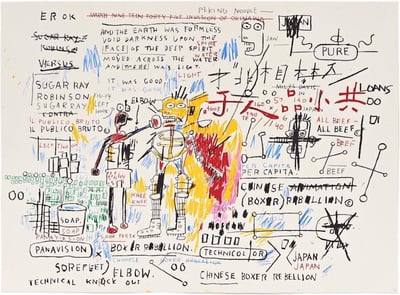
Lettrism is an art form that uses letters, words, and symbols to create artwork. The movement was established in Paris in the 1940s and later gained popularity in the 1950s in America. Lettrisme is the French spelling of the movement's name, derived from the French word for letter.