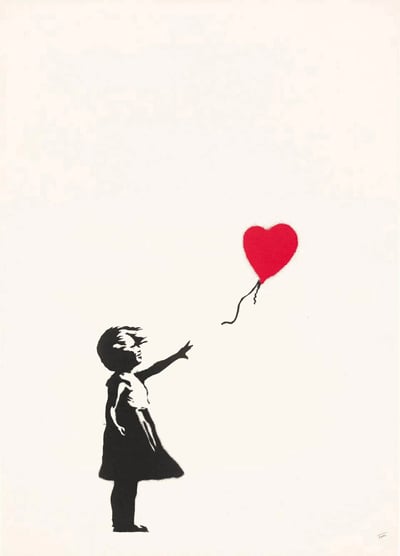
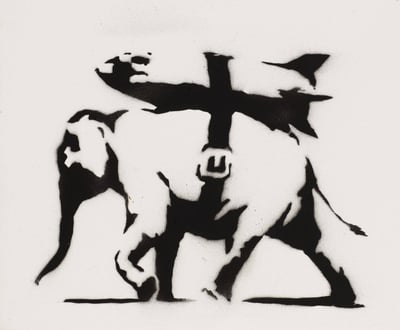
Screenprint in colours.
Unsigned, numbered, and blind stamped.
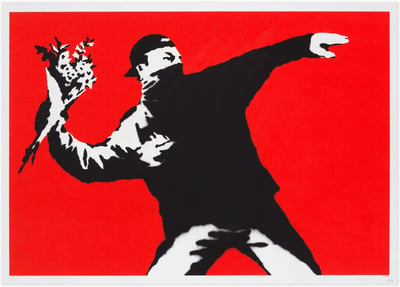
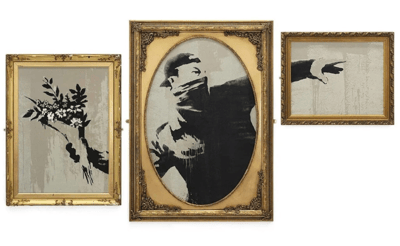
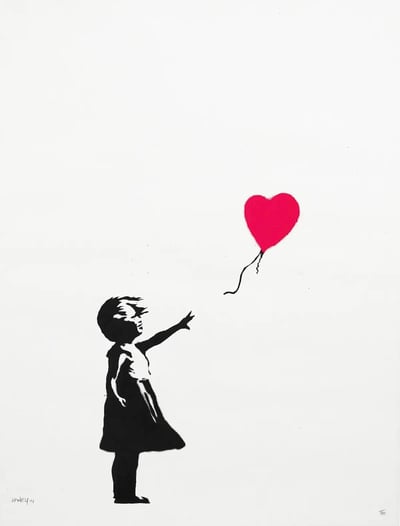
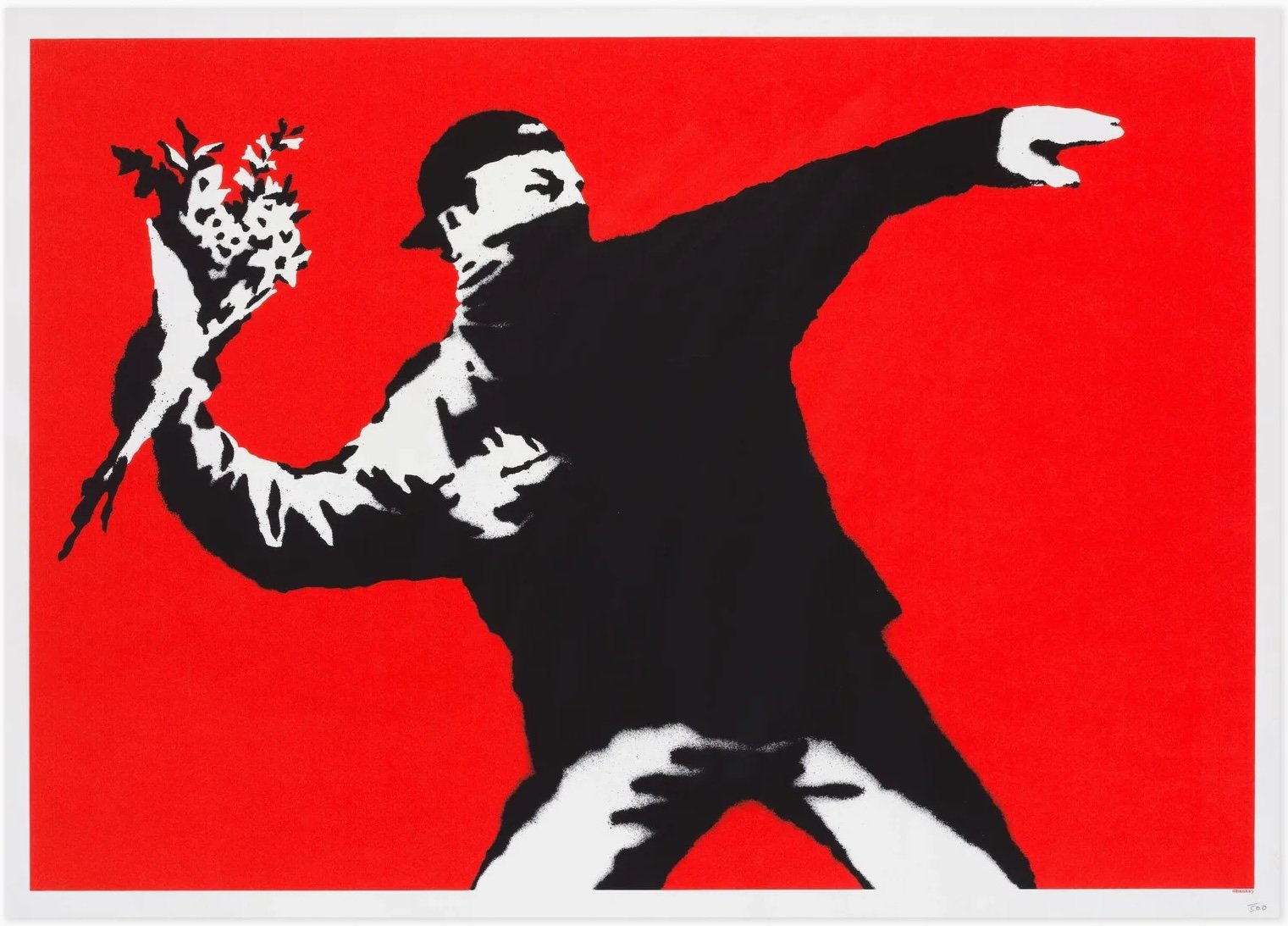
Love Is In The Air remains one of Banksy's most iconic and universally reproduced images, a work that has transcended the gallery system to become a symbol recognised across global visual culture. A single figure clad in black confronts the viewer in three-quarter pose, arm extended in the act of hurling what appears to be a Molotov cocktail or improvised explosive device — but at the moment of release, the object transforms into a burst of vibrant flowers rendered in brilliant reds, pinks, greens, and yellows. The flower-thrower encapsulates the entire trajectory of Banksy's artistic philosophy: the substitution of violence with beauty, aggression with hope, the revolutionary gesture redirected toward the cultivation of joy. The compositional simplicity and iconic power of the image — the stark black silhouette against white field, punctuated by the explosive floral intervention — make it endlessly adaptable, and it has been reproduced on everything from t-shirts to murals to fine art editions. This unsigned variant, authenticated by Pest Control's numbering and stamping system, represents perhaps the most collectible version for those who value the work's authentic pedigree without requiring a hand-signature. The edition of 500 reflects Banksy's ambition in the early 2000s to create work of genuine mass cultural penetration. Love Is In The Air distils the essential Banksy gesture: the collision of street art's directness with painterly sensibility, the marriage of political message with formal elegance, the insistence that art remains an instrument of hope and transformation in an age of commodification and despair.
Banksy (United Kingdom, active since the 1990s) is an anonymous street artist and activist renowned for his satirical and politically charged graffiti. His works, often created with stencils, critique social injustice, consumerism, and war, blending humor with powerful messages. Banksy’s art has gained global acclaim, sparking debates about the role of street art in contemporary culture.
Screen-print Screen printing is a technique where ink is transferred through a mesh onto a substrate, with areas blocked by a stencil to prevent ink from passing through. This method, also known as serigraphy or silkscreen printing, is commonly used to produce prints on posters, T-shirts, vinyl, stickers, wood, and other materials. The process is a type of stencil printing, allowing for vibrant, detailed designs on various surfaces.
Screenprint in colours.
Unsigned, numbered, and blind stamped.
Love Is In The Air remains one of Banksy's most iconic and universally reproduced images, a work that has transcended the gallery system to become a symbol recognised across global visual culture. A single figure clad in black confronts the viewer in three-quarter pose, arm extended in the act of hurling what appears to be a Molotov cocktail or improvised explosive device — but at the moment of release, the object transforms into a burst of vibrant flowers rendered in brilliant reds, pinks, greens, and yellows. The flower-thrower encapsulates the entire trajectory of Banksy's artistic philosophy: the substitution of violence with beauty, aggression with hope, the revolutionary gesture redirected toward the cultivation of joy. The compositional simplicity and iconic power of the image — the stark black silhouette against white field, punctuated by the explosive floral intervention — make it endlessly adaptable, and it has been reproduced on everything from t-shirts to murals to fine art editions. This unsigned variant, authenticated by Pest Control's numbering and stamping system, represents perhaps the most collectible version for those who value the work's authentic pedigree without requiring a hand-signature. The edition of 500 reflects Banksy's ambition in the early 2000s to create work of genuine mass cultural penetration. Love Is In The Air distils the essential Banksy gesture: the collision of street art's directness with painterly sensibility, the marriage of political message with formal elegance, the insistence that art remains an instrument of hope and transformation in an age of commodification and despair.
Banksy (United Kingdom, active since the 1990s) is an anonymous street artist and activist renowned for his satirical and politically charged graffiti. His works, often created with stencils, critique social injustice, consumerism, and war, blending humor with powerful messages. Banksy’s art has gained global acclaim, sparking debates about the role of street art in contemporary culture.
Banksy is a street artist that is best known for his graffiti work. He has a distinctive stenciling technique that makes his work easily identifiable. The fact that all of his work is carried out in public means that he is an artist that can really connect with people and make them think about the messages that are contained in his work. His work has been influenced by the underground scene in Bristol, and comparisons have been drawn between his work and that of French artist Blek le Rat. His stenciling career began when he was almost caught by police painting graffiti on a railway bridge, and he began to think about ways that his art work could be carried out faster. His work is usually carried out somewhere in a public place. He has been known to use walls and bridges as canvases for his work. This has led to people actually trying to take these things apart in order to be able to own a piece of his art. He does not produce reproductions of his art for members of the public to buy which means that his street work is always in high demand. Banksy was in the public eye recently due to his involvement in the alternative theme park Dismaland. Although this did not feature much of his trademark artwork, it is certainly a piece of social commentary, something which he is also well known for. Demand for tickets was far more than was expected, and when tickets were released each day they sold out within minutes. (Artist website)
Graffiti art refers to drawings and writings that are painted, scratched, or scribbled on walls or other surfaces, typically in public spaces. This art form ranges from small tags to elaborate wall paintings. Graffiti has been in existence since ancient times, with examples dating back to the Roman Empire, Ancient Greece, and Ancient Egypt.