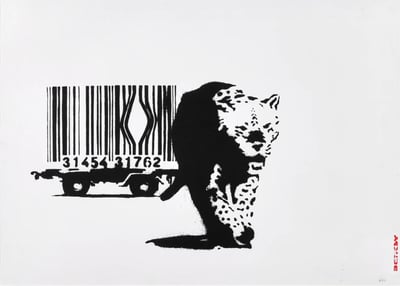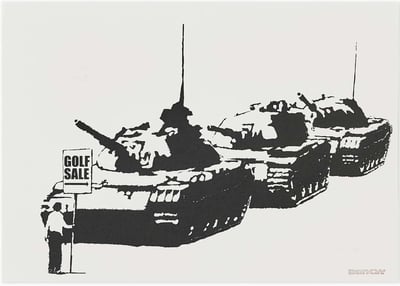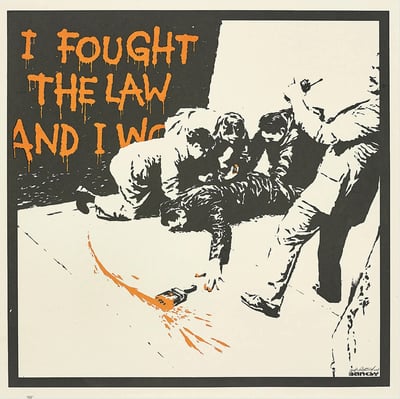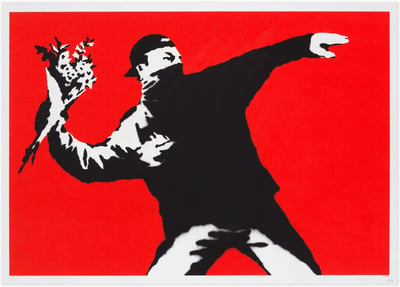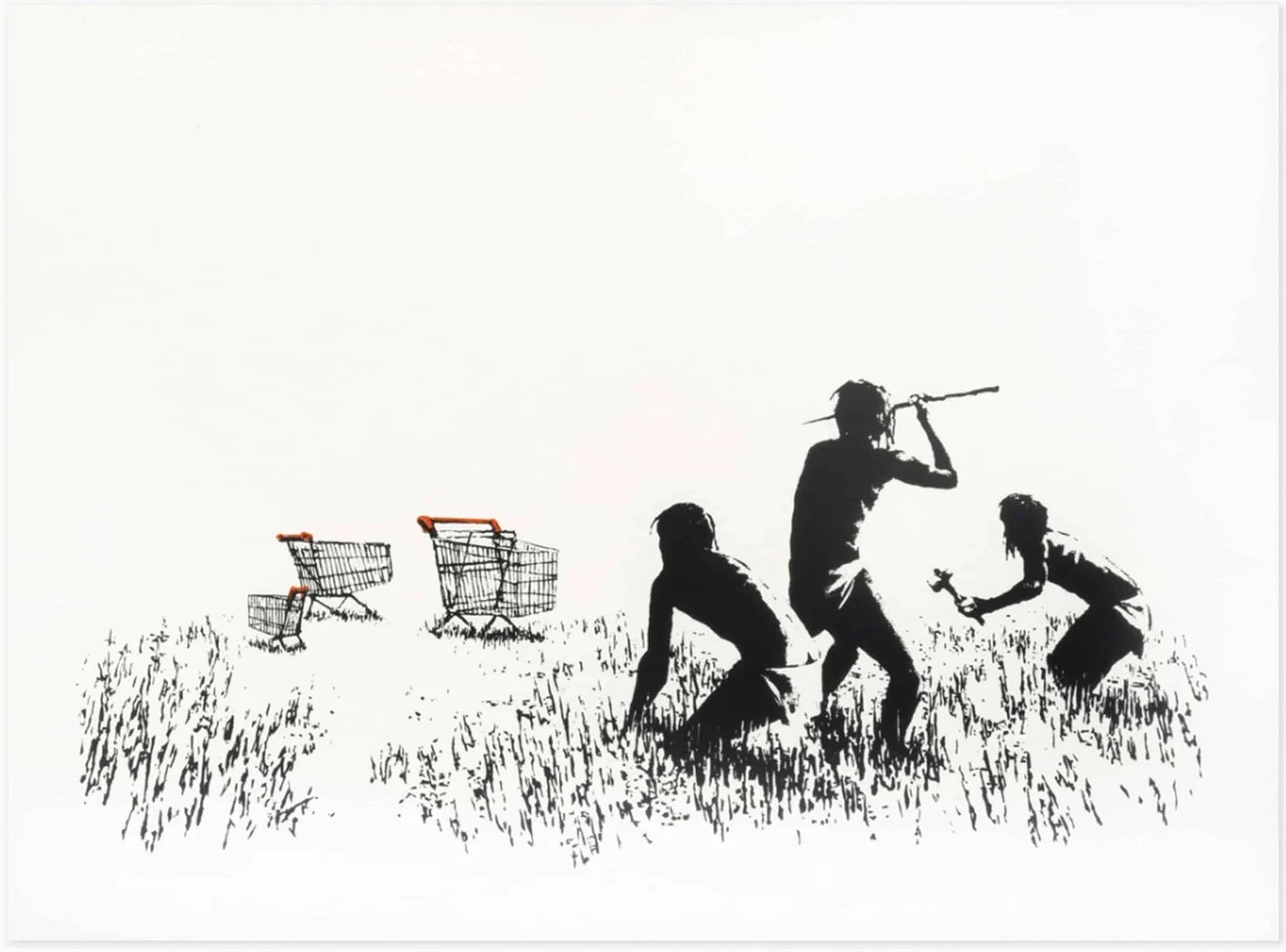
Screenprint in colours on paper.
Unsigned, stamped by artist’s estate. Hand-numbered with Banksy’s stamp.
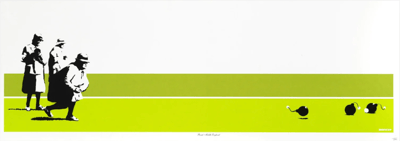
This monochrome unsigned variant of Banksy's Trolleys presents the artist's critique of consumerism rendered entirely in black and white, concentrating the work's conceptual force through the elimination of colour. The silhouetted hunter-gatherer figures pushing supermarket trolleys across the composition retain all the philosophical weight of the original colour version, but stripped of its sepia archæological tonality, the work reads with even greater starkness and universality. The black-and-white palette paradoxically extends the association with prehistoric cave painting — by removing colour, Banksy returns his work to the visual language of the most ancient human art, pure line and shadow on pigmented surface. The unsigned status and Pest Control stamp confirm this as an authenticated edition work from the height of Banksy's productivity, produced in a run of 500 impressions. The loss of the artist's hand-signature becomes conceptually significant: it increases the work's accessibility to collectors who prefer to own authenticated prints without hand-signatures, and it emphasises the reproducibility and mechanical nature of the screenprint process itself. The Trolleys composition, in any format, speaks to the colonisation of all human behaviour by consumer ideology, but this austere black-and-white version distils the concept to its most potent visual form, achieving a timeless quality that transcends moment-specific commodity critique. It is among the most intellectually rigorous of the Banksy editions.
Banksy (United Kingdom, active since the 1990s) is an anonymous street artist and activist renowned for his satirical and politically charged graffiti. His works, often created with stencils, critique social injustice, consumerism, and war, blending humor with powerful messages. Banksy’s art has gained global acclaim, sparking debates about the role of street art in contemporary culture.
Screen-print Screen printing is a technique where ink is transferred through a mesh onto a substrate, with areas blocked by a stencil to prevent ink from passing through. This method, also known as serigraphy or silkscreen printing, is commonly used to produce prints on posters, T-shirts, vinyl, stickers, wood, and other materials. The process is a type of stencil printing, allowing for vibrant, detailed designs on various surfaces.
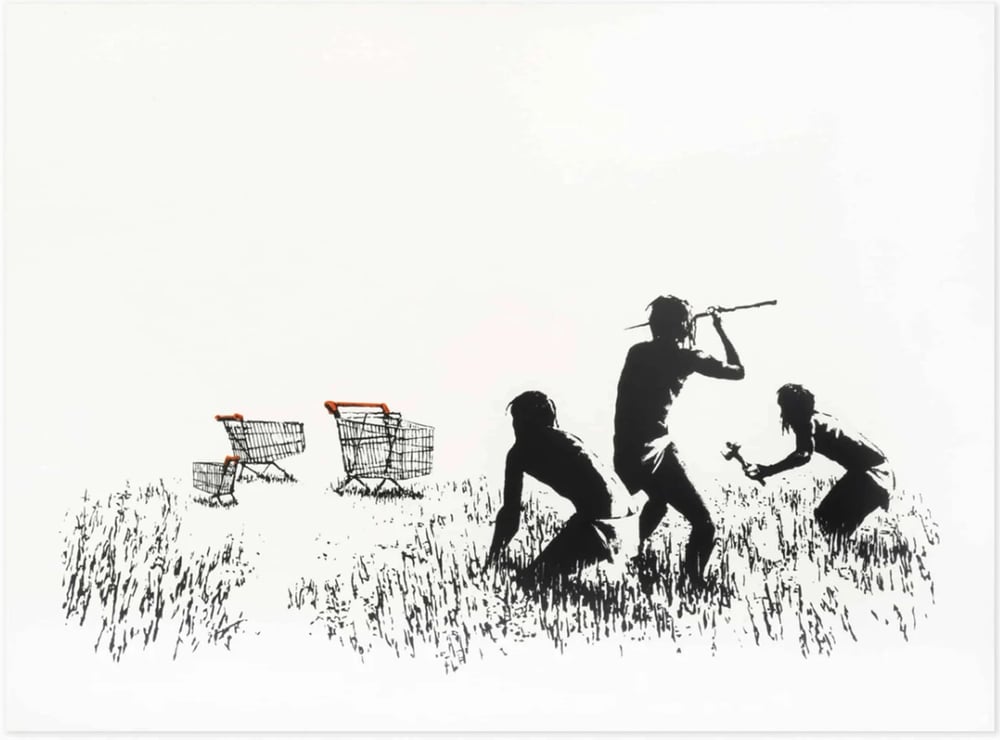
Screenprint in colours on paper.
Unsigned, stamped by artist’s estate. Hand-numbered with Banksy’s stamp.
This monochrome unsigned variant of Banksy's Trolleys presents the artist's critique of consumerism rendered entirely in black and white, concentrating the work's conceptual force through the elimination of colour. The silhouetted hunter-gatherer figures pushing supermarket trolleys across the composition retain all the philosophical weight of the original colour version, but stripped of its sepia archæological tonality, the work reads with even greater starkness and universality. The black-and-white palette paradoxically extends the association with prehistoric cave painting — by removing colour, Banksy returns his work to the visual language of the most ancient human art, pure line and shadow on pigmented surface. The unsigned status and Pest Control stamp confirm this as an authenticated edition work from the height of Banksy's productivity, produced in a run of 500 impressions. The loss of the artist's hand-signature becomes conceptually significant: it increases the work's accessibility to collectors who prefer to own authenticated prints without hand-signatures, and it emphasises the reproducibility and mechanical nature of the screenprint process itself. The Trolleys composition, in any format, speaks to the colonisation of all human behaviour by consumer ideology, but this austere black-and-white version distils the concept to its most potent visual form, achieving a timeless quality that transcends moment-specific commodity critique. It is among the most intellectually rigorous of the Banksy editions.
Banksy (United Kingdom, active since the 1990s) is an anonymous street artist and activist renowned for his satirical and politically charged graffiti. His works, often created with stencils, critique social injustice, consumerism, and war, blending humor with powerful messages. Banksy’s art has gained global acclaim, sparking debates about the role of street art in contemporary culture.
Banksy is a street artist that is best known for his graffiti work. He has a distinctive stenciling technique that makes his work easily identifiable. The fact that all of his work is carried out in public means that he is an artist that can really connect with people and make them think about the messages that are contained in his work. His work has been influenced by the underground scene in Bristol, and comparisons have been drawn between his work and that of French artist Blek le Rat. His stenciling career began when he was almost caught by police painting graffiti on a railway bridge, and he began to think about ways that his art work could be carried out faster. His work is usually carried out somewhere in a public place. He has been known to use walls and bridges as canvases for his work. This has led to people actually trying to take these things apart in order to be able to own a piece of his art. He does not produce reproductions of his art for members of the public to buy which means that his street work is always in high demand. Banksy was in the public eye recently due to his involvement in the alternative theme park Dismaland. Although this did not feature much of his trademark artwork, it is certainly a piece of social commentary, something which he is also well known for. Demand for tickets was far more than was expected, and when tickets were released each day they sold out within minutes. (Artist website)
Cynical Realism is a term first used in 1992 by art critic Li Xianting to describe a group of Beijing artists who created satirical social realist paintings. The group aimed to depict the psychological turmoil experienced in China as the country grappled with new political ideologies.