Wooden installation with Neon lamps – comes with an electrical installation. Signed in marker
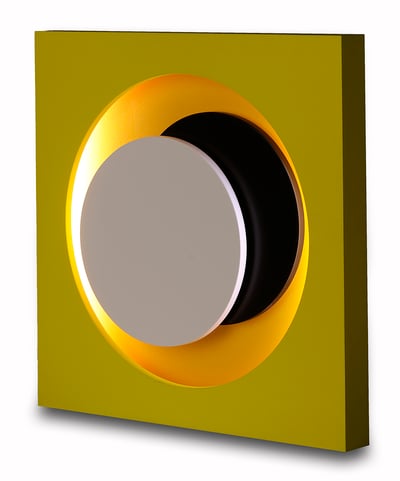
Cercle Blanc et Bleu by Geneviève Claisse, crafted between 1968 and 1972, is a compelling mixed-media sculpture that highlights her skill in geometric abstraction. This piece features a bold circular form in deep blue, framed against a neutral, off-white background, with an inner black segment creating a sense of depth. The neon lighting embedded within the sculpture intensifies the vibrant blue, adding a luminescent quality that enhances its visual impact. The interaction of circular shapes and contrasting colors produces a minimalist yet dynamic composition that embodies Claisse’s refined approach to form and light. Signed by the artist, this limited-edition work combines simplicity with the striking presence of light and color.
Geneviève Claisse (France, 1935–2018) was a prominent geometric abstract painter. Influenced by her great-uncle, Auguste Herbin, she developed a style characterized by pure forms and vibrant colors. Claisse's work is celebrated for its formal purity and meticulous execution, contributing significantly to the geometric abstraction movement.
Mixed MediaMixed media refers to artwork that incorporates more than one medium within a single piece. Unlike multimedia art, which combines distinct forms of visual art and often includes elements like sound, video, or digital media, mixed media focuses on combining traditional art materials, such as paint, ink, and collage. Mixed media art allows artists to achieve a wide range of effects and textures by layering and blending different materials.
Size
Inches
Centimeters
40 X 40 X 4 cm
Edition
Edition of 2
Price
USD
EUR
GBP
CHF
2,500EUR
?
+ VAT/import Duties (if applicable)
Authenticity Guaranteed
Insured Shipping
Online Since 2005
Share
●Inventory 8484
●Signed
●Comes with gallery invoice and certificate
●Any questions?
Wooden installation with Neon lamps – comes with an electrical installation. Signed in marker
Cercle Blanc et Bleu by Geneviève Claisse, crafted between 1968 and 1972, is a compelling mixed-media sculpture that highlights her skill in geometric abstraction. This piece features a bold circular form in deep blue, framed against a neutral, off-white background, with an inner black segment creating a sense of depth. The neon lighting embedded within the sculpture intensifies the vibrant blue, adding a luminescent quality that enhances its visual impact. The interaction of circular shapes and contrasting colors produces a minimalist yet dynamic composition that embodies Claisse’s refined approach to form and light. Signed by the artist, this limited-edition work combines simplicity with the striking presence of light and color.
Geneviève Claisse (France, 1935–2018) was a prominent geometric abstract painter. Influenced by her great-uncle, Auguste Herbin, she developed a style characterized by pure forms and vibrant colors. Claisse's work is celebrated for its formal purity and meticulous execution, contributing significantly to the geometric abstraction movement.
There is a deep investigation around each piece. I always paint from real models.
- Geneviève Claisse
Geneviève Claisse (b. 1935 France, d. 2018 France) was a prominent French artist known for her contributions to geometric abstraction. A student and niece of the painter Auguste Herbin, Claisse quickly established herself as a leading figure in the post-war abstract art scene. Her work is characterized by its precision, clarity, and the use of vibrant colors and clean geometric shapes. Claisse's compositions often explore the interplay between form and space, creating a sense of movement and rhythm through meticulously balanced arrangements. Her dedication to the principles of abstraction and her ability to infuse her work with both dynamism and harmony have made her one of the key figures in 20th-century French abstract art.
Hard Edge art is a style of abstract painting that became popular in the 1960s. It features areas of color separated by crisp, sharp edges that are painted with geometric precision. The term hard-edge painting was coined by art critic Jules Langsner to describe this approach, which contrasts with the softer, more fluid forms of other abstract styles.