Original Intaglio Print - Unsigned and not numbered - Published by Pierre de Tartas -
Printed by Pierre Jean Mathan
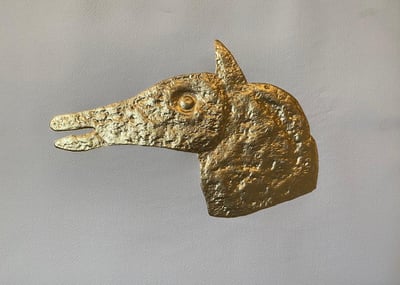
Georges Braque's Aréion (Horse), a 1971 limited edition intaglio print, measures 38.1 x 55.9 cm. Published by Pierre de Tartas and printed by Pierre Jean Mathan, this embossing showcases Braque’s skillful manipulation of texture and form. The horse’s head is portrayed with a distinct roughness, highlighting Braque’s ability to bring movement and life to the composition through the subtle interplay of light and shadow. The embossing technique emphasizes the tactile quality of the surface, giving the impression of depth and dimensionality. The image captures the essence of Braque’s style, combining simplicity with a powerful, expressive form.
Georges Braque (France, 1882–1963) was a seminal figure in modern art and a co-founder of Cubism alongside Pablo Picasso. His work, characterized by fragmented forms and muted palettes, explored the interplay between perspective and abstraction. Later, he developed the papier collé technique, influencing the evolution of collage and modern painting.
EmbossingEmbossing is a technique used to create raised designs or images on a surface, typically paper. Artists achieve this effect by altering the shape of the paper, often by pressing it from the reverse side using a template and a tool like a sanded dowel. The result is a design with multiple levels of depth, giving a three-dimensional appearance.
Original Intaglio Print - Unsigned and not numbered - Published by Pierre de Tartas -
Printed by Pierre Jean Mathan
Georges Braque's Aréion (Horse), a 1971 limited edition intaglio print, measures 38.1 x 55.9 cm. Published by Pierre de Tartas and printed by Pierre Jean Mathan, this embossing showcases Braque’s skillful manipulation of texture and form. The horse’s head is portrayed with a distinct roughness, highlighting Braque’s ability to bring movement and life to the composition through the subtle interplay of light and shadow. The embossing technique emphasizes the tactile quality of the surface, giving the impression of depth and dimensionality. The image captures the essence of Braque’s style, combining simplicity with a powerful, expressive form.
Georges Braque (France, 1882–1963) was a seminal figure in modern art and a co-founder of Cubism alongside Pablo Picasso. His work, characterized by fragmented forms and muted palettes, explored the interplay between perspective and abstraction. Later, he developed the papier collé technique, influencing the evolution of collage and modern painting.
Art is made to disturb. Science reassures.
- Georges Braque
Georges Braque (b. 1882 France, d. 1963 France) was a French painter, collagist, and sculptor who, alongside Pablo Picasso, is credited with developing Cubism, one of the most influential art movements of the 20th century. Braque's early work was influenced by Fauvism, characterized by vibrant colors and bold brushwork. However, his collaboration with Picasso around 1907 marked a significant shift in his style, leading to the development of Analytical Cubism, which deconstructed objects into geometric shapes and depicted multiple perspectives within a single plane. Later, he transitioned to Synthetic Cubism, incorporating elements such as stenciled text and collage into his paintings. Braque's work is known for its subtle use of color, intricate compositions, and a focus on everyday objects, often emphasizing the tactile qualities of surfaces. His exploration of form and space had a profound impact on the trajectory of modern art, and his works are held in major museums worldwide, including the Louvre in Paris and the Museum of Modern Art in New York.
Cubism is an art movement that aimed to depict multiple perspectives of objects or figures within a single picture. Artists Georges Braque and Pablo Picasso pioneered this style around 1907. The name Cubism emerged from their use of geometric shapes and outlines that often resembled cubes, breaking objects down into abstracted forms.