Wood engraving printed in blue, on Japon paper
Hand signed lower right.
Printed by Féquet and Baudier, Paris.
Published by Louis Broder, Paris.
Reference: Vallier 181.
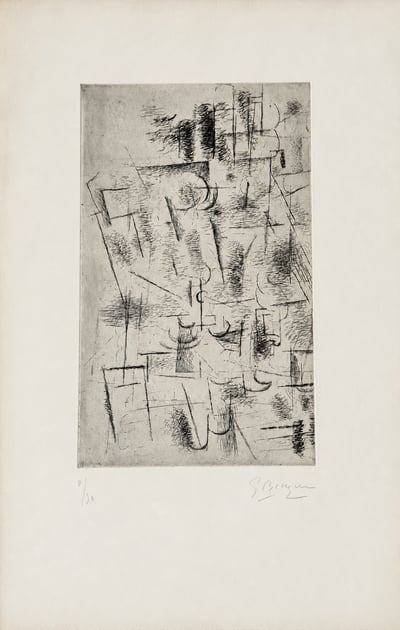
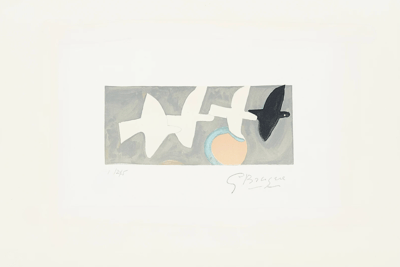
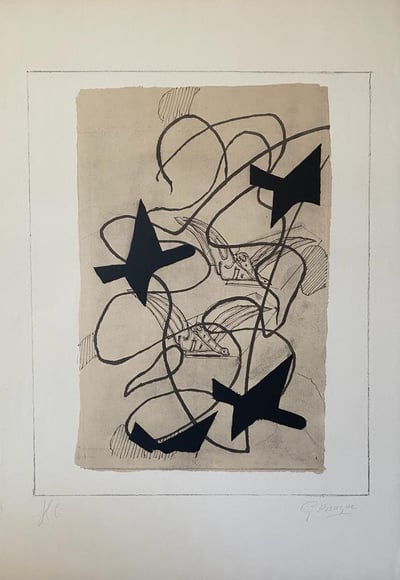
Si je mourais là-bas (1962) is one of Georges Braque's last major graphic works, a wood engraving printed in deep blue on Japon paper -- a choice of extraordinary refinement. The title, drawn from a poem by Guillaume Apollinaire, lends the work a quietly elegiac tone: If I were to die over there. The composition is characteristic of Braque's late style: spare, meditative, and charged with a sense of deep time. Printed by Féquet and Baudier in Paris and published by Louis Broder, this work belongs to the tradition of the livre d'artiste, where text and image enter into close dialogue. Hand signed lower right and catalogued as Vallier 181, Si je mourais là-bas is a profound final statement from one of the founders of Cubism -- intimate in scale yet vast in resonance.
Georges Braque (France, 1882–1963) was a seminal figure in modern art and a co-founder of Cubism alongside Pablo Picasso. His work, characterized by fragmented forms and muted palettes, explored the interplay between perspective and abstraction. Later, he developed the papier collé technique, influencing the evolution of collage and modern painting.
EngravingEngraving is a printmaking technique where a metal plate or surface is directly cut using a sharp engraving tool called a burin. The tool creates deep lines or grooves, which are then filled with ink. The plate is pressed onto paper with heavy pressure, transferring the inked image. This process results in a clear and precise print.
Wood engraving printed in blue, on Japon paper
Hand signed lower right.
Printed by Féquet and Baudier, Paris.
Published by Louis Broder, Paris.
Reference: Vallier 181.
Si je mourais là-bas (1962) is one of Georges Braque's last major graphic works, a wood engraving printed in deep blue on Japon paper -- a choice of extraordinary refinement. The title, drawn from a poem by Guillaume Apollinaire, lends the work a quietly elegiac tone: If I were to die over there. The composition is characteristic of Braque's late style: spare, meditative, and charged with a sense of deep time. Printed by Féquet and Baudier in Paris and published by Louis Broder, this work belongs to the tradition of the livre d'artiste, where text and image enter into close dialogue. Hand signed lower right and catalogued as Vallier 181, Si je mourais là-bas is a profound final statement from one of the founders of Cubism -- intimate in scale yet vast in resonance.
Georges Braque (France, 1882–1963) was a seminal figure in modern art and a co-founder of Cubism alongside Pablo Picasso. His work, characterized by fragmented forms and muted palettes, explored the interplay between perspective and abstraction. Later, he developed the papier collé technique, influencing the evolution of collage and modern painting.
Art is made to disturb. Science reassures.
- Georges Braque
Georges Braque (b. 1882 France, d. 1963 France) was a French painter, collagist, and sculptor who, alongside Pablo Picasso, is credited with developing Cubism, one of the most influential art movements of the 20th century. Braque's early work was influenced by Fauvism, characterized by vibrant colors and bold brushwork. However, his collaboration with Picasso around 1907 marked a significant shift in his style, leading to the development of Analytical Cubism, which deconstructed objects into geometric shapes and depicted multiple perspectives within a single plane. Later, he transitioned to Synthetic Cubism, incorporating elements such as stenciled text and collage into his paintings. Braque's work is known for its subtle use of color, intricate compositions, and a focus on everyday objects, often emphasizing the tactile qualities of surfaces. His exploration of form and space had a profound impact on the trajectory of modern art, and his works are held in major museums worldwide, including the Louvre in Paris and the Museum of Modern Art in New York.
Cubism is an art movement that aimed to depict multiple perspectives of objects or figures within a single picture. Artists Georges Braque and Pablo Picasso pioneered this style around 1907. The name Cubism emerged from their use of geometric shapes and outlines that often resembled cubes, breaking objects down into abstracted forms.